
Before You Throw It Away: Reuse, Repair, Donate or Dispose
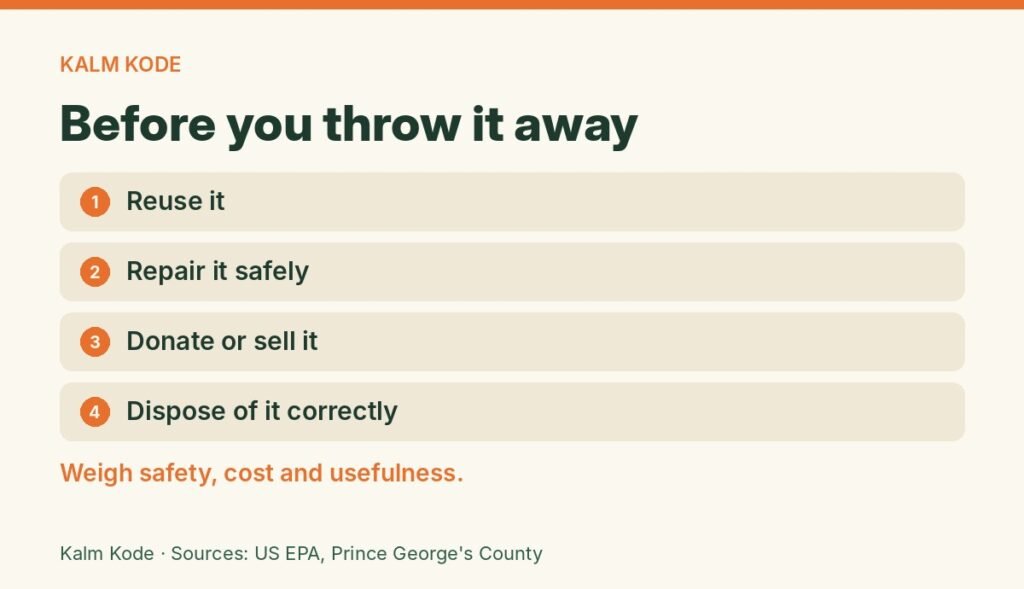
Many unwanted household items don’t need to go in the trash. They need to go somewhere. A chair with a wobbly leg, a working microwave you’ve replaced, a box of clothes that don’t fit: each of these has a better route than the curb, if you know where to look.
The trouble is that “where to look” is different for every item, and the quickest option is usually the bin. So things get thrown away that someone else could have used, or that a twenty-minute fix would have saved.
This guide gives you four options to check before anything leaves your home: reuse, repair, donate or sell, or dispose of it correctly. They’re options, not a strict ranking. The right one depends on the item’s safety, the cost and how useful it still is. The guide works anywhere, and it links to Prince George’s County options and our item-by-item guides, so you can go from “I don’t want this” to “it’s handled” without guessing.
Short answer: Before you throw something away, ask four questions. Can I reuse it myself? Can it be repaired safely? Can someone else use it, through donation, sale or a free giveaway? If not, what’s the correct way to dispose of this item where I live? The US Environmental Protection Agency puts it simply: “The most effective way to reduce waste is to not create it in the first place.” In Prince George’s County, our Can They Take This? tool covers pickup, appointment and drop-off guidance for 22 common household items.
How to Choose Between the Options
There’s no single right order for every item. A broken lamp might be cheaper to replace than repair. A working couch might be easier to donate than to reuse. Weigh three things:
- Safety. Damaged electrical items, recalled products and anything that’s become unsafe shouldn’t be reused, repaired at home or passed on.
- Cost. Compare the cost of a repair, a pickup or a drop-off trip with what the item is worth to you or someone else.
- Usefulness. If it still does its job, someone can probably use it. If it doesn’t, recycling or disposal may be the honest answer.
The EPA lists the benefits of reducing and reusing: it “saves money,” “saves energy,” “reduces the amount of waste that will need to be recycled or sent to landfills and incinerators” and “allows products to be used to their fullest extent.”
There’s a practical benefit too. Rules depend on the material and where you live. Some batteries, for example, shouldn’t go in household trash, while the EPA says that in most communities alkaline and zinc-carbon batteries can. Checking first means you’re less likely to put something in the bin that doesn’t belong there.
Option 1: Can You Reuse It?
Before an item leaves, give it one more look. Reuse is the simplest route because nothing has to be packed, scheduled or driven anywhere. It also costs nothing, and it often solves a problem you’d otherwise buy something new to fix.
Use it for something else
- Furniture can move rooms. A dining chair becomes a desk chair; a bookshelf becomes garage storage.
- Containers and jars become storage for screws, spices, cables and craft supplies.
- Old towels and T-shirts become cleaning rags.
- Leftover building materials can finish a small project around the house.
Keep it for a season
If you’re getting rid of something only because you don’t need it right now, ask whether you’ll need it again soon. Seasonal items, kids’ things for a younger sibling and tools you use once a year are often worth keeping, as long as you have the space.
Borrow, don’t buy, next time
The EPA suggests you “borrow, rent or share items that are used infrequently, like party decorations, tools or furniture.” Tool libraries, neighbors and community groups make this easier. The fewer single-use purchases you make, the less you’ll need to get rid of later.
Our guide on how to declutter your home without just moving the piles has a five-bin system for deciding what stays and what goes.
Option 2: Can It Be Repaired?
A lot of what gets thrown away is one small fix away from working. The EPA’s advice is direct: “Maintain and repair products, like clothing, tires and appliances.”
Easy repairs to try first
- Clothing: loose buttons, small tears and fallen hems are often a needle-and-thread job.
- Furniture: wobbly legs usually need a tightened screw or a bit of wood glue.
- Lamps: sometimes all a lamp needs is a new bulb.
- Small appliances: check that it’s plugged in, the outlet works and any filter is clean before you decide it’s dead.
- Electronics: a new charging cable can bring a device back.
If an electrical item has a damaged cord or plug, sparks, smells hot or has been dropped in water, stop using it. Don’t try to fix the wiring yourself. Take it to a qualified repair person, or recycle it.
Get help from a repair café
Repair cafés are free community events where volunteers help you fix household items. In Prince George’s County, a July 2026 Greenbelt Online article reported that the Greenbelt MakerSpace Co-operative was holding a Repair Café “the third Saturday of every month from 10am until noon” at 115 Centerway in Greenbelt. It says volunteers help with things like lamps, toasters, clothing, jewelry and furniture, and sharpen knives and scissors. “Repair Cafes are free to all,” the article notes, though “none of the repairs are guaranteed.” Check the Greenbelt MakerSpace Repair Café page for current dates before you go. It’s free and volunteer staffed, and no repair is guaranteed.
Learn one repair at a time
You don’t need to be handy to start. Pick one common repair, like sewing on a button, fixing a hem or tightening furniture joints, and learn it properly. Video tutorials and repair café volunteers can walk you through it. Each skill you learn saves items again and again.
When repair isn’t worth it
Sometimes repair costs more than the item is worth, or the part isn’t available. That’s fine. Move on to the next step. The point is to check, not to fix everything.
Option 3: Can Someone Else Use It?
If it works, or nearly works, and you don’t need it, someone else probably does.
Donate it
Prince George’s County encourages residents to “consider donating your gently used appliances, clothing, furniture, or other household items.” Its Recycling/Reuse Alternatives page lists organizations that accept donations, including:
- Community Forklift: building materials, cabinets, furniture and fixtures.
- Habitat for Humanity ReStore: appliances, furniture, building materials and household goods.
- Goodwill: books, clothing and shoes, games and toys, housewares and some electronics. The county notes that Goodwill no longer accepts furniture and bulky items.
- The Salvation Army: appliances, clothing, electronics, furniture and toys.
- GreenDrop / Purple Heart: clothing, household items, small appliances, electronics and small furniture.
Before you load the car, follow the county’s advice: “Please check the organization’s guidelines to see what items are accepted.” Most organizations won’t take items that are broken, stained, recalled or missing parts, and some offer pickup only in certain areas.
Give it away free
Free listings on neighborhood apps and community groups work well for things that are useful but hard to sell: furniture, moving boxes, garden supplies and leftover materials. The county page also points to options such as Freecycle and Craigslist’s free section. Describe the item honestly, include photos and agree on a pickup time.
Sell it
If the item has real value, selling it passes it on and puts money back in your pocket. Electronics, furniture in good condition, tools and appliances often sell well. Be safe with in-person sales: meet in a public place where possible, and don’t share more personal information than you need to.
Prepare it first
- Clean it. A wiped-down item is far more likely to be accepted or picked up.
- Erase your data properly. Before you donate, sell or recycle a phone, tablet or computer, back it up, sign out of your accounts and follow the manufacturer’s instructions for erasing it. If a device won’t power on, don’t assume the data is gone; ask the manufacturer or a recycler that offers data destruction. Our guide on what to do before you get rid of a phone or computer walks through each step.
- Keep the parts together. Put cables, remotes, manuals and screws in a bag and tape it to the item.
Option 4: Dispose of It Correctly
When an item truly can’t be reused, repaired or passed on, the last step is getting it to the right place. A quick check here helps you choose the right route.
Identify the material, then check the local rule
Disposal rules depend on exactly what the item is and where you live. Two things that sound alike can follow completely different rules. Cooking oil and motor oil, for example, don’t go to the same place. Start by identifying the material, then check your local guidance. Our item guides do that for common ones:
- Batteries. It depends on the type. The EPA says that in most communities, alkaline and zinc-carbon batteries can go in household trash, but rechargeable batteries and button-cell, coin and lithium single-use batteries shouldn’t. For recycling, the EPA suggests taping terminals or putting batteries in separate plastic bags, and following the collection program’s instructions. See how to dispose of household batteries.
- Paint. Rules depend on the type of paint and your area. See how to dispose of paint.
- Cooking oil and grease can clog drains. See how to dispose of cooking oil. Motor oil is a separate material with its own rules.
- TVs and electronics. See how to get rid of a TV in Prince George’s County.
Store items for recycling the way the collection program tells you to, and keep different materials separate rather than mixing them in one bag.
Bulky items: check the collector and the item
What happens to a bulky item depends on two things: who collects your trash, and what the item is.
In Prince George’s County, if your home gets county-contracted trash collection, many ordinary bulky items, like furniture and mattresses, can go out next to your cart on your regular trash day without an appointment, within the county’s limits. Appliances, tires, scrap metal and electronics need to be scheduled through PGC311. If a city, an HOA, your apartment complex or a private hauler collects your trash, the rules can be different. Our bulky trash guide walks through it:
- Do you need an appointment for bulky trash?
- How to get a mattress picked up
- How to get rid of a couch
- Bulky trash not picked up? What to check next
Use the Disposal Check
If you live in Prince George’s County, our Can They Take This? tool covers pickup, appointment and drop-off guidance for 22 common household items. Pick the item, and it points you to the county’s current guidance. If you’d rather read than click, the guides above cover the same items in full.
Outside Prince George’s County
Rules vary a lot between cities and counties. Search your local government’s waste or recycling page for the item, or look for a household hazardous waste program. Many counties publish an A-to-Z list of items and where they go.

Item-by-Item Quick Guide
| Item | First try | If that doesn’t work |
|---|---|---|
| Clothing and shoes | Repair small damage; donate clean, wearable pieces | Textile recycling where available; worn-out items as rags |
| Furniture | Tighten, glue or refinish; donate or give away | Bulky pickup (check your collector’s rules); see our couch guide |
| Small appliances | Check it’s plugged in and the filter is clean; repair café | Donate if working; recycling if not. Damaged cord or plug: stop using it |
| Phones and computers | Back up, sign out, erase per the manufacturer; sell or donate | Electronics recycling; see our device guide |
| TVs | Donate if working (check the organization accepts TVs) | Electronics recycling per local rules; see our TV guide |
| Mattresses | Donate only if the organization accepts them | Check your collector’s rules; see our mattress guide |
| Paint | Use it up or give leftover cans away | Depends on paint type and area; see our paint guide |
| Batteries | Stop using any battery that’s damaged, swollen or failing | Depends on battery type; see our battery guide |
| Building materials | Community Forklift or Habitat ReStore | Correct disposal for the material |
Is It Good Enough to Donate?
A useful rule: donate only what you’d be comfortable giving to a friend. Donation centers have to sort, clean and sometimes dispose of what they receive, so items they can’t use cost them time and money.
An item is usually a good candidate if it:
- Works, or works with all its parts included.
- Is clean, with no strong odors, stains or pests.
- Is complete, with matching pieces, cables, lids and hardware.
- Is safe, with no recalls, cracks or exposed wiring.
- Is accepted by the organization you’re bringing it to.
If an item doesn’t meet these, it may still have a route. A repair café might fix it, a free listing might find someone who wants the parts, or recycling might recover the materials. It just shouldn’t be left for a charity to deal with.
A Worked Example
Here’s a hypothetical. Say you’ve just replaced your microwave and your old desk chair, and you’re clearing out a closet.
- Microwave. It still works. You wipe it down, check that the glass plate and ring are there, and confirm on the organization’s site that it accepts small appliances before you drop it off.
- Desk chair. One wheel is broken. You find a replacement caster that fits, swap it in and give the chair to a neighbor who’s setting up a home office.
- Closet. Three shirts are clean and wearable, so they go in the donate box. One has a missing button, so you sew it on and keep it. Two worn-out T-shirts become cleaning rags.
- Old phone in the closet. It no longer charges, so you don’t assume it’s empty. You check the manufacturer’s guidance on erasing or recovering data, then take it to an electronics recycler, ideally one that offers data destruction.
In this example, nothing went in the trash, and the work was spread over a few days.
Room by Room: What Usually Has Another Life
Going room by room makes the four options easier to apply.
Kitchen
Duplicate pots and pans, small appliances you’ve replaced and unused dishes are some of the most commonly donated household items. Check that appliances work and include their parts. Food storage containers without lids, chipped glassware and nonstick pans with damaged coatings are less likely to be accepted, so check the organization’s guidelines. Used cooking oil never goes down the drain; our cooking oil guide explains where it goes.
Closet
Clean, wearable clothing and shoes are easy to donate. Items with small damage, like a missing button or a loose hem, are often worth repairing first. Clothing that’s worn out can become cleaning rags, and some areas offer textile recycling for fabric that can’t be worn again.
Living room
Furniture is often worth donating or giving away if it’s clean and sturdy. Organizations such as Habitat for Humanity ReStore accept furniture, while the county notes that Goodwill no longer does. For TVs and electronics, check donation first if they work, and your local electronics recycling rules if they don’t.
Garage and shed
Leftover paint, tools, building materials and garden supplies often have a second life. Community Forklift and Habitat for Humanity ReStore take many building materials. Tools are easy to give away or sell. Paint, solvents, some batteries and anything with fuel can have special rules, so check the specific item before you move it.
Home office
Old phones, laptops, printers and cables pile up quickly. Wipe your data first, then sell, donate or recycle. Many electronics retailers and county sites accept devices for recycling.
Kids’ rooms
Outgrown clothes, books and toys are often wanted by friends, family and local groups. Check for recalls before passing on car seats, cribs and other baby gear, and follow each organization’s rules; many won’t accept these items for safety reasons.
Moving Out? Use the Order Under Time Pressure
When time runs short during a move, usable items can end up in the trash. A little planning keeps more out of the bin.
- Start four to six weeks out. Donation pickups and any items that need scheduling can take time.
- Sort as you pack. Keep, donate, sell, repair and dispose. Don’t pack anything you’re not taking.
- List items for sale or free early, so you’re not giving everything away on moving day.
- Check your collector’s bulky item rules and book any donation pickups or required appointments as soon as you know your date.
- Set aside items with special rules, like some batteries, paint and electronics, and store each one the way its collection program says.
Our change of address checklist for Maryland and DC covers the rest of the move.
Helping a Neighbor or Family Member Clear Out
Sometimes the person who needs this most can’t do it alone: an older neighbor, a relative moving into care or a family clearing a loved one’s home. The same four options apply, with a few extra steps.
- Ask before you sort. Let them decide what matters. Items with sentimental value may not look valuable to you.
- Go slowly. A few boxes a day is easier than one overwhelming weekend.
- Look for paperwork and valuables before anything leaves: documents, photos, jewelry and keys.
- Get permission first. Ask before you book a pickup, share their address or contact details, open their files or reset a device.
- Offer to handle the logistics. With their OK, scheduling a donation pickup is a simple, practical way to help.
- Handle devices with care. With their permission, back up photos and contacts before a phone or computer is reset.
Helping one person clear out is a small act of community care, and it keeps a lot of good things in use.
Common Mistakes
Treating every battery the same. Rechargeable, lithium and button-cell batteries shouldn’t go in household trash, according to the EPA, while alkaline batteries usually can. Check the type and your local rules.
Donating broken items. Donation centers often have to pay to dispose of things they can’t use. If it doesn’t work, repair or recycle it instead.
Leaving items at a closed donation center. Many organizations ask people not to leave items outside after hours. Drop off during open hours.
Skipping the data step. Follow the manufacturer’s erasure instructions before a device leaves your hands, and don’t assume a dead device is empty.
Waiting until the last minute. Donation pickups and any required appointments take time to book. Start early.
Make It a Habit
The easiest way to throw less away is to plan for it.
- Keep a “donate” box somewhere handy. When it’s full, drop it off.
- Keep a “fix” basket for small repairs, and bring it to the next repair café.
- Set items with special rules aside separately, like used rechargeable batteries or old electronics, stored the way their collection program says, so they don’t end up in the trash by accident.
- Buy with the end in mind. The EPA suggests buying used where you can, which also keeps another item in use.
Our home maintenance checklist can help you look after the things you own so they last longer in the first place.
Small Actions That Add Up
You don’t have to overhaul your home to make a difference. A few habits, repeated, keep a lot out of the landfill.
- One bag a month. Fill one donation bag each month and drop it off. Over a year, that’s a lot of useful items back in circulation.
- Fix one thing. Pick one broken item and either fix it or take it to a repair café.
- Share one tool. Lend something you rarely use to a neighbor instead of letting them buy their own.
- Clear one special item. Find out the rule for one item you’ve been holding onto, like an old phone or leftover paint, and get it to the right place.
- Pass on one skill. If you know how to fix something, show someone else how.
Choose one action that fits your time and resources. Together, they’re how a neighborhood looks after itself.
Before You Travel or Book: Confirm These Five Things
Showing up with something that can’t be taken is one avoidable wasted trip. Before you load the car or book a pickup, confirm:
- Condition. Is the item clean, complete and safe? Does it work, and does the organization take items that don’t?
- Acceptance. Does this organization or program take this exact item right now? Accepted items change, so check its current list or call.
- Pickup area. If you want a pickup, does it serve your address? Some pickups only cover certain ZIP codes or neighborhoods.
- Fees. Is there a charge for pickup, drop-off or disposal? Some programs are free; others charge by item or load.
- Preparation. How should it be prepared? Cleaned, emptied, taped, bagged, labeled or disassembled? Data erased? Store and pack it the way the program asks.
If you can’t confirm all five, don’t travel yet. A quick check now saves a wasted trip, and saves the organization from having to deal with something it can’t use.
Before You Throw It Away: Checklist
- Can I reuse it myself, or keep it for later?
- Can it be repaired safely, by me, at a repair café or by a qualified repair person?
- Can someone else use it through donation, sale or a free listing?
- Have I confirmed condition, acceptance, pickup area, fees and preparation before traveling or booking?
- Have I erased my data using the manufacturer’s instructions?
- If it has to go, what’s the correct disposal route where I live?
Why This Is Part of Something Bigger
This guide is the first campaign on our Earth Care & Community Help page. Kalm Kode has always been about the practical side of everyday life. Getting things to the right place, instead of the nearest bin, is one of the simplest ways to look after your neighborhood and the planet at the same time.
One item at a time adds up.
More guides like this live on our Earth Care & Community Help page.
Frequently asked questions
What should I do before throwing something away? Check four options: reuse it, repair it safely, donate or sell it, or dispose of it correctly. Some items, including certain batteries and electronics, have special local rules, so identify the material and check before you bin it.
Where can I donate household items in Prince George’s County? The county’s Recycling/Reuse Alternatives page lists organizations including Community Forklift, Habitat for Humanity ReStore, Goodwill, The Salvation Army and GreenDrop/Purple Heart. Check each organization’s guidelines first, since accepted items vary.
Is there a free repair café in Prince George’s County? A July 2026 Greenbelt Online report said the Greenbelt MakerSpace Co-operative was holding a free monthly Repair Café in Greenbelt. Check the Greenbelt MakerSpace Repair Café page for current dates.
How do I know if an item can go in the trash? Check your local government’s waste guidance. In Prince George’s County, Kalm Kode’s Can They Take This? tool and item guides cover pickup, appointment and drop-off rules for common household items.
Sources
- Reducing and Reusing Basics (US EPA, January 2017 archive) (government archive; the original page has been retired)
- Recycling/Reuse Alternatives (Prince George’s County Department of the Environment) (government)
- What’s Happening at Greenbelt MakerSpace: Monthly Repair Cafés and More (Greenbelt Online, July 15, 2026) (local news)
- Used Household Batteries (US EPA) (government)
- Kalm Kode item guides and the Can They Take This? tool, each with its own official sources (linked in the text).