
First Repair Café Visit: What to Bring Near DC
A lamp that flickers. A toaster that won’t pop. A favorite jacket with a broken zipper. A chair with a wobbly leg. Most of us have a little pile of things that are almost working, sitting in a closet until we give up and throw them away.
A repair café is where that pile gets a second chance. You bring the broken thing, a volunteer with repair skills sits down with you, and together you try to fix it. Often it works. When it doesn’t, you usually leave knowing why, and what to do next.
This guide explains how repair cafés work, how to get the most out of your first visit and where to find free repair events near DC and in Prince George’s County. Event schedules change often, so always check the organizer’s current listing before you go.
Short answer: A repair café is a free community event where volunteers help you repair household items: small appliances, lamps, clothing, electronics, jewelry, toys, furniture and more. Repair Café International says the first one was held in Amsterdam in 2009 and that there are now over 2,500 worldwide. Near DC, the District’s Department of Energy and Environment runs Fix-It DC, free repair events for District residents where you work with a coach; it provides tools but not replacement parts. In Prince George’s County, the Greenbelt MakerSpace describes its Repair Café as “a free community service staffed by volunteers.” Bring the item, its parts and any manual, describe the problem clearly, and expect to help with the repair. A volunteer may help diagnose the problem, attempt a repair or explain why a professional or replacement part is needed. Neither repair nor diagnosis is guaranteed.
What Is a Repair Café?
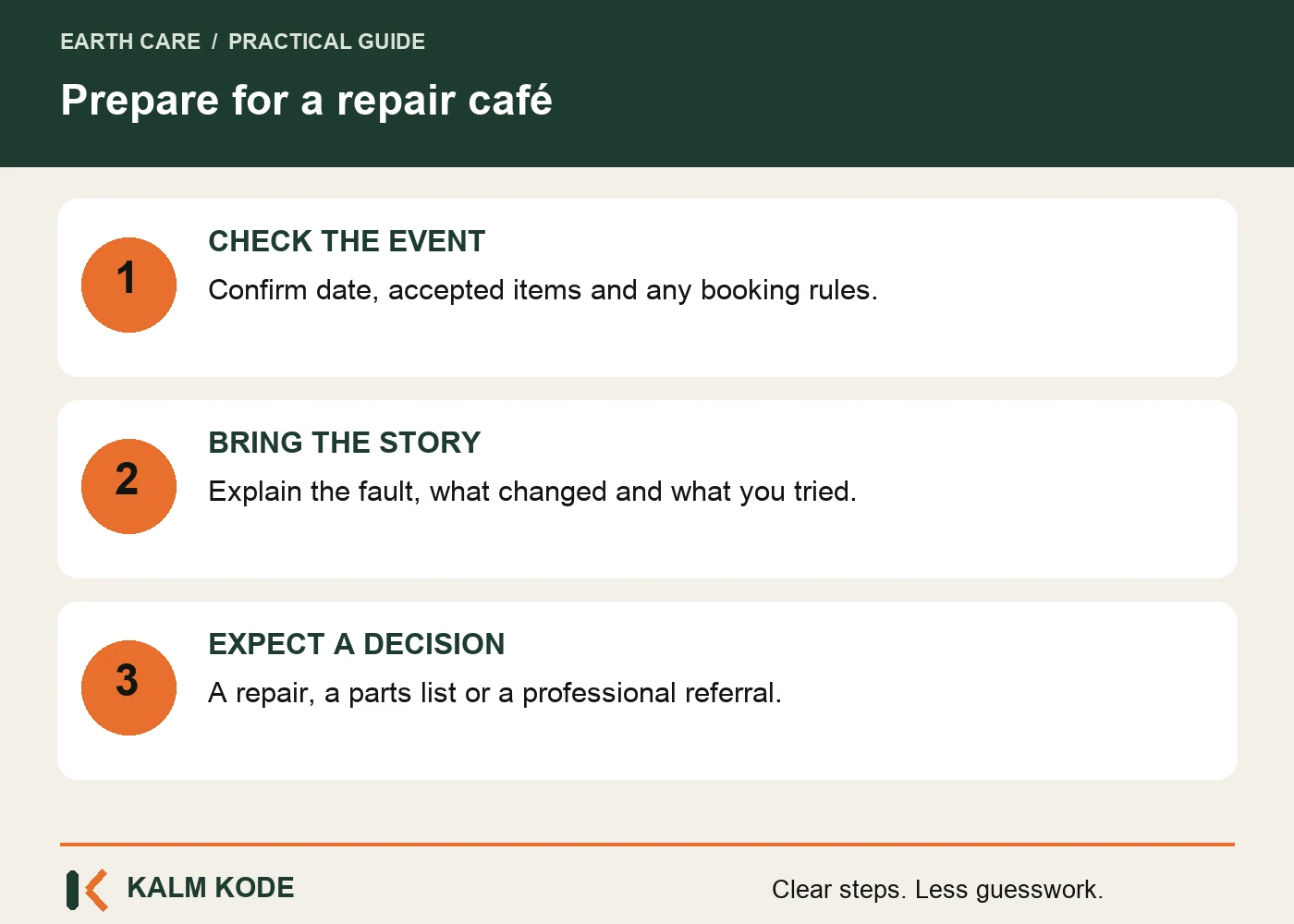
Repair Café International says Martine Postma organized the first Repair Café in Amsterdam on October 18, 2009, and that its foundation has supported local groups since 2011. It describes repair cafés as “free meeting places” where visitors bring broken items from home and make repairs with volunteer experts, using the tools and materials on site.
That last part matters: you’re not dropping off a repair job. You sit with the volunteer and work on it together. Many people find that’s the best part. You learn how your item works, why it broke and how to keep it from breaking again.
Repair café, fix-it clinic, repair event
You’ll see different names: repair café, fix-it clinic, repair fair, community repair event. The ideas are the same. Some are run by libraries or local governments, some by makerspaces, some by community groups. Some are drop-in; some ask you to register. Some follow Repair Café International’s model and name, and others run their own way.
Who volunteers?
Repair volunteers are usually people with everyday skills: someone who’s good with a sewing machine, a retired electrician, a bike mechanic, a jeweler, a woodworker, a person who’s been fixing their own electronics for years. DOEE describes Fix-It DC’s volunteer coaches as having skills such as jewelry, small appliances and bicycles.
Is it really free?
The events in this guide describe themselves as free. Repair Café International calls repair cafés “free meeting places.” Greenbelt MakerSpace calls its Repair Café “a free community service.” DOEE says Fix-It DC hosts “free community repair events.” Some groups accept donations to cover costs, and parts are usually your responsibility.
Where to Find Repair Events Near DC
Fix-It DC (Washington, DC)
The DC Department of Energy and Environment (DOEE) runs Fix-It DC, which it says “hosts free community repair events for all District residents.” At these events, residents bring broken household items and work with a coach on the repair. DOEE says Fix-It DC provides repair tools but not replacement parts.
Events have been held at DC Public Library branches. DOEE’s Fix-It DC page lists upcoming events and a registration form, and points to related resources: tool libraries at the Martin Luther King Jr. Memorial Library and Twin Oaks Library, and the eCYCLE DC electronics recycling program. Questions go to reuse@dc.gov.
Library-hosted repair clinics may have their own registration, orientation, identification or release requirements. Check the specific current event listing. Requirements in a past library event notice should not be treated as rules for every Fix-It DC session.
Greenbelt MakerSpace Repair Café (Prince George’s County)
The Greenbelt MakerSpace in Greenbelt, Maryland, runs a Repair Café that it describes as “a free community service staffed by volunteers.” It’s located in the Granite Building at 115 Centerway, Greenbelt, MD 20770.
According to the MakerSpace, volunteers help with:
- Clothing and fabric
- Computers and electronics
- Small appliances
- Jewelry
- Small motors
- Bicycles (simple repairs)
- Furniture
- Tool sharpening
The MakerSpace says not every item can be fixed, that some items, including some electronics, may need recycling instead, and that success isn’t guaranteed. For some repairs, it suggests bringing matching materials or spare parts you already have. If you need parts, volunteers can help you order them from local businesses so you can finish the repair later.
Greenbelt MakerSpace’s official repair-café page describes the program. Use its upcoming-events page for the next confirmed date and any special instructions. A third-Saturday schedule reported in July 2026 is historical reporting, not a guarantee of the next event.
Finding others
New repair events start all the time, and some stop. A few ways to find one:
- Repair Café International’s map, for events that use the Repair Café name and model.
- Community Repair Hub, developed with and hosted by iFixit in partnership with the Restart Project, with PIRG organizing participation. PIRG’s explainer describes the collaboration.
- Your library’s events calendar. Libraries host many repair clinics and often have tool libraries.
- Makerspaces and community centers near you.
- DC’s reuse program at reuse.dc.gov, which lists repair and reuse resources for District residents.
Before You Go
A little preparation makes your visit much more likely to end in a fix.
Check the event’s rules
Look at the listing for:
- Registration. Some events are drop-in. Some ask you to sign up in advance or book a time slot.
- What they repair. Not every event has a sewing volunteer or a bike mechanic every time.
- Limits. Some events limit you to one or two items so everyone gets a turn.
- Forms. Some ask you to sign a release before a volunteer works on your item.
- What to bring, such as ID or a library card for library events.
Bring the right things
- The item itself, cleaned off. A greasy toaster full of crumbs is harder to open and work on.
- All its parts: cords, chargers, remotes, batteries, lids, attachments and any pieces that fell off.
- Spare parts you already have, like matching thread, buttons, a replacement bulb or fuse, or a part you’ve ordered.
- The manual, if you still have it, or the make and model number written down.
- A short note on what’s wrong: when it started, what happens and what you’ve tried.
Describe the problem clearly
“It’s broken” is hard to work with. Try something like:
- “The lamp works for a few seconds, then flickers off. New bulb didn’t help.”
- “The toaster heats on one side only.”
- “The zipper teeth separate below the slider.”
- “The chair wobbles when you lean back. The back left leg is loose.”
The more specific you are, the faster a volunteer can find the cause.
Don’t bring
- Items that are unsafe to handle: anything that’s been in a fire or flood, has a melted or damaged cord or plug, smells of burning, is leaking or has a swollen battery. Stop using these. Do not transport a damaged battery or other hazardous item in an ordinary repair basket. Ask the manufacturer, local hazardous-waste program or relevant authority for safe handling instructions; it does not belong in ordinary trash or curbside recycling.
- Gas-powered equipment with fuel in it, unless the event says it can handle it.
- Huge items you can’t carry in, unless the event confirms they can help.
- Anything you’re not willing to risk. Repairs can fail. Don’t bring something irreplaceable unless you accept that.
What Happens at a Repair Café
Every event runs a little differently, but a typical first visit looks like this:
- Check in. You sign in, describe your item and may sign a release form.
- Wait your turn. There’s often a short wait. Many events have coffee or a place to sit.
- Meet your volunteer. You explain the problem and show them the item.
- Diagnose together. The volunteer opens it up, tests and looks for the cause. They’ll often explain what they’re seeing.
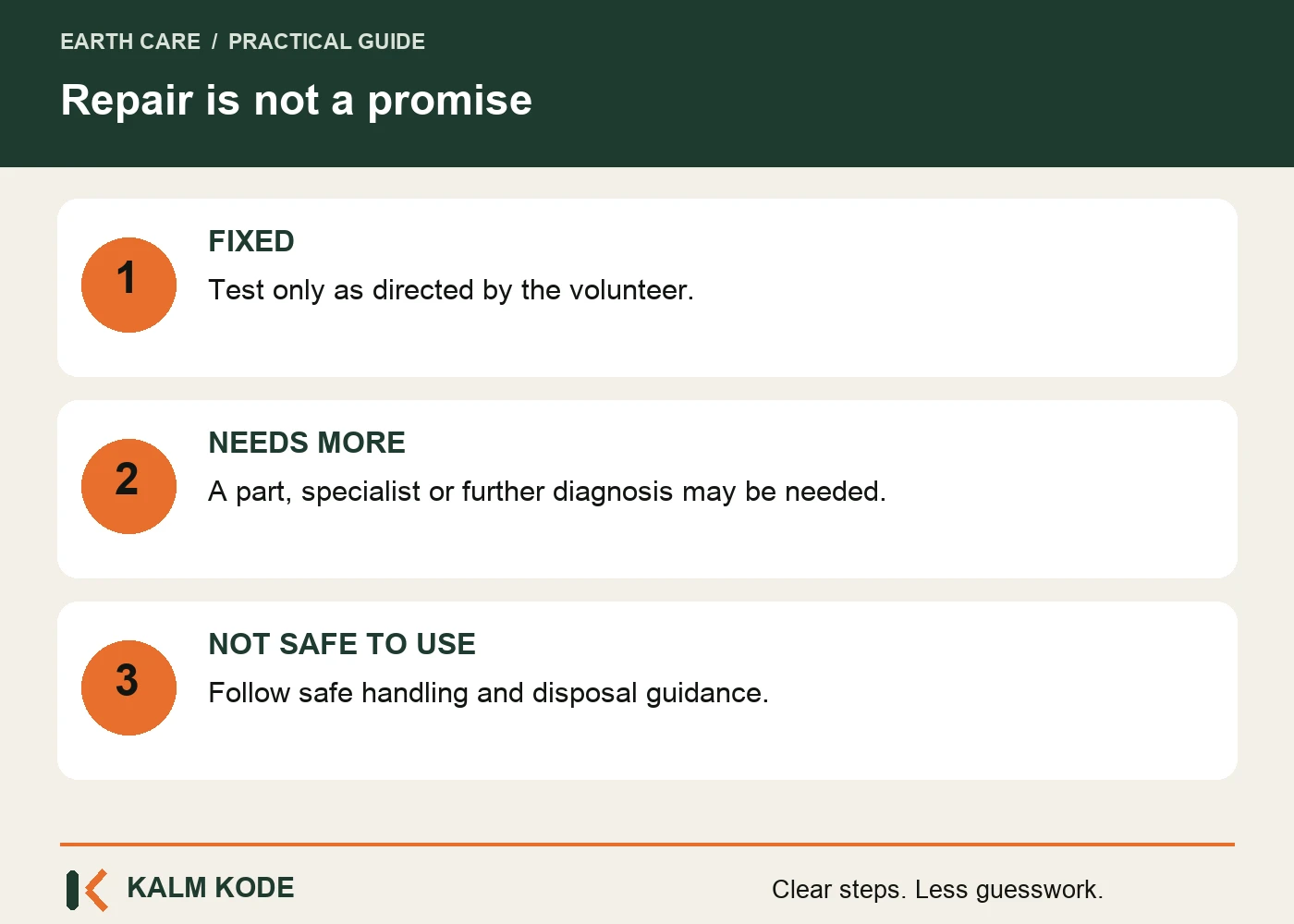
- Fix or plan. If it’s a quick fix, you do it together. If it needs a part, the volunteer may tell you what to order and invite you back.
- Let the volunteer lead the safety check and testing. Do not reconnect power or put weight on a repaired item until the person supervising has said that is appropriate.
- Say thanks, and pass it on. If the event takes donations, chip in. Tell someone else about it.
You’re part of the repair
At most repair events, the volunteer guides and you help. You might hold a screwdriver, thread a needle or test a connection. Ask which tasks are appropriate to repeat yourself and which need trained help. Watching one repair does not establish that you can safely diagnose or repeat an electrical repair.
When it can’t be fixed
Some things truly can’t be repaired, or the repair isn’t worth it. A volunteer may tell you a part isn’t available, the damage is too extensive, or the item isn’t safe to keep using. That’s still a useful answer. You may be advised to consult a professional before deciding whether to repair or dispose of it. A community volunteer’s inability to fix something does not prove that no professional could help. Greenbelt MakerSpace notes some items, including some electronics, may need recycling instead.
If you’re in Prince George’s County, our Can They Take This? tool and our guides to TV disposal and batteries help with what’s next. In DC, DOEE points to the eCYCLE DC electronics recycling program.
Questions to ask your volunteer
You’ll get more out of the visit if you ask as you go. A few good ones:
- What caused this to break, and was it wear, damage or a weak part?
- How can I keep it from happening again?
- Is this something I could fix myself next time? What tool would I need?
- If it needs a part, what exactly should I order, and where?
- Is it still safe to use after this repair?
- Is there anything else on this item that looks like it’ll fail soon?
Write the answers down or take a photo of the part and model number. That way you’re not starting from zero if it breaks again.
Safety at the repair table
Volunteers will usually lead on safety, but it helps to know the basics:
- Unplugged means unplugged. Electrical items are opened and worked on while disconnected. Testing happens only after the item is closed back up.
- Let the volunteer decide whether an item is safe to open. Some items, like microwaves and anything with large capacitors, can hold a charge after unplugging, and some volunteers won’t open them.
- Watch little fingers. If you bring kids, keep them close; repair tables have sharp tools and small parts.
- Accept a no. If a volunteer says an item is unsafe, stop using it and ask for the appropriate professional assessment or disposal route. Do not treat all hazardous items as ordinary recycling.
Safe Checks at Home First
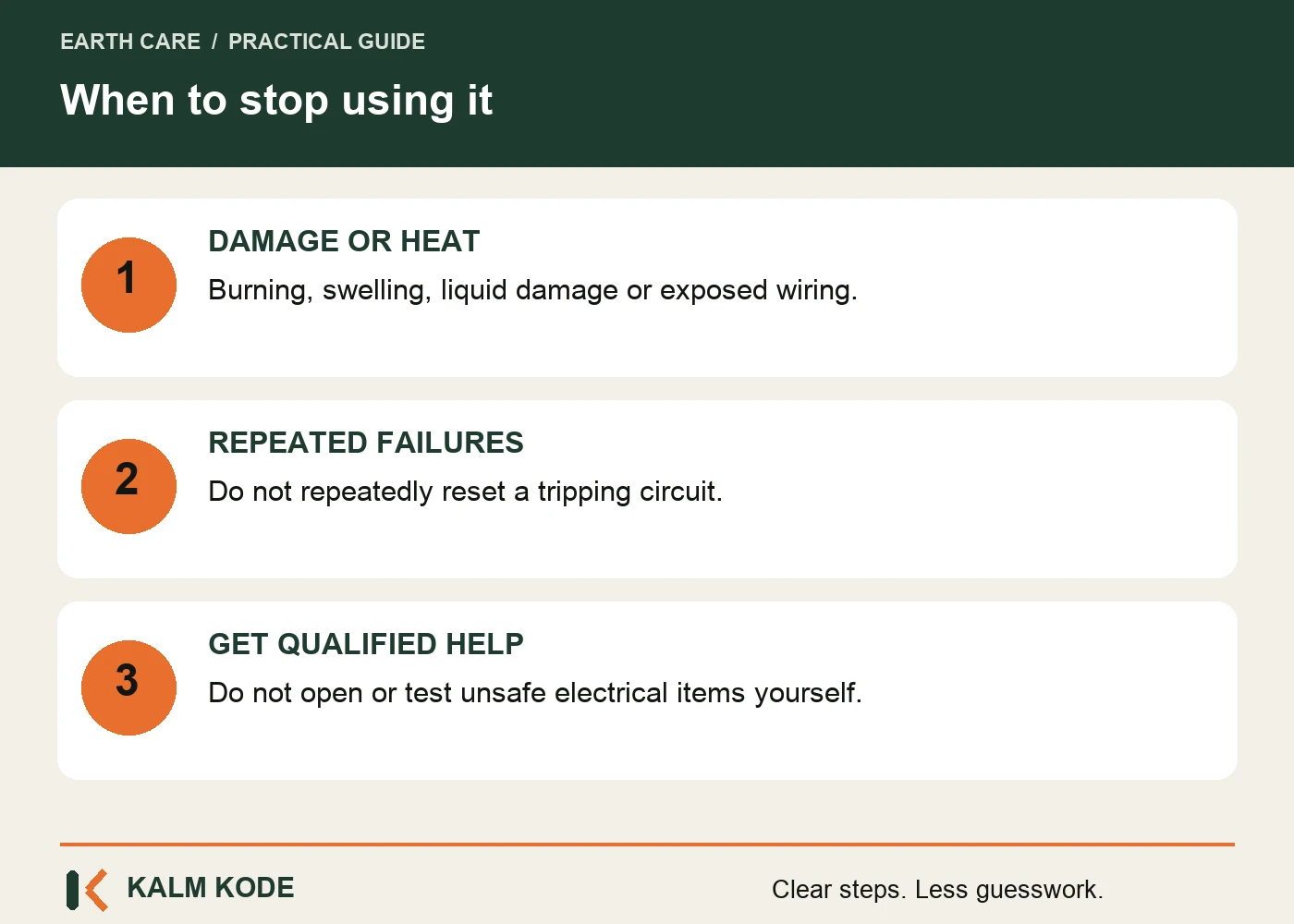
Start with the manufacturer’s instructions and observations you can make without opening the item. Write down the model, what happened and whether there was a smell, unusual heat, liquid exposure or a damaged part. An accurate note can be more useful than repeated attempts to switch a faulty appliance on.
- Stop for warning signs. Burning smells, melted cords, water damage, swollen batteries and repeated breaker trips are reasons to stop use and seek suitable advice, not keep resetting or testing.
- Check settings and assembly only when safe. A switch position or a correctly seated removable part may explain the problem. Follow the manual and disconnect power before any user maintenance it permits.
- Use only compatible accessories. Do not improvise a charger, fuse or replacement part. Match the maker’s requirements rather than assuming a connector that fits is suitable.
- Read the user-maintenance section. Cleaning a removable filter may be appropriate; opening a sealed appliance may not be. Keep within the instructions and your competence.
- Check non-electrical details. Note a missing button, a zipper that separates or a loose furniture joint. Do not continue using unstable furniture while waiting for the event.
If you are unsure whether an item is safe to bring, contact the organizer with a description before travelling. Keep hazardous items out of a general fix basket and follow the designated handling route.
Bringing Kids
Repair cafés can be a great outing for curious kids. Watching a toaster come apart or a sewing machine stitch a seam shows them that things can be fixed, not just replaced. Check the event’s rules on children first, keep kids beside you at the table and let them help with safe tasks like holding a part, sorting screws or testing the finished repair.
Examples of Items Local Events May Accept
These are examples of categories listed by the events in this guide, not a ranking of the most frequent or successful repairs:
| Category | Common fixes | Bring |
|---|---|---|
| Small appliances | Toasters, lamps, fans, vacuums, coffee makers | The cord, any removable parts |
| Clothing and fabric | Seams, hems, buttons, zippers, small tears | Matching thread, buttons, the zipper if replaced |
| Electronics | Speakers, radios, some computers | Chargers, cables, model number |
| Jewelry | Clasps, jump rings, chains | All the pieces |
| Furniture | Loose joints, wobbly legs, small breaks | Hardware, photos if it’s too big to carry |
| Bicycles | Simple repairs, chains, brakes | The bike, if the event takes bikes |
| Tools | Sharpening knives and scissors | The tools, safely wrapped |
After the Repair: Make It Last
A fixed item lasts longer with a little care. A few habits help:
- Unplug by the plug, not the cord. Yanking cords is one of the most common ways lamps and appliances get damaged.
- Don’t overload it. Toasters, blenders and vacuums last longer when they’re not pushed past what they’re built for.
- Clean it regularly. Crumb trays, lint traps, filters and vents all need emptying.
- Store it properly. Wrap cords loosely, keep fabric dry and keep jewelry in a box where chains won’t tangle.
- Deal with small problems early. A loose button or unstable joint deserves attention before more damage occurs; repair difficulty and suitability vary.
- Keep the notes. The part number, the volunteer’s tips and a photo of what was fixed make the next repair easier.
Why Repair Matters
Every item fixed is one that doesn’t go in the trash and doesn’t need to be replaced. Across a community, that adds up. Repair Café International counts more than 2,500 repair cafés worldwide, and many local governments now support repair events because they keep usable goods out of landfills.
There’s a money side too. A successful repair may avoid the cost of a replacement, although parts or professional work can change that calculation. And there’s a people side. Repair cafés are social. You meet neighbors, learn skills and see that the stuff around you isn’t as mysterious as it seems.
A repair event can also make the options clearer. A volunteer might show you a clothing mend you can practice, identify a part to ask a professional about or explain why an item should no longer be used. The useful result is an informed next step, not an assumption that every repair is now safe to attempt alone.
As the EPA puts it, one of the ways to reduce waste is to “maintain and repair products, like clothing, tires and appliances.” Repair cafés make that easier.
Volunteer at a Repair Café
If you’re the friend everyone calls when something breaks, repair cafés need you. Volunteers don’t have to be professionals. Skills that help:
- Sewing and mending
- Small appliance and lamp repair
- Electronics troubleshooting
- Jewelry repair
- Woodworking and furniture repair
- Bike repair
- Sharpening
- Greeting and check-in, if you’d rather not fix things
Contact the organizer of an event near you. DOEE invites questions about Fix-It DC at reuse@dc.gov, and Greenbelt MakerSpace lists contact information on its site. Ask about any training, safety rules and what tools you’d need to bring.
Start a Repair Café
If there’s no repair event near you, you can start one. Repair Café International supports local groups that want to use its model and name. Libraries, faith communities, schools and community centers are good partners because they have space and an audience.
The basics: a room with tables and power, a handful of skilled volunteers, simple tools, a sign-in process, clear safety rules and a way to get the word out. Start small, with a few volunteers and a few categories, and grow from there.
A Worked Example
Here’s a hypothetical visit built around non-electrical items, not a promise of what any particular volunteer can fix. You have a jacket with a split zipper, a cushion cover with an open seam and a dull pair of kitchen scissors.
- Check the listing. You find an event that lists sewing help and asks visitors to register and bring no more than two items. You confirm those requirements rather than assuming every repair café uses the same rules.
- Pick two. You bring the jacket and cushion cover. You ask separately whether tool sharpening will be available at a future event; the scissors stay home for now.
- Prepare. You wash and dry the fabric, bring matching thread if available and note exactly where the zipper separates. You keep any detached pieces in a small bag.
- The seam. A volunteer examines the fabric and shows you a possible mend. In this example, the material is sound enough for a repair and the seam can be closed. Different fabric damage could require a different answer.
- The zipper. The volunteer suspects the slider needs replacing but cannot confirm a suitable part from what is on hand. You record the details and ask what must be checked before ordering, rather than buying a random slider.
- The next step. You leave with one repaired item and a plan for the other. You check a return event’s sewing availability before coming back with a part.
This example shows that a useful visit need not end with everything fixed. A clear explanation of a limit, a part specification or a recommendation to see a professional can prevent an uninformed next step.
Common Mistakes
Showing up without the parts. A missing cord or charger can stop a repair cold.
Bringing something unsafe. Swollen batteries, melted cords and fire- or flood-damaged items shouldn’t be handled at a community event without the organizer’s OK.
Expecting a drop-off service. Repair cafés are do-it-together. Plan to stay and help.
Skipping the listing. Registration, item limits and forms vary. Check first.
Giving up too soon. If a repair needs a part, order it and go back. Many repairs happen over two visits.
Make It a Habit
Keep a “fix” basket at home. Use it only for ordinary items safe to store and handle. Hazardous, leaking, heat-damaged or swollen-battery items need separate advice and safe handling, not a place in the basket. When the next repair event comes around, you take the basket. Our guide Before You Throw It Away has more ideas for keeping things in use.
This guide is part of Earth Care & Community Help, where Kalm Kode helps neighbors keep good things in use.
Keep a useful repair record
A short record helps if you return to the event or consult a professional afterward. Include the item model, the symptom you reported, any part discussed and what was actually done. Separate a suspected cause from a confirmed finding. For example, “the volunteer suggested checking the slider size” is different from “the zipper needs this exact replacement.” Ask before recording a volunteer or photographing other visitors.
If a part must be ordered, confirm who will fit it and whether the event expects you to return. Do not assume the same specialist will attend every session. Keep the packaging and receipt until compatibility is established, and check return conditions before opening or modifying a part. An inexpensive wrong part is still wasted money and material.
After a repair, follow the instructions you were given and stop use if the original fault returns or a new warning sign appears. The event is not a substitute for a manufacturer’s safety notice or recall. If there is uncertainty about safe operation, ask a qualified professional rather than relying on the fact that it worked briefly at the table.
About this guide
Written and edited for Kalm Kode by King. This is a practical guide compiled from the linked public sources, not a claim that Kalm Kode operates these programs or has a partnership with them. Provider rules can change; use the official contact or event page to confirm the details for your own item, address or visit.
Frequently asked questions
What is a repair café?
A free community event where volunteers help you repair household items. Repair Café International says the first was held in Amsterdam in 2009 and that there are now over 2,500 worldwide.
Is there a repair café in DC?
DOEE runs Fix-It DC, free community repair events for District residents where you work with a coach. It provides tools but not replacement parts. Check DOEE’s Fix-It DC page for upcoming events and registration.
Is there a repair café in Prince George’s County?
The Greenbelt MakerSpace runs a free, volunteer-staffed Repair Café at 115 Centerway in Greenbelt. Check its events page for current dates.
What should I bring?
The item, cleaned off, with its cords, chargers and parts; any spare parts you have; the manual or model number; and a short note on what’s wrong.
Do I have to pay?
The events in this guide describe themselves as free. Some accept donations, and replacement parts are usually your cost.
Can a repair café guarantee that my item will be fixed?
No. Volunteer skills, time, parts and the condition of the item all affect what is possible. A volunteer may recommend a professional, a replacement part or a safe disposal route instead.
Should I bring a swollen battery or an appliance that smells of burning?
Stop using it and seek appropriate safe-handling guidance before transport. Do not put hazardous items in an ordinary repair basket or curbside recycling. Ask the manufacturer, local hazardous-waste program or relevant authority what to do.
Does watching a repair mean I can do the same electrical job at home?
No. Ask which tasks are safe for you to repeat and which need qualified help. Keep user maintenance within the manufacturer’s instructions; observing one repair does not establish competence to diagnose electrical faults.
Sources
- About Repair Café (Repair Café International)
- Fix-It DC (DC Department of Energy and Environment)
- Repair Cafés (Greenbelt MakerSpace)
- What’s happening at Greenbelt MakerSpace: monthly Repair Cafés and more (Greenbelt Online, July 2026)
- Fix-It DC Clinic listing (DC Public Library)
- Community Repair Hub (US PIRG Education Fund)
- Reducing and Reusing Basics (US EPA, January 2017 archive)