
How to Get Rid of a Couch: Choose the Right Route Before Moving It
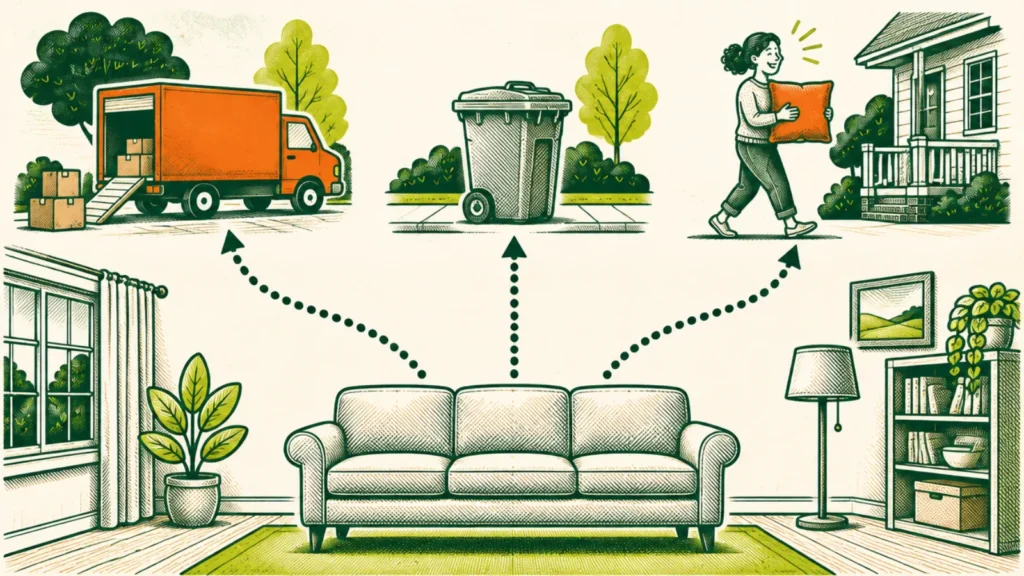
Short answer: decide the route before you lift the couch. A clean, unbroken couch can be sold, given away or donated. A worn but usable one can go to a free listing or your city or county bulk pickup. A broken, stained or smelly one goes to bulk pickup, a paid junk removal crew, or a drop-off site. Pick the route first, confirm it takes your couch, then move it once.
In Prince George’s County? Homes with county-contracted trash can set a couch next to the cart on trash day, no appointment. In DC, DPW collects bulk items by 311 appointment for homes it already serves (details below).
Last checked November 10, 2026, against Prince George’s County, DC DPW and other public sources (listed at the bottom). Kalm Kode is an independent guide, not a hauler or a donation service. The group collecting your couch has the final word on what it takes.
The 30-second version
- Check the condition first. Rips, deep stains, strong odors and broken frames rule out most donation routes. Be honest about it before you call anyone.
- Good couch? Sell it, give it away or donate it. Someone else may pick it up for free, or pay you.
- Worn couch? Free listing or bulk pickup. Plenty of people will take a usable couch with a few scuffs.
- Done couch? Bulk pickup, junk removal or drop-off. Your local trash service may take it at no extra charge. Otherwise, pay a crew or haul it yourself.
- Confirm before you promise. Ask about pickup fees, condition rules, stairs and dates before you tell a buyer, a landlord or a mover it’s handled.
- Move it once. Dragging a couch to the curb, then back inside, then out again is the part everyone regrets.
Step 1: Sort your couch into one of three piles
Most couch headaches come from picking a route that doesn’t fit the couch. A charity truck that turns away a stained sofa at your door costs you a day. So start here.
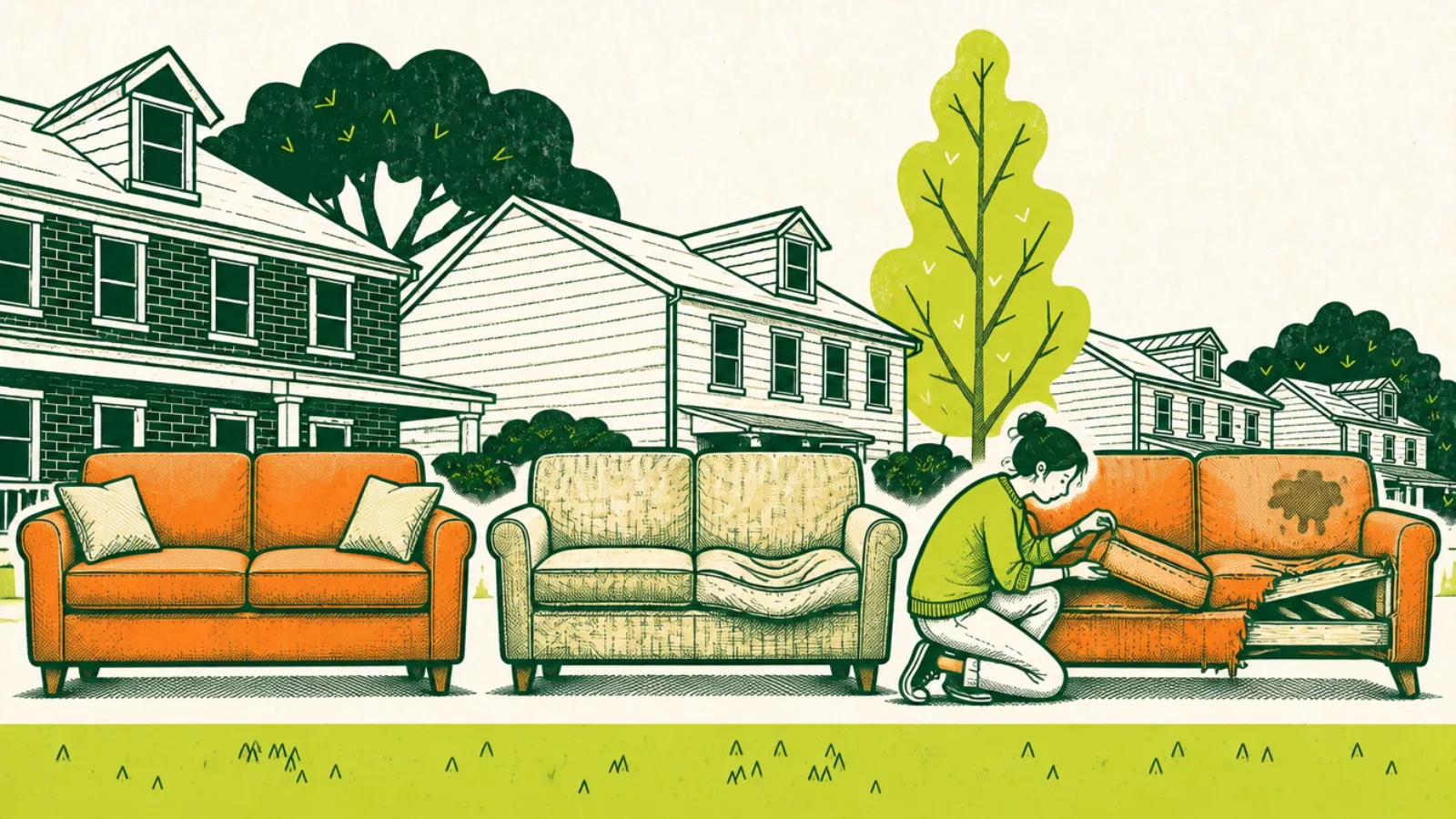
Pile A: Sellable or donatable. The frame is solid, it sits level, the cushions hold their shape, and there are no rips, burns, deep stains or odors. Pet hair can be vacuumed. A few light marks are fine. This couch has the most options, including free pickup from some charities.
Pile B: Usable but worn. It works and it’s clean enough to sit on, but it has visible wear: faded fabric, a small tear, a sagging cushion, scratched legs. Most donation centers will pass. Neighbors, students and first-apartment folks often won’t.
Pile C: Done. A broken frame, springs poking through, water damage, mold, strong smoke or pet odor, or stains that won’t come out. This couch’s next stop is trash, bulk pickup or a hauler.
Take three photos in good light: front, back and the worst spot. You’ll use them for listings, donation requests and junk removal quotes. Many services ask for photos before they’ll book anything.

Route 1: Sell it or give it away
If your couch is in Pile A or B, a buyer or a free taker can be the fastest and cheapest exit. The person picking it up does the lifting.
Where people list couches:
- Facebook Marketplace. Big local audience, and furniture moves fast.
- Nextdoor. Good for neighbors who can come over the same week.
- Buy Nothing groups. Local gift groups where everything is free.
- Craigslist. Still used for furniture, especially free items.
A listing that actually gets the couch out the door:
- Measure it. Width, depth and height. Buyers need to know it fits their door and their car.
- Say how it leaves. “You pick up. Ground floor. Bring one helper.” Saves a dozen messages.
- Show the worst spot. Honest photos stop no-shows after someone sees it in person.
- Mention pets and smoking. People with allergies will ask anyway.
- Set a deadline. “Free to whoever picks it up by Saturday” gets action.
Pricing a used couch is guesswork. Look at similar listings near you and price a little under them if you need it gone soon. If a few days pass with no bites, drop the price or make it free.
When you give it away, stay flexible about pickup times but firm about the date. If no one comes by your deadline, move to the next route. That way you’re not stuck with a couch in the living room on moving day.
Route 2: Donate it
Donation is a good home for a Pile A couch. Rules change from one store to the next, so treat everything below as what to ask, not a promise.
What donation centers say they want:
- The Salvation Army lists “unbroken furniture,” including sofas, among items it generally accepts in good, gently used condition. It notes that rules vary by location and points people to 1-800-SA-TRUCK.
- Habitat for Humanity ReStores accept new or gently used furniture. Habitat says many ReStores offer free pickup of large items, but it also says each ReStore is unique, so you call yours to confirm.
- A Wider Circle, based in Silver Spring, lists a sofa or upholstered chair among its most-requested items. It asks that donations be gently used, clean and functional, with no rips, stains or damage, and apartment-sized.
That last line is a good test for any charity. If your couch has a rip, a stain or a smell, expect a no.

Before you promise “free pickup,” confirm these
Free pickup is common, but it’s not universal, and some groups charge for it. A Wider Circle, for example, lists pickup fees: $50 for standard in-home pickup and $20 curbside with at least two weeks’ notice, more for rush pickups. Drop-off at its Silver Spring center is free.
Ask the store or charity:
- Do you accept sofas right now? Some stores pause furniture when the floor is full.
- What condition do you accept? Ask specifically about tears, stains, pet hair and sleeper sofas.
- Do you pick up, and is it free? Get the fee in writing if there is one.
- What’s the earliest date? Some pickup calendars run a week or two out.
- Can the crew handle stairs? Some only pick up from the ground floor, the curb or a garage.
- Who decides on the day? Drivers can turn down an item at the door. Ask what happens then.
- Do I get a receipt? If you plan to claim a tax deduction, ask for one.
If the answer to any of these doesn’t work for your timeline, keep going. Don’t lock in a moving date around a pickup you haven’t confirmed.
Route 3: Your city or county bulk pickup
Most local trash services take couches. Some collect them on trash day, some by appointment, and some don’t serve your building at all. The real question is who collects your trash.
- County or city trash service. You likely have a bulky item option. Look up your local public works or waste page for limits and set-out times.
- Apartment, condo or HOA. Your property manager or the hauler they hire usually handles bulk items. Ask before you put anything outside.
- Private hauler you pay yourself. Ask the hauler. Bulk pickup may be included, extra, or not offered.
Rules that usually come with bulk pickup:
- An item limit. Prince George’s County allows four bulky items per collection day for county-contracted homes. DC allows up to seven items per appointment.
- A set-out window. Too early can earn a ticket in some places. Too late and the truck may have passed.
- A spot. Usually next to your cart or where your trash is normally collected, not blocking the sidewalk.
Bulk pickup is the best fit for a Pile C couch. Your trash service may take it at no extra charge, and you only carry it as far as the curb.

Route 4: Hire a junk removal crew
If you can’t move the couch, can’t wait for a pickup date, or have more than a couch to clear, a junk removal company or a hauling app does the lifting and the disposal for you.
What it costs varies a lot by area, access and how much else goes on the truck. Two national cost guides give a sense of the range:
- HomeAdvisor says having a pro remove just a sofa or couch runs $75 to $150, with sectionals listed at $100 to $175. It notes that some haulers charge a minimum of $50 to $150.
- Thumbtack, in a guide updated April 15, 2026, puts the national average for couch removal at $123 to $274.
Those are national figures, not quotes. Your price depends on things like:
- Size and type. Sectionals and sleeper sofas weigh more and take longer.
- Access. Stairs, tight hallways and long walks to the truck add time.
- Timing. Same-day or next-day service often costs more.
- What else goes. A full truckload costs more in total, but each piece costs less.
- Where it ends up. Disposal fees vary by area. Some crews donate usable pieces.
To get a real number, send two or three companies the same photos and the same details: size, floor, stairs, distance to the door, and the date you need. Ask whether the quote is all-in, and whether it changes if the couch comes apart or turns out heavier.

Route 5: Haul it yourself to a drop-off site
If you have a truck, a trailer or a friend with one, you can take the couch to a landfill, transfer station or residential drop-off center. This works well when you’re clearing several things at once.
Before you load up:
- Check that the site takes furniture. Some take it, some take only certain materials.
- Check who can use it. Many county sites are for residents only and may ask for ID or proof of address.
- Check the hours and fees. HomeAdvisor estimates landfill fees of about $10 to $50 per large item when you haul it yourself. Your county’s rate may be different, or there may be no charge for residents.
- Bring a helper. You’ll be the one unloading it.
Strap the couch down with ratchet straps, cushions removed and loaded separately. Couches catch wind on the highway, so tie them down more than you think you need.

Route 6: Retailer haul-away when you buy a new couch
If a new couch is coming, ask the store whether it will take the old one away when it delivers. Some furniture retailers offer haul-away for a fee or as part of a delivery package. It saves you a separate pickup date, and the old couch leaves the same hour the new one arrives.
Ask before you check out:
- Is haul-away offered for my order? And is it an add-on fee?
- What do I need to do? Some crews want the old piece empty, cleared of items and near the door.
- Do they take sleepers or sectionals? Size and type can change the answer.
If haul-away isn’t offered, line up one of the other routes for the same day so the old couch doesn’t end up in the garage.
Getting the couch out of the house
Most of the work is getting it through the door. A few minutes of prep makes it easier for whoever is carrying it, you, a buyer or a crew.
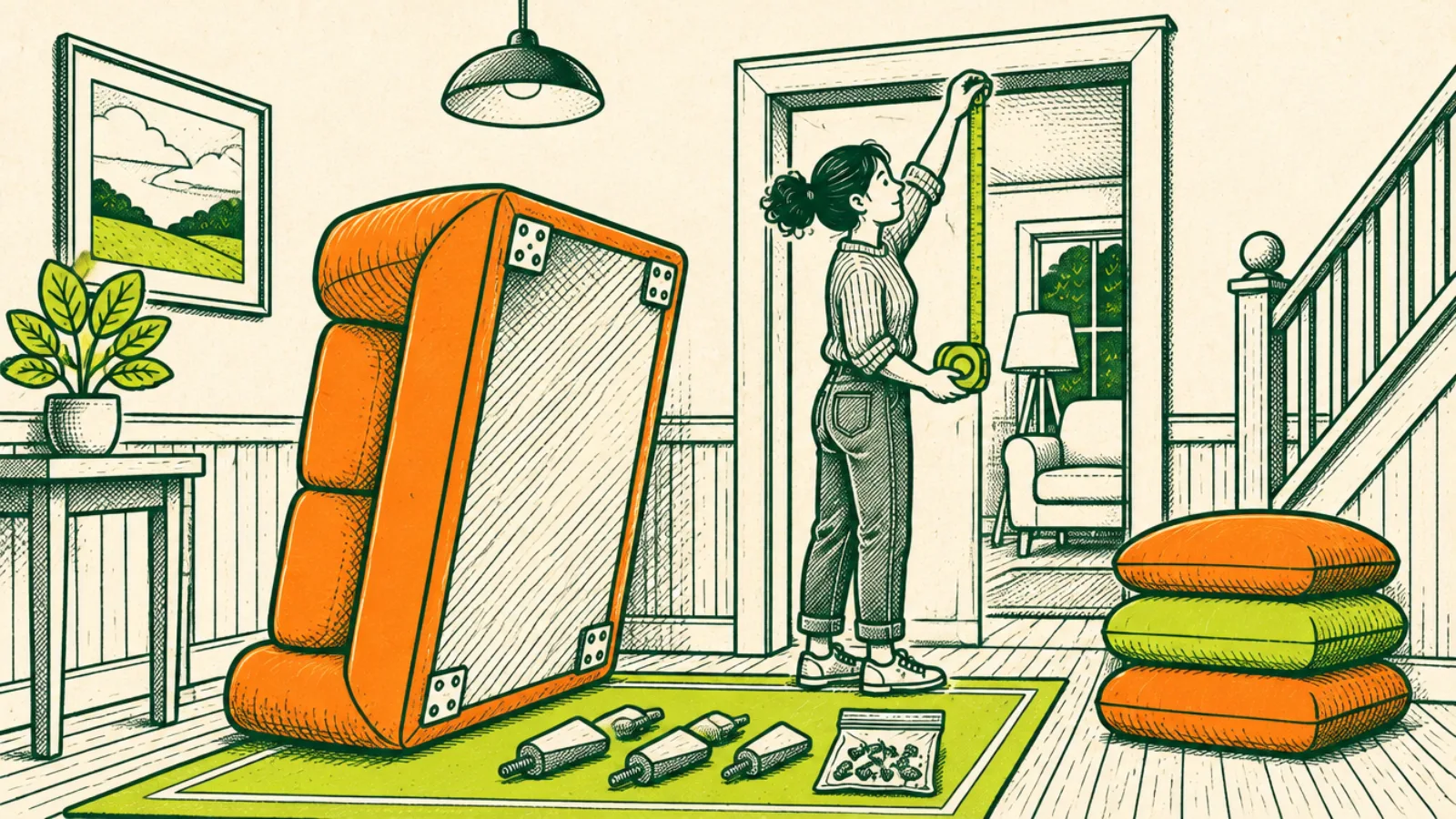
- Measure the path. Doorways, hallway turns and the stairwell. Compare them to the couch’s depth and height, not just its width.
- Take off what comes off. Cushions, pillows and the legs. Many legs unscrew by hand. Put the screws in a bag and tape it to the frame.
- Check for hidden hardware. Some arms and backs come off with a few bolts underneath.
- Stand it on end for tight turns. Tipping a couch upright often gets it around a corner it can’t clear flat.
- Wrap it if it’s going to a new home. A moving blanket or plastic wrap keeps the fabric clean.
- Clear the path. Rugs, shoes, the bike in the hall. Prop the doors open.
If the couch came in through a window or was built in the room, it may not leave whole. Some people take apart a couch that’s headed for the trash. Only do that if your hauler or bulk pickup accepts pieces, and keep the pieces bundled together.
Sleeper sofas, sectionals and recliners
Not all couches are just couches. A few types need an extra question.
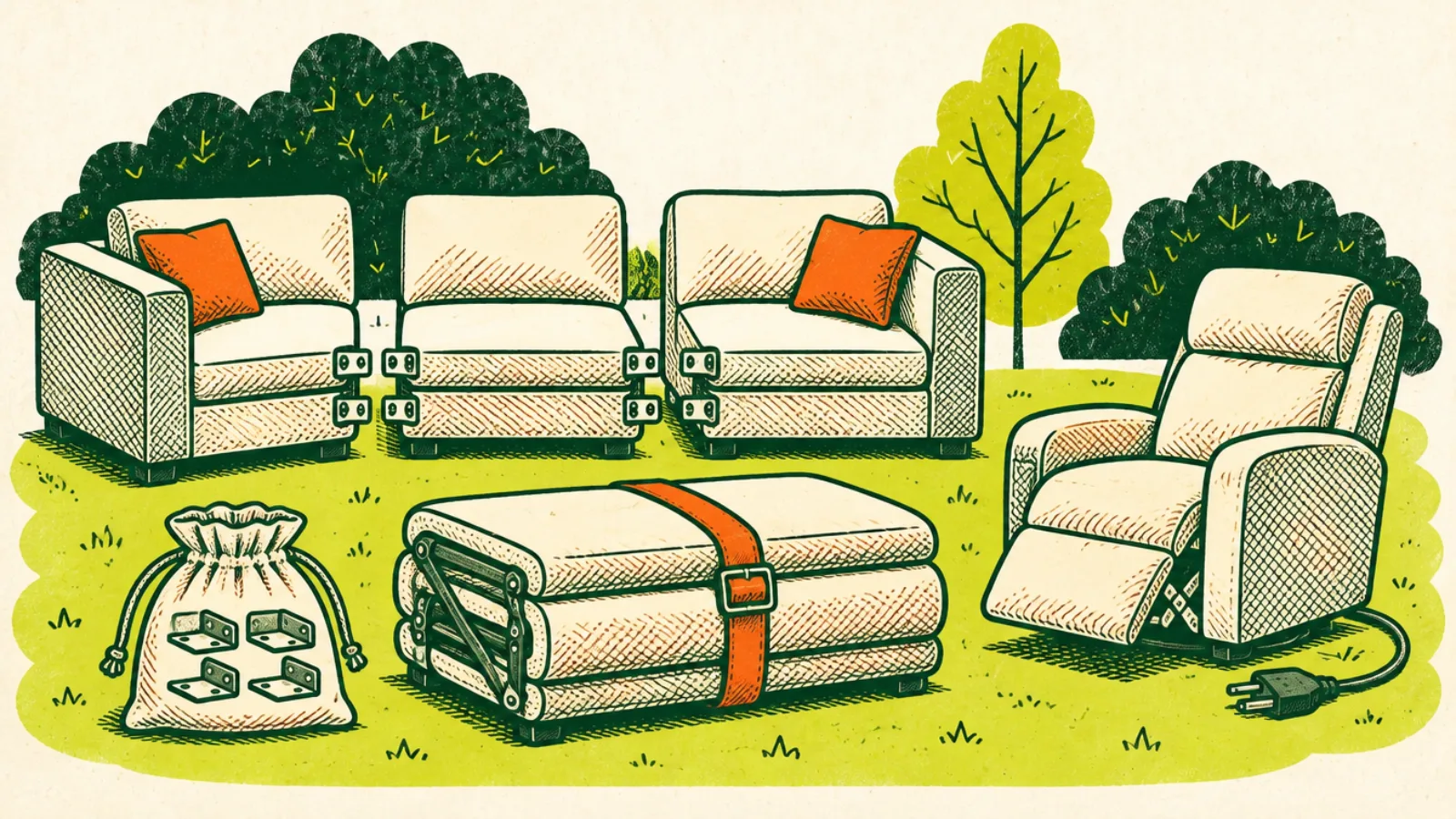
Sleeper sofas. The fold-out bed frame adds a lot of weight, and some charities won’t take sleepers. Fold the bed in and tie or tape it closed so it can’t spring open while it’s carried. Mention “sleeper” when you ask for a quote or a pickup.
Sectionals. Each piece is its own item for lifting purposes. Ask your bulk pickup or hauler whether a sectional counts as one item or several, because it can change your item limit or your quote. Keep the connecting brackets in a bag with the pieces.
Recliners and power sofas. Unplug them, put the backs and footrests in the closed position, and coil the cords. Power furniture is heavy, so mention it in the quote.
Futons. The frame and the mattress are often handled separately. Ask whether your pickup or hauler counts them as one item or two.
Comparing the routes
- Sell or give away. Cost: free or you get paid. Speed: a few days to a week. Best for: Pile A and B. You do: photos and messages.
- Donate. Cost: free to a fee for pickup. Speed: often a week or more for pickup. Best for: Pile A. You do: photos, a call and a confirmation.
- Bulk pickup. Cost: often included in your trash service. Speed: next trash day or an appointment date. Best for: Pile C. You do: carry it to the curb on time.
- Junk removal. Cost: varies, see the ranges above. Speed: as soon as same day. Best for: any pile, heavy lifting, tight timelines. You do: get quotes.
- Haul it yourself. Cost: vehicle plus any site fee. Speed: whenever the site is open. Best for: several items at once. You do: all the lifting.
- Retailer haul-away. Cost: depends on the store. Speed: delivery day. Best for: a swap for a new couch. You do: ask before you buy.
In Prince George’s County, Maryland
- County-contracted trash: set the couch next to your trash cart on your regular trash day. The county lists sofas among acceptable bulky furniture, and it allows up to four bulky items per collection. Large bags count toward the four.
- Timing: the county’s bulky trash page says items must be out by 5 a.m. on collection day.
- No appointment needed for a couch if you have county-contracted service. Appointments through PGC311 are for appliances, tires, scrap metal and electronics.
- Live in a city, town, apartment complex or HOA with its own collection? The county route may not apply. Check with your local waste office or property manager first.
- Left at the curb? See PG County bulky trash not picked up for what to check before you report it.
Related guides: PG County bulky trash: do you need an appointment?, PG County mattress pickup and the Can They Take This? trash checker.
In Washington, DC
- Who qualifies: DPW collects bulk items by appointment from households that get DPW trash collection. Buildings with four or more units, condos, co-ops and commercial properties use a private licensed hauler instead.
- How to schedule: call 311, use 311.dc.gov or the 311 app. DPW says appointments are usually available within 10 to 14 days.
- Limit: up to seven items per appointment. You can request another appointment for more.
- Set-out window: no earlier than 6:30 p.m. the night before and no later than 6 a.m. on collection day, where your trash is normally collected. DPW lists household furniture as an acceptable bulk item.
- Drop-off: DPW’s page lists residential drop-off at transfer stations, but it describes the Fort Totten and Benning Road sites differently in different places. Call 311 to confirm the current site and hours before you drive.
Moving in DC at the same time? See DC moving truck permits.
Common mistakes
- Booking a donation pickup for a stained couch. It gets turned away at the door, and you lose the date.
- Setting it out on the wrong day. Outside the window, it may sit there, or earn a ticket.
- Promising a free pickup you haven’t confirmed. Check fees, dates and stairs first.
- Forgetting the item limit. A couch plus a mattress plus a few bags can push you over.
- Not measuring. The couch that came in through a window won’t leave through the door.
- Leaving the legs on. Taking them off often gives you the inch you need.
- Waiting until moving day. Most routes need a few days. Start a week or two ahead.
Your couch checklist
- Sort the couch: Pile A, B or C.
- Take three photos: front, back, worst spot.
- Measure the couch and the path out.
- Pick a route and a backup.
- Confirm the route: condition rules, fees, date, stairs.
- Prep it: cushions off, legs off, sleeper tied closed.
- Move it once, to the curb, the truck or the buyer’s car.
- If the plan falls through, switch to the backup that day.
FAQ
What’s the cheapest way to get rid of a couch?
Giving it away or selling it, if it’s in good shape, since the person picking it up does the lifting. For a worn-out couch, your city or county bulk pickup is often the cheapest route because it may be included in your trash service.
Will a charity pick up my couch for free?
Some will. Habitat for Humanity says many ReStores offer free pickup of large items, and the Salvation Army accepts unbroken sofas. Others charge a fee. Rules vary by location, so call first and ask about condition, fees and dates.
What condition does a couch need to be in to donate it?
Generally gently used, clean and unbroken. A Wider Circle, for example, asks for no rips, stains or damage. Expect a no for tears, deep stains, odors or a broken frame.
How much does couch removal cost?
HomeAdvisor puts removing just a sofa at $75 to $150. Thumbtack lists a national average of $123 to $274. Your quote depends on size, stairs, timing and location.
Can I put a couch out with the trash in Prince George’s County?
Yes, if you have county-contracted trash service. Set it next to your cart by 5 a.m. on trash day. The county allows up to four bulky items per collection, and a couch doesn’t need an appointment.
How do I get rid of a couch in DC?
If DPW collects your trash, schedule a bulk pickup through 311. DPW says appointments are usually available within 10 to 14 days and allows up to seven items. Buildings with four or more units use a private hauler.
Should I take the couch apart?
Only if you need to. Taking off cushions and legs is easy and often helps. Taking apart the frame makes sense for a couch headed to the trash, if your pickup or hauler accepts pieces.
What do I do if no one picks up my couch?
Move it back off the curb if your area doesn’t allow it to sit out, then check the basics: right day, right spot, within the item limit, and eligible for that service. Then rebook, or switch to junk removal or a drop-off.
Sources
Checked November 10, 2026:
- Prince George’s County: Bulky trash
- Prince George’s County: Acceptable and non-acceptable bulky trash
- Prince George’s County: Waste, recycling and disposal facilities
- DC DPW: Bulk trash collection
- The Salvation Army: What to donate
- Habitat for Humanity: Donate to a ReStore
- A Wider Circle: Donate items
- HomeAdvisor: Furniture and mattress removal costs
- Thumbtack: How much does couch removal cost?