
How to Declutter Your Home Without Just Moving the Piles

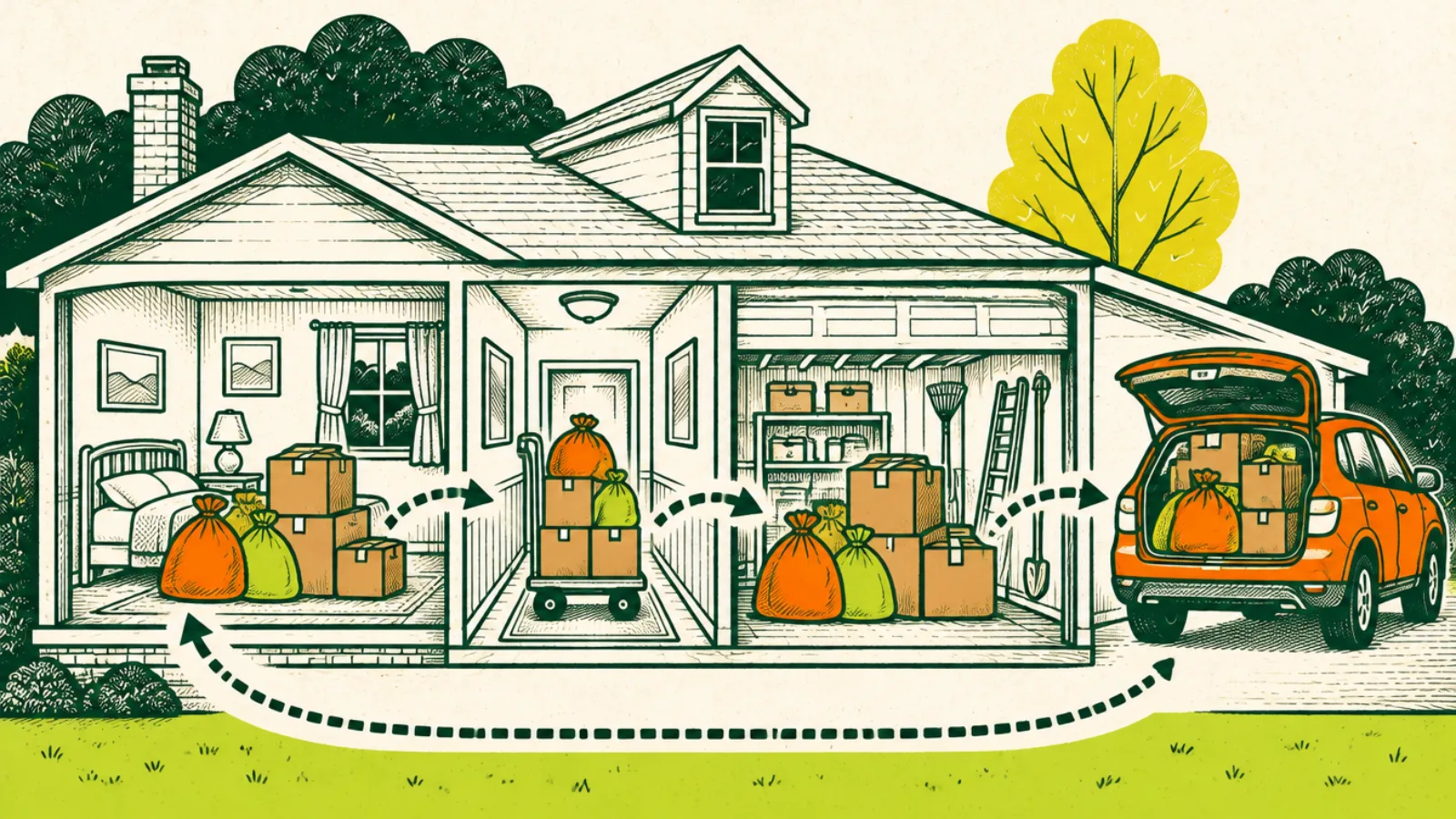
Short answer: decluttering isn’t finished when the stuff is sorted. It’s finished when the stuff is gone. Before you start, give every pile a real destination, a named place it’s going and a day it leaves, and only sort as much as you can move out that week. That’s the difference between a cleared room and the same piles sitting in the hallway.
In Prince George’s County or DC? The county and the District both keep reuse and donation lists, and Kalm Kode has local guides for couches, mattresses, TVs, cooking oil and bulky trash (links below).
Last checked November 10, 2026, against EPA, IRS, Prince George’s County, Reuse DC and DC DPW sources (listed at the bottom). Kalm Kode is an independent guide. Each donation center, buyer and trash service sets its own rules for what it takes.
The 30-second version
- Plan the exits first. Before you open a closet, know where donations, sales, recycling and trash are going, and when.
- One zone at a time. A drawer, a shelf, a closet. Not “the house.”
- Five bins, no maybe pile. Keep, sell, give, special drop-off, trash. Anything else is a pile that comes back.
- Every bin gets a destination and a date. “Donate” isn’t a destination. “The thrift store on Route 1, Saturday morning” is.
- Only sort what you can move this week. If the bags will sit in the car for a month, sort less.
- Close the loop. It’s done when the car is empty, the listing is sold or pulled, and the special items are dropped off.
Why the piles keep coming back
Most decluttering advice is about deciding what to keep. That part matters, but it’s not where most people get stuck. They get stuck after the decision.
You’ve probably seen it, or lived it. A Saturday purge fills six bags. Two go out with the trash. The other four move to the hallway, then the garage, then the trunk of the car. The box of cables waits for “the electronics place.” The old lamp waits for someone on Marketplace who never shows. A month later, half of it has drifted back into closets.
That isn’t a willpower problem. It’s a logistics problem. Each item that leaves your home needs three things:
- A place to go. A specific store, buyer, person, pickup or drop-off site.
- A way to get there. Your car, a pickup, the curb, the mail.
- A day. Without one, “later” wins.
When any of the three is missing, the item stalls. So this guide treats decluttering as two jobs: deciding, and exiting. You plan the second job before you start the first.
The rule: nothing gets sorted without an exit
Here’s the whole method in one sentence: don’t pull something out to get rid of it until you know where it’s going and when.
That sounds slow. It’s actually faster, because you stop making piles you have to handle twice. It also changes how much you take on. If you know you can make one donation run and one trash day this week, sort for that, not for the entire house.
A destination is specific:
- Not a destination: “donate,” “sell,” “recycle,” “give to someone.”
- A destination: “the donation drop-off near work, Thursday after 5,” “list on Marketplace tonight, free by Sunday if no buyer,” “bulky pickup on trash day,” “my sister, when she visits on the 22nd.”
Write each one down before you start. A note on your phone is enough.

Step 1: Pick one zone and a time box
Start smaller than you think. A single drawer, one shelf of the closet, the cabinet under the sink, the floor of the coat closet. Small zones finish, and finished zones keep you going.
Set a time limit. Thirty to sixty minutes works for most people. When the time is up, you stop sorting and start exiting, even if the zone isn’t done. A half-done drawer is fine. Four overflowing bags with nowhere to go is not.
Good first zones:
- The bathroom cabinet. Lots of quick trash decisions, few emotional ones.
- The coat closet. Easy to see what nobody wears.
- The kitchen junk drawer. Small, fast and satisfying.
- The entryway. The spot that makes the whole house feel messy.
Save the hard zones, like photos, letters, a family member’s things or the garage, for after you’ve got the routine down.
Step 2: Set up five bins
Grab five bags, boxes or laundry baskets. Five, not three, because “get rid of it” is really four different routes, and mixing them is how piles stall.
- Keep. It stays, and it goes back where it belongs today. If it belongs in another room, it goes there at the end of the session, not into a “put away later” pile.
- Sell. Only things worth the time to list. Be strict: if it wouldn’t sell for enough to make the photos, messages and pickup worth it, it’s a give item.
- Give. Donations and things for specific people. Clean, working, ready to use.
- Special drop-off. Electronics, batteries, paint, chemicals, cooking oil, light bulbs, mattresses, bulky items. These need their own route, so they get their own bin.
- Trash. Broken, worn out, expired or unusable, and not accepted anywhere else.
No “maybe” bin. If you truly can’t decide, put it in a box, tape it shut, write the date on it and store it out of the way. If you don’t open it in a set time, it goes to the give bin without reopening.

Step 3: Decide fast with three questions
For each item, ask:
- Do I use it, or do I just keep it? Used in the last year, or for a real upcoming need, is a keep. Kept “just in case” is usually not.
- Would I buy it again today? If not, it’s probably not earning its space.
- Does someone else need it more than I do? If yes, it’s a give or sell item.
Move quickly. The first answer that comes to mind is usually right. Hesitating over one item for five minutes is how sessions end with nothing done.
For duplicates, keep the best one or two and let the rest go. Most homes have more mugs, cables, water bottles, tote bags and spatulas than anyone uses.
Step 4: Give every bin a destination
Before your session, fill this in. If you can’t fill in a line, shrink that bin or skip that category this week.
- Sell: where you’ll list, when you’ll post, and the date it becomes free or a donation if it doesn’t sell.
- Give: which store or charity, its hours, and whether it takes the item type. Or which person, and when they’ll pick it up.
- Special drop-off: which site or event takes it, the date, and whether you need proof of residency.
- Trash: your trash day, your bulky trash rules, and any item limits.
Call or check the website before you load the car. Donation centers don’t all take the same things, and rules change. For example, Prince George’s County’s reuse page notes that Goodwill locations there stopped accepting furniture and bulky items in December 2021. That’s the kind of detail that turns a donation run into a wasted trip.
Step 5: Put the exits on your calendar
This step is the one most people skip, and it’s the one that matters most.
Add each exit as a real appointment:
- Donation run: a day and time, ideally on your way somewhere you already go.
- Selling deadline: the day unsold items move to the give bin.
- Trash day: when the trash bags and any bulky items go out.
- Special drop-off: the date of the event or the day you’ll drive to the site.
- Pickup for a friend: a confirmed date, or it goes to donation.
Load the car the night before a donation run, and put the bags in the front seat if you have to. Things in the trunk get forgotten.

Where common things actually go
Here’s a quick map for the categories that clog up most decluttering sessions. Rules vary by place, so treat this as where to look first.
- Clothing and shoes. Donate clean, wearable pieces. Worn-out textiles are a tougher sell. EPA estimates the US generated about 17 million tons of textiles in 2018 and landfilled about 11.3 million tons of it, so clean, wearable donations are the better path when you have the choice. Some stores and programs collect worn textiles for recycling; check before you bring stained or torn items.
- Furniture. Sell, give away or donate if it’s in good shape; bulk pickup or a hauler if it isn’t. See How to Get Rid of a Couch for the full decision path.
- Mattresses. Many donation centers won’t take them. Check your trash service’s rules. PG County residents can see PG County mattress pickup.
- Electronics. EPA says to delete all personal information from your electronics before you donate or recycle them, and to remove batteries that are user-removable, since they may need separate recycling. TVs have their own rules in many places; see PG County TV disposal.
- Batteries. EPA says to keep lithium-ion batteries and devices with them out of household garbage and recycling bins. Only take out batteries that are made to be removed by the user. For loose lithium-ion batteries, EPA says to tape the terminals or put each one in its own plastic bag to prevent fires, then keep them in a separate container until you can drop them off.
- Cooking oil and grease. Never down the drain. See How to Dispose of Cooking Oil.
- Paint, cleaners and chemicals. These go to household hazardous waste collection, not the trash bin, in most areas. Check your county or city.
- Books. Thrift stores, little free libraries, schools or a book bin. In PG County, the library system isn’t taking book donations right now, but it lists third-party donation bins at several branches.
- Kitchen items. Donate full sets and working small appliances. Chipped dishes and nonstick pans with peeling coating go in the trash.
- Paper. Recycle what you can. Shred anything with account numbers or personal details. DC DPW runs document shredding at its special waste events.
When you aren’t sure, Kalm Kode’s Can They Take This? checker covers common PG County items.

Donation rules worth knowing
Donation is the best home for good stuff, as long as it’s actually good stuff. A few rules save you a trip:
- Clean and working. Most centers want items ready to resell. If you wouldn’t give it to a friend, don’t give it to a store.
- Check what they take. Some stores don’t take furniture, mattresses, TVs, car seats or large appliances. Others do. It depends on the store.
- Check drop-off hours. Donation hours can be shorter than store hours.
- Get a receipt if you plan to deduct. The IRS says you can’t deduct clothing or household items unless they’re in good used condition or better. The one exception in IRS Publication 526: a single item that isn’t in good used condition can still be deducted if you claim more than $500 for it and include a qualified appraisal and a completed Form 8283, Section B.
- Bag by category. Clothes in one bag, kitchen in another. It makes drop-off faster and the staff’s job easier.
Selling without letting it take over your week
Selling can be worth it for furniture, tools, electronics in good shape, baby gear and name-brand items. It can also turn one Saturday into three weeks of messages.
Keep it simple:
- List everything in one sitting. Good photos in daylight, measurements and an honest description.
- Price to move. Look at similar listings nearby and price a little under them.
- Bundle small things. “Kitchen box, $15” sells better than ten listings for $2 each.
- Set a deadline. If it hasn’t sold by your date, it becomes a give item. No extensions.
- Make pickup easy. Put sold items by the door or on the porch so you’re not tied to the house.
If something isn’t worth listing, don’t list it. The time is the cost.

A worked example: one weekend, one apartment
Here’s how the method plays out for a typical two-bedroom apartment. It’s an illustration, not a client story, but every step is the same one you’d use.
Wednesday night, 15 minutes: plan the exits.
- Donation: a thrift store on the way to the grocery store, Saturday at 10. Checked the website: it takes clothes, housewares and small electronics, but not furniture.
- Selling: a dresser and a stand mixer go on Marketplace Thursday night. Free on Sunday if not sold.
- Special drop-off: old phones, cords and a box of batteries go to a drop-off the following Saturday. Phones get reset first.
- Trash: regular trash day is Monday. One broken bookshelf goes out as a bulky item.
Thursday night, 30 minutes: list the two sell items. Photos, measurements, prices. Done.
Friday night, 45 minutes: coat closet and entryway. Five bins out. Two bags of coats and shoes for donation, one bag of trash. The bags go straight into the front seat of the car.
Saturday morning, 90 minutes: kitchen and bathroom. Duplicates, expired items, a toaster nobody uses. One more donation bag. A small bin of batteries and an old phone go into the special drop-off box by the door. Donation run at 10.
Saturday afternoon, 60 minutes: bedroom closets. Two more bags of clothes. These can’t make today’s run, so they get a new date: next Saturday, along with the electronics.
Sunday: the dresser sold, the mixer didn’t. The mixer goes in the donation pile for next Saturday.
Monday: trash day. Bags and the broken bookshelf go out on time.
The result: four zones cleared, and nothing is sitting around without a date. The leftover bags already have a run on the calendar.

Your exit list
Copy this into your notes or print it before each session.
Before you start
- ☐ Zone picked: ________
- ☐ Time limit set: ________
- ☐ Donation place, hours and accepted items checked: ________
- ☐ Selling deadline: ________
- ☐ Special drop-off site and date: ________
- ☐ Trash day and bulky rules checked: ________
During the session
- ☐ Five bins out: keep, sell, give, special, trash
- ☐ Keep items put back today
- ☐ Electronics wiped or set aside to wipe
- ☐ Removable batteries pulled out, terminals taped or bagged
After the session
- ☐ Give bags in the car, front seat
- ☐ Sell items photographed and listed
- ☐ Special items boxed and labeled by type
- ☐ Trash out on the right day
- ☐ Every exit on the calendar
Done when
- ☐ Car is empty
- ☐ Unsold items donated by the deadline
- ☐ Special items dropped off
- ☐ No bags left in the hallway, garage or trunk
Keeping it from coming back
Decluttering once feels great. Keeping it clear is about small habits:
- A standing donation bag. Keep one in a closet. When something doesn’t fit or doesn’t get used, it goes in. When the bag is full, it goes on the calendar.
- One in, one out. New shoes in, old shoes out. Works especially well for clothes, mugs and kids’ toys.
- A monthly exit day. Pick one day a month for the donation run, special drop-offs and returns.
- A landing zone. A tray or hook by the door for keys, mail and bags, so the entryway doesn’t fill back up.
- Pause before you buy. Ask where it will live before it comes home.

In Prince George’s County, Maryland
- Reuse and donation list: the county’s Recycling/Reuse Alternatives page lists organizations that take items in good, working condition, including Community Forklift, GreenDrop/Purple Heart, Habitat for Humanity, the MD Recycles directory, MOM’s Organic Market (specific items only) and The Salvation Army. It notes that Goodwill there stopped taking furniture and bulky items in December 2021.
- Bulky trash: homes with county-contracted service can set out up to four bulky items next to the cart on trash day. See PG County bulky trash: do you need an appointment? and, if something gets left behind, bulky trash not picked up.
- Item guides: couches, mattresses, TVs and cooking oil.
- Not sure about an item? Try Can They Take This?
In Washington, DC
- Reuse DC: the District’s hub for finding where to repair, donate and shop secondhand, with a searchable directory, a page on donation pickup services and a way to exchange items with neighbors.
- Bulk trash: if DPW collects your trash, schedule bulk pickup through 311. DPW says appointments are usually available within 10 to 14 days, for up to seven items.
- Special waste: DPW collects household hazardous waste and electronics and offers document shredding at its special waste events. Registration is required and free: sign up for an arrival window, then bring your registration and proof of DC residency, like a driver’s license, utility bill or lease. DC residents only, and no entry after 2 p.m.
- Item guide: How to Get Rid of a Couch covers DC bulk pickup in detail.
Common mistakes
- Starting with the whole house. Big goals stall. Small zones finish.
- Sorting without exits. The bags have nowhere to go, so they move around the house.
- A “maybe” pile. It’s a keep pile in disguise.
- Mixing special items with donations. Batteries and chemicals in a donation bag mean a rejected bag.
- Listing everything for sale. Low-value items cost more time than they earn.
- No selling deadline. Unsold items stay forever.
- Leaving bags in the trunk. Out of sight is out of mind. Front seat, and a date.
FAQ
Where should I start decluttering?
Somewhere small and low-stakes, like a bathroom cabinet, the coat closet or a junk drawer. Quick wins build momentum. Leave sentimental items and the garage for later.
What do I do with stuff I can’t decide on?
Box it, seal it, write the date on it and put it away. If you don’t open it within a set time, donate it without reopening.
How do I stop the piles from coming back?
Plan the exits before you sort. Give every bin a specific destination and a date, put the dates on your calendar, and only sort what you can move out that week.
Where can I donate furniture?
It depends on the store. Some take furniture and some don’t. In Prince George’s County, the county notes that Goodwill there stopped accepting furniture and bulky items in December 2021. Check before you load the car, or see Kalm Kode’s couch guide.
Can I deduct donated clothes and household items?
The IRS says clothing and household items must be in good used condition or better to deduct. The exception is a single item claimed at more than $500, with a qualified appraisal and Form 8283, Section B. Other IRS rules still apply: you have to itemize to deduct, any single gift of $250 or more needs a written acknowledgment from the charity, and noncash gifts over $500 in total go on Form 8283. Get a receipt when you drop off.
What should I do before donating a phone or computer?
EPA says to delete all personal information from your electronics and to remove batteries that are user-removable, since they may need separate recycling. Follow the maker’s own reset instructions for your device.
Can I throw batteries in the trash?
EPA says to keep lithium-ion batteries, and devices that contain them, out of household garbage and recycling bins. Tape the terminals or bag each one separately, keep them in their own container and take them to a drop-off.
How long should a decluttering session be?
Thirty to sixty minutes is enough for most zones. When the time is up, stop sorting and handle the exits: load the car, post the listings and put the trash out on the right day.
Sources
Checked November 10, 2026:
- EPA: Textiles, material-specific data
- EPA: Electronics donation and recycling
- IRS Publication 526: Charitable contributions
- Prince George’s County: Recycling/Reuse Alternatives
- Prince George’s County: Bulky trash
- Reuse DC
- DC DPW: Bulk trash collection
- DC DPW: Household hazardous waste, e-cycling and document shredding