
Furniture Donation in DC & PG County: Pickup and Fees

A good couch, a solid dresser or a dining set you’ve outgrown can furnish someone else’s home. The hard part isn’t finding a charity. It’s finding one that takes your specific piece, comes to get it, and doesn’t surprise you with a fee or a “we can’t take that” at the door.
This guide sorts DC and Prince George’s County furniture donation options by how they actually work: free pickup, paid pickup and drop-off. It covers what organizations look for, what usually gets turned away, how to prepare a piece so it’s accepted, and what to do when no one will take it.
Pickup programs, fees and service areas change, sometimes quickly. Everything here was checked against each organization’s own site or a government page on November 12, 2026. Confirm the details before you schedule.
Short answer: Start with the District’s own list of donation pickup services, which includes A Wider Circle, Community Forklift, FurnishHopeDC, Goodwill, GreenDrop, Mary’s Center, the Salvation Army and Vietnam Veterans of America. FurnishHopeDC says it picks up furniture at no cost within 20 miles of DC. The Salvation Army offers free pickup that you book by ZIP code. A Wider Circle charges a pickup fee: $20 curbside or $50 in-home with at least two weeks’ notice, more for faster service, and drop-off at its Silver Spring center is free. Goodwill of Greater Washington offers a paid priority pickup through Resupply. In Prince George’s County, the county lists Community Forklift, Habitat for Humanity, the Salvation Army and GreenDrop/Purple Heart for furniture, and notes that Goodwill no longer takes furniture at its donation sites. If nobody will take it, use your collector’s bulky trash rules.

Before You Call Anyone: Is It Donatable?
Every organization in this guide has its own list, but they ask the same basic question: can they place or sell this piece without spending money to fix or dispose of it?
FurnishHopeDC puts it plainly: furniture “must be gently-used and stain-free, no obvious signs of wear and tear.” A Wider Circle asks for items that are “Gently-used,” “Clean & functional” and “Apartment-sized.” The Salvation Army asks that furniture be undamaged. Greenbelt’s city donation page describes the common standard as furniture without stains or tears.
Run through this quick check:
- Sturdy. No wobbly legs, broken frames, cracked tops or drawers that won’t open.
- Clean. No stains, pet hair, strong odors or smoke smell.
- Complete. All the shelves, knobs, legs, hardware and matching pieces.
- Pest-free. No sign of bed bugs, roaches or other pests. If you’ve had pests, don’t donate upholstered pieces or mattresses.
- Right-sized. Some organizations furnish apartments and can’t use oversized sectionals, armoires or very large dining sets.
- Safe. Not recalled, not missing safety parts.
If a piece fails one of these, it may still have a route. A repair may make a piece suitable, but cost and difficulty vary. Use the correct hardware or qualified help where needed, then ask the recipient whether the repaired piece meets its rules. If you’re not sure, ask the organization before you book. Most will tell you quickly if it’s a no.
Photograph it first
Several organizations ask for photos before they’ll schedule. A Wider Circle says pickup requests require photos of every furniture item. FurnishHopeDC asks donors to include their address and pictures when they email to schedule. Community Forklift accepts furniture and decor “on a case by case basis” and asks for photos.
Take clear photos in good light: the whole piece, the top and seat, any wear, and a tag or label if there is one. Note the measurements. Good photos save a wasted trip and help the organization say yes faster.
Option 1: Free Pickup
Free pickup is the most popular option, and it’s where most of the “they wouldn’t take it” stories come from. Free pickup usually depends on your location, the condition of the piece and whether the organization needs that item right now.
FurnishHopeDC
FurnishHopeDC says it picks up furniture from your home “providing you live within 20 miles of Washington, DC,” and that “there is no cost for pick-up.” It notes that drivers appreciate a tip.
What it says it accepts:
- Couches, living room chairs, end tables, coffee tables, TV stands and low bookcases
- Mattresses (no king size), toddler beds, cribs, dressers and night tables
- Dining tables and chairs that aren’t too large
- Household goods, including dinner plates, regular water glasses, pots and pans, silverware, small appliances like microwaves and toaster ovens, like-new towels, lamps and TVs from within the last five to eight years
What it says it can’t take: furniture made with glass, armoires and credenzas, wine or specialty glasses, and king-size mattresses.
To schedule, it asks you to email donatefurniture@furnishhopedc.org with your address and pictures of the items.
The Salvation Army
The Salvation Army’s donation site describes a “free furniture and other donation pickup service.” You enter your ZIP code, describe what you’re donating, pick a date and enter your address. You can also call 1-800-SA-TRUCK (1-800-728-7825).
Its listed furniture examples include beds, chairs, coffee tables, desks, end tables, dining room furniture, cabinets, mattresses and sofas, as long as they’re undamaged. Accepted items vary by location, and the site recommends calling to confirm what your local center takes. The City of Greenbelt’s donation page notes that the Salvation Army doesn’t pick up in the Greenbelt area, which is a reminder to check your ZIP code first.
Community Forklift
Community Forklift, a nonprofit reuse center for building materials, offers what it calls “a limited free donation pickup service for deconstruction projects, large volumes of materials, specialty items, and materials that are in high demand.” It accepts furniture and decor “on a case by case basis,” so send photos with your request.
Its process: fill out the online pickup request, and its Donations Coordinator says it will contact you within three to five business days. Pickups are scheduled one to three weeks after confirmation, based on location and on a first-come, first-served basis. If your donation doesn’t qualify for pickup, it may suggest dropping the items at its reuse warehouse.
Other organizations on DC’s pickup list
The District’s reuse program lists these donation pickup services that serve DC: A Wider Circle, Community Forklift, FurnishHopeDC, Goodwill, GreenDrop, Mary’s Center, the Salvation Army and Vietnam Veterans of America. The District notes the list is “not a comprehensive list” and “not an endorsement.”
GreenDrop, Mary’s Center and Vietnam Veterans of America each have their own pickup scheduling pages. Their accepted items differ, so check each one’s list before you book. GreenDrop’s own accepted-items list refers to small furniture; that is not a promise to collect a full-size sofa or dining set. The City of Greenbelt’s page, for example, says Vietnam Veterans of America takes wood or wicker furniture only, with no upholstered pieces.
Option 2: Paid Pickup
Paid pickup sounds backwards, but it often makes sense. You’re paying for speed, scheduling flexibility, carrying from inside your home, stairs, and sometimes disassembly. For a big piece on a tight moving timeline, it can be the difference between donating and dumping.
A Wider Circle
A Wider Circle, based in Silver Spring, furnishes homes for people moving out of poverty. Its donation page spells out pickup fees, which are non-refundable and collected when you schedule:
| Pickup type | Notice | Fee |
|---|---|---|
| Curbside, standard | 2+ weeks | $20 |
| In-home, standard | 2+ weeks | $50 |
| Priority, up to 5 items | Under 2 weeks | $250 |
| Priority, 6+ items | Under 2 weeks | $500 |
| Community group pickup | $250 |
A pickup qualifies if it includes at least one of its four most-requested items: a mattress or box spring, a sofa or upholstered chair, a dresser, or a dining table and/or four or more chairs. Otherwise, it needs at least three furniture pieces. Requests require photos of every item. Priority pickups depend on availability. For faster service at extra cost, it points to its partner Resupply, which it says offers 24 to 48 hour pickup.
Goodwill of Greater Washington
Goodwill of Greater Washington offers a priority donation pickup provided by Resupply. Its page says the service “charges a fee” and lists benefits including a priority pickup within 24 hours (not Sundays), pickup from multiple floors, furniture disassembly and removal of items Goodwill can’t accept. You get an estimate before you book.
Note the difference between this paid service and Goodwill’s donation sites. Prince George’s County’s reuse page says Goodwill no longer accepts furniture and bulky items at its locations, as of December 2021. Don’t bring furniture to a Goodwill drop-off expecting it to be accepted.
When paying makes sense
- You’re moving soon and free pickup is booked out for weeks.
- The piece is upstairs or hard to move, and free pickup is curbside only.
- You need the whole room cleared at once, including items a charity can’t take.
- You don’t have a vehicle big enough to drop it off yourself.
Ask what’s included before you pay: inside pickup or curbside, stairs, disassembly and what happens to items that aren’t accepted.
Option 3: Drop It Off Yourself
If you have a truck, a van or a friend with one, drop-off is usually free and gives you the most control. You see right away whether the item is accepted.
A Wider Circle’s Center for Community Service
A Wider Circle says drop-off is free with no appointment needed at its Center for Community Service, 9159 Brookville Road, Silver Spring, MD 20910. Its listed drop-off hours are Monday 9 to 5, Tuesday 9 to 4, Wednesday 9 to 5, Friday 9 to 5 and Saturday 9 to 5. It says, “We don’t accept drop-offs on Thursdays.” It’s closed Sundays.
Habitat for Humanity Metro Maryland: a nearby option serving PG County
Do not rely on an old directory listing for a Brentwood ReStore. Habitat for Humanity Metro Maryland’s current ReStore page and donation page list the Rockville ReStore at 515 Dover Road, Rockville, MD 20850. Rockville is outside Prince George’s County. The organization says its pickup area typically includes Montgomery and Prince George’s counties and lists its pickup coordinator at 301-926-4104.
Those pages list donation drop-offs Tuesday through Sunday, noon to 3 p.m., and residential pickups through ReSupply. Older directories can contain different location details. Confirm the current destination, donation hours and acceptance of your specific piece before loading a vehicle. Ask the pickup service for a fee quote; neither inclusion in a directory nor the word donation establishes free collection.
This is a different Habitat provider from the old Brentwood listing, not evidence that the old store moved to Rockville. Its own accepted-items guidance controls what it can take. Check the bed and dining-set restrictions rather than assuming every item on a county reuse list qualifies.
Community Forklift’s reuse warehouse
Community Forklift’s warehouse in Edmonston takes building materials and, case by case, furniture. If you’re clearing out a kitchen, a basement or a renovation along with furniture, it may be able to take more of the load than a furniture-only charity.
Drop-off tips
- Go during open hours. Don’t leave furniture outside a closed donation site. It gets rained on, damaged or dumped, and the organization pays to haul it away.
- Call ahead for big pieces. Space is limited, and some days are full.
- Bring help. Staff may not be able to unload heavy items for you.
- Bring the hardware. Tape a bag of screws, shelf pins and keys to the piece.
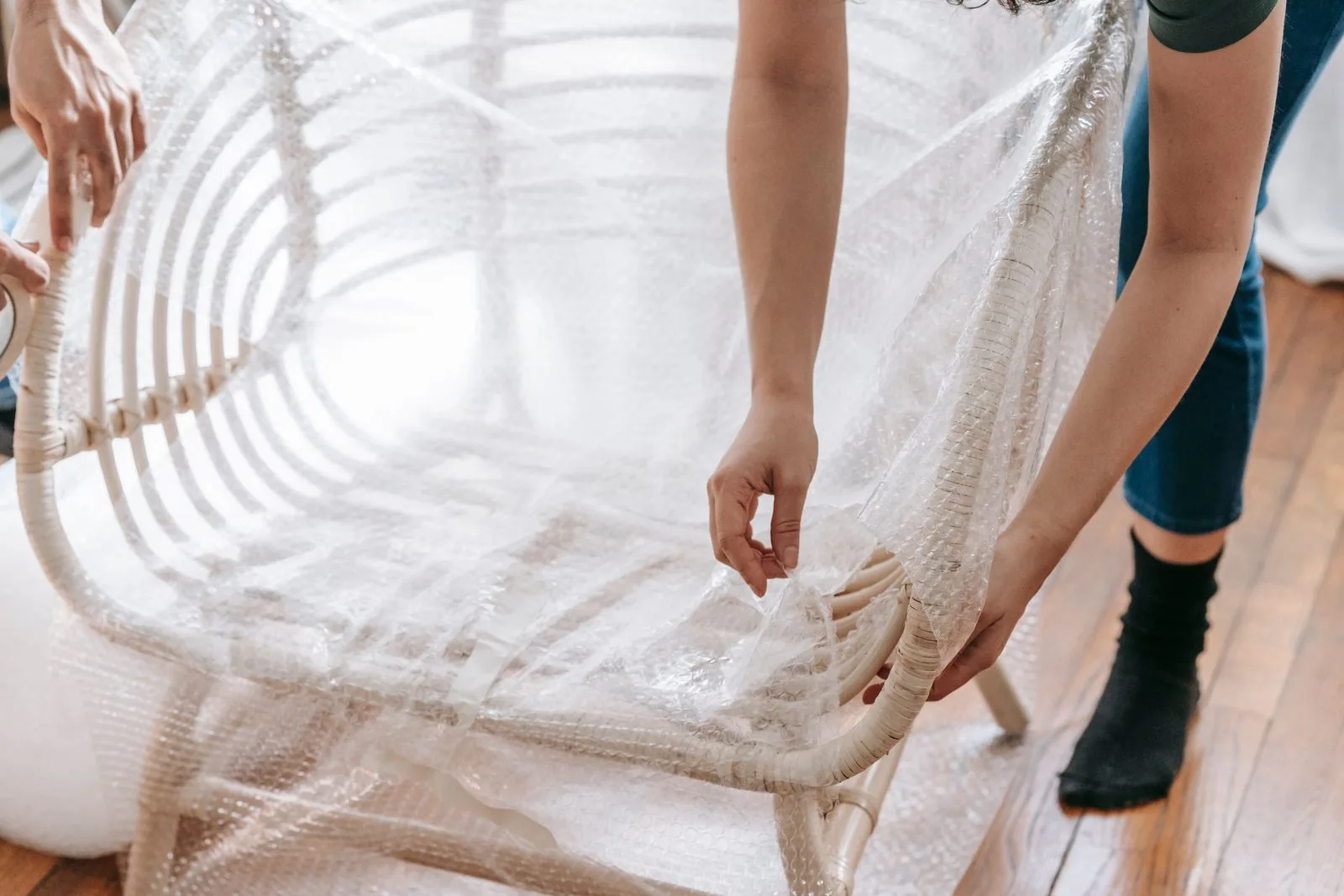
How to Prepare Furniture So It’s Accepted
A little prep makes a big difference. The goal is a piece someone could use the day it arrives.
- Empty it. Check every drawer, shelf and cushion. You’d be surprised what turns up: keys, papers, photos, cash.
- Clean it. Vacuum upholstery, wipe down wood and metal, and air out anything musty.
- Tighten it. Snug up loose screws and bolts. If a joint remains loose, stop and assess it properly rather than assuming tightening alone makes it safe.
- Gather the parts. Shelves, legs, knobs, cushions and hardware stay with the piece.
- Disassemble only if asked. Some organizations want beds and tables broken down; others don’t. Ask.
- Measure doors and halls. Make sure the piece can get out without damaging it or your walls.
- Have it ready. If it’s curbside pickup, set it out when the organization tells you to, not days early in the rain.
A note on mattresses
Mattresses are one of the hardest items to donate. Some organizations take them, often with conditions. FurnishHopeDC takes mattresses but not king size. A Wider Circle counts a mattress or box spring among its four most-requested items. Many others won’t take them at all. Never donate a mattress that’s stained, sagging or has had pests. Our mattress pickup guide covers disposal if it can’t be donated.
A note on cribs and baby furniture
The US Consumer Product Safety Commission advises that “a consumer should not resell, donate or give away a crib that does not meet the new crib standards.” Its guidance, from when the federal crib standard took effect in June 2011, gives “donating to a local thrift store” as an example of what not to do with an older crib. Check recalls at cpsc.gov before passing on any baby gear, and confirm the organization accepts it. FurnishHopeDC lists cribs and toddler beds among accepted items.

Receipts and Tax Deductions
If you itemize deductions, ask the organization for a donation receipt when it picks up or accepts your furniture. FurnishHopeDC, for example, says it’s a 501(c)(3) and that donations are tax deductible.
Goodwill of Greater Washington’s pickup page notes that federal law lets donors claim deductions for donated clothing and household items in good used condition or better, and that the IRS requires donors to value their own items. It also says that if a donation may be worth more than $5,000 and you plan to claim a deduction, you may need the organization to complete certain tax forms, so call first. For anything beyond a simple receipt, check IRS guidance or ask a tax professional. Keep your photos with the receipt; they’re a handy record of the condition you donated in.
What to Do When Nobody Will Take It
Some furniture has simply reached the end of its useful life. That’s fine. The goal is to get it to the right place, not to force it on a charity.
Give it away free first
A piece that a charity can’t use might still be perfect for a neighbor: a student, a first apartment or someone who likes to refinish furniture. The District’s reuse program has an Exchange With Neighbors page with ideas for giving items to people nearby. Free listings on neighborhood apps and community groups work too. Describe the piece honestly, include photos and agree on a pickup time.
Use bulky trash correctly
In DC: The Department of Public Works collects bulk items by appointment for households that get DPW trash service, which includes single-family homes and buildings with three or fewer units. Apartment buildings with four or more units, condos, co-ops and commercial properties have to use a private licensed hauler. You book by calling 311, at 311.dc.gov or through the app. DPW says appointments are “usually available within 10 to 14 days of your call,” with up to seven items per appointment. Household furniture, rugs (rolled and tied) and mattresses and box springs (wrapped in plastic) are accepted. Set items out no earlier than 6:30 pm the night before and no later than 6 am on collection day, where your trash and recycling are collected. Items left in public space at other times can get a ticket.
In Prince George’s County: The rules depend on who collects your trash. If your home gets county-contracted collection, many bulky items like furniture can go out on your regular trash day without an appointment, within the county’s limits, while appliances and some other items need a PGC311 appointment. If a city, HOA, apartment complex or private hauler collects your trash, their rules apply. Our guide to whether you need an appointment for bulky trash walks through it, and the Can They Take This? tool covers common items.
Prince George’s County also runs a Comprehensive Community Cleanup Program in some unincorporated communities, with bulky trash collection during a scheduled two-week cleanup. If your community is scheduled, the county says you’ll get a flyer from your civic or homeowners association or see it in your newsletter.
A Worked Example
Here’s a hypothetical. Say you’re moving out of a two-bedroom apartment in DC in five weeks. You have a sofa in good shape, a dresser, a queen bed frame, a glass-top coffee table, a desk with a broken drawer and a stained recliner.
- Week one: photos and requests. You photograph everything, measure the big pieces and send requests to two free pickup services that serve your ZIP code.
- Sort by likely answer. The sofa, dresser and bed frame are strong candidates. The glass-top table won’t work for organizations that say no glass furniture. The stained recliner probably won’t be accepted anywhere.
- Fix what’s easy. You assess the desk, repair the runner using an appropriate method and check its stability. You disclose that repair and ask whether the recipient will accept it.
- Book the pickup. One service confirms the sofa, dresser, bed frame and desk for a date two weeks before your move.
- List the rest. You post the glass-top table on a neighborhood free group. Someone picks it up that weekend.
- Dispose correctly. The recliner goes out through your building’s bulk trash process, because you’re in a large apartment building that uses a private hauler, not DPW.
In this example, five of six pieces found a new home. The one that didn’t went out the right way.
Common Mistakes
Waiting until moving week. Free pickups book up, and paid pickups get expensive when you need them fast. Start four to six weeks out.
Assuming every charity takes furniture. Goodwill’s donation sites don’t take furniture in our area, according to Prince George’s County. Check each organization’s list.
Skipping photos. Many organizations need photos to approve a pickup. Without them, your request sits.
Donating broken or stained pieces. Charities pay to dispose of what they can’t use. If it isn’t something you’d give to a friend, find another route.
Leaving items at a closed site. It’s not a donation if it sits outside in the rain. Drop off during open hours.
Forgetting what’s inside. Check every drawer and cushion before the truck arrives.
Why It Matters
Furniture is heavy, bulky and hard to recycle. When a solid piece goes to the curb, it takes up landfill space and someone else ends up buying new. When it goes to a family setting up a home, it does a job twice.
Organizations like A Wider Circle and FurnishHopeDC exist because many people move into homes with almost nothing: no bed, no table, no chair. A dresser you no longer need can be the first piece of furniture in someone’s new start.
That’s the Earth Care idea in practice. Keep good things in use, and help a neighbor while you’re at it.
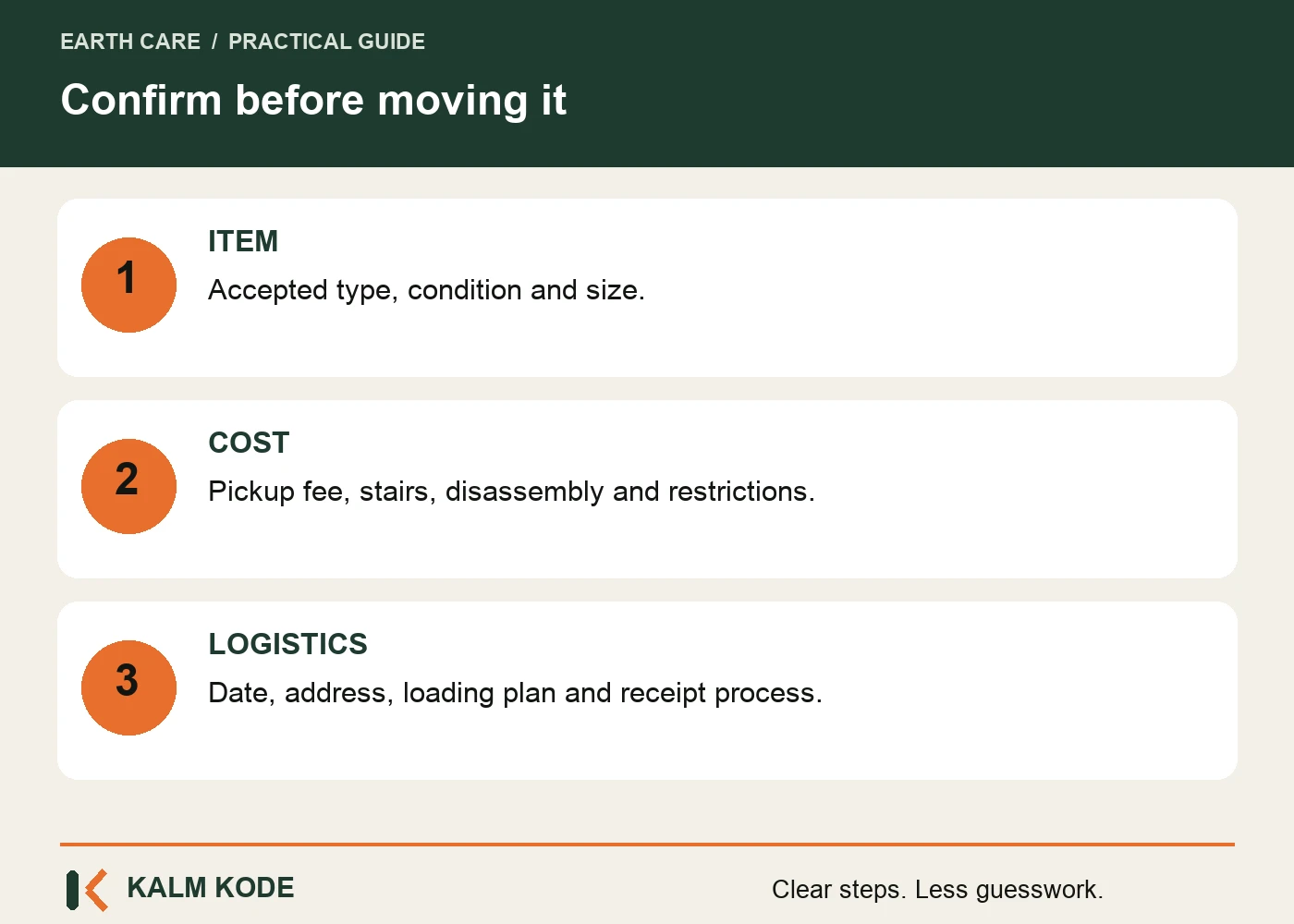
Quick Reference
| Organization | Route | What it says about furniture | Notes |
|---|---|---|---|
| FurnishHopeDC | Free pickup | Gently used, stain-free; no glass, armoires or credenzas; no king mattresses | Within 20 miles of DC; email photos and address |
| Salvation Army | Free pickup | Undamaged furniture | Book by ZIP code or 1-800-SA-TRUCK; varies by location |
| Community Forklift | Limited free pickup or drop-off | Furniture case by case | Reply in 3–5 business days; pickup 1–3 weeks out |
| A Wider Circle | Paid pickup or free drop-off | Gently used, clean, apartment-sized | $20 curbside / $50 in-home with 2+ weeks’ notice; no Thursday drop-off |
| Goodwill of Greater Washington | Paid priority pickup | Through Resupply | Donation sites no longer take furniture, per PG County |
| Habitat Metro Maryland | Rockville drop-off; ReSupply pickup inquiry | Check its current accepted-items list | Nearby provider serving PG; confirm location, acceptance and fee quote |
| DC DPW bulk | Disposal | Furniture, mattresses (wrapped), rugs (tied) | Eligible homes only; 311 appointment |
This guide is part of Earth Care & Community Help, where Kalm Kode helps neighbors keep good things in use. See also Before You Throw It Away and how to get rid of a couch.
A decision you can make before booking
Put the recipient’s acceptance decision ahead of the transport decision. A paid hauler may be able to remove an item that a charity cannot use, but removal and donation are different outcomes. Ask which destination is planned for each piece and what happens if it is rejected. Keep the quote and acceptance message together so everyone handling the pickup has the same instructions.
For an apartment pickup, confirm access with your building as well as the collector. Ask about loading areas, elevators, scheduled move windows and whether an appointment must be recorded with management. Do not assume a collection booking reserves those facilities. Clear the route without blocking a shared hallway or emergency exit. If the provider requires the furniture at curbside, arrange safe help rather than trying to move a heavy piece alone.
About this guide
Written and edited for Kalm Kode by King. This is a practical guide compiled from the linked public sources, not a claim that Kalm Kode operates these programs or has a partnership with them. Provider rules can change; use the official contact or event page to confirm the details for your own item, address or visit.
Frequently asked questions
Who picks up donated furniture for free in DC?
DC’s reuse program lists several donation pickup services. FurnishHopeDC says it picks up at no cost within 20 miles of DC, and the Salvation Army offers free pickup booked by ZIP code. Community Forklift offers limited free pickup, with furniture considered case by case. Each has condition rules and service areas.
Does Goodwill take furniture in Prince George’s County?
Prince George’s County says Goodwill no longer accepts furniture and bulky items at its donation sites, as of December 2021. Goodwill of Greater Washington offers a paid priority pickup through Resupply.
How much does A Wider Circle charge for furniture pickup?
Its page lists $20 for curbside and $50 for in-home pickup with at least two weeks’ notice, $250 or $500 for priority pickup with less notice, and $250 for community group pickups. Drop-off at its Silver Spring center is free.
Can I donate a mattress?
Sometimes. FurnishHopeDC accepts mattresses but not king size, and A Wider Circle lists a mattress or box spring among its most-requested items. Many organizations don’t take mattresses. Never donate one that’s stained or has had pests.
What if no charity will take my furniture?
Try a free listing for neighbors first. If it’s truly done, use your collector’s bulky trash rules: DC DPW appointments through 311 for eligible homes, or your Prince George’s County collector’s rules.
Does a directory listing guarantee that an organization takes my sofa?
No. Directories identify possible routes, not an acceptance decision. Check the recipient’s current list and submit photos, dimensions and your address or ZIP code as requested.
Is the Rockville Habitat ReStore in Prince George’s County?
No. Habitat Metro Maryland lists a Rockville store and says its pickup area typically includes Prince George’s County. Confirm the current address, hours, accepted items and pickup quote directly; do not substitute it for the old Brentwood listing.
Should I leave furniture outside a closed donation site?
No. Use the agreed appointment or donation hours. Leaving items outside exposes them to weather and may create a disposal problem for the organization.
Sources
- Donation Pick-Up Services (DC reuse program)
- FurnishHopeDC: Donors
- The Salvation Army: donation pickup
- Community Forklift: Request a Donation Pickup
- A Wider Circle: Donate items
- Goodwill of Greater Washington: Schedule a Pickup
- Recycling/Reuse Alternatives (Prince George’s County)
- Donation Opportunities (City of Greenbelt)
- Bulk Trash Collection (DC Department of Public Works)
- Comprehensive Community Cleanup Program (Prince George’s County)
- The New Crib Standard: Questions and Answers (US Consumer Product Safety Commission)