
Flying With a Pet From BWI, DCA or Dulles

Short answer: book your pet with the airline that actually operates the flight, as early as you can, because in-cabin pet spots are limited per flight. Get a carrier that fits that airline’s size limit and slides under the seat. At security, take your pet out of the carrier, send the empty carrier through the X-ray, and carry your pet through the metal detector. Then find the pet relief area before you board. BWI, Reagan National and Dulles all have them, before and after security.
Flying from somewhere else? The airline steps and TSA steps work at any US airport. Only the relief-area locations below are specific to BWI, DCA and Dulles.
Last checked November 10, 2026, against the three airports’ own pages, TSA, the US Department of Transportation, USDA APHIS, the CDC and the pet pages of American, Delta, United and Southwest (listed at the bottom). Kalm Kode is an independent guide. Your airline has the final word on your pet’s booking. For a quick lookup, use the Pet Travel Check.
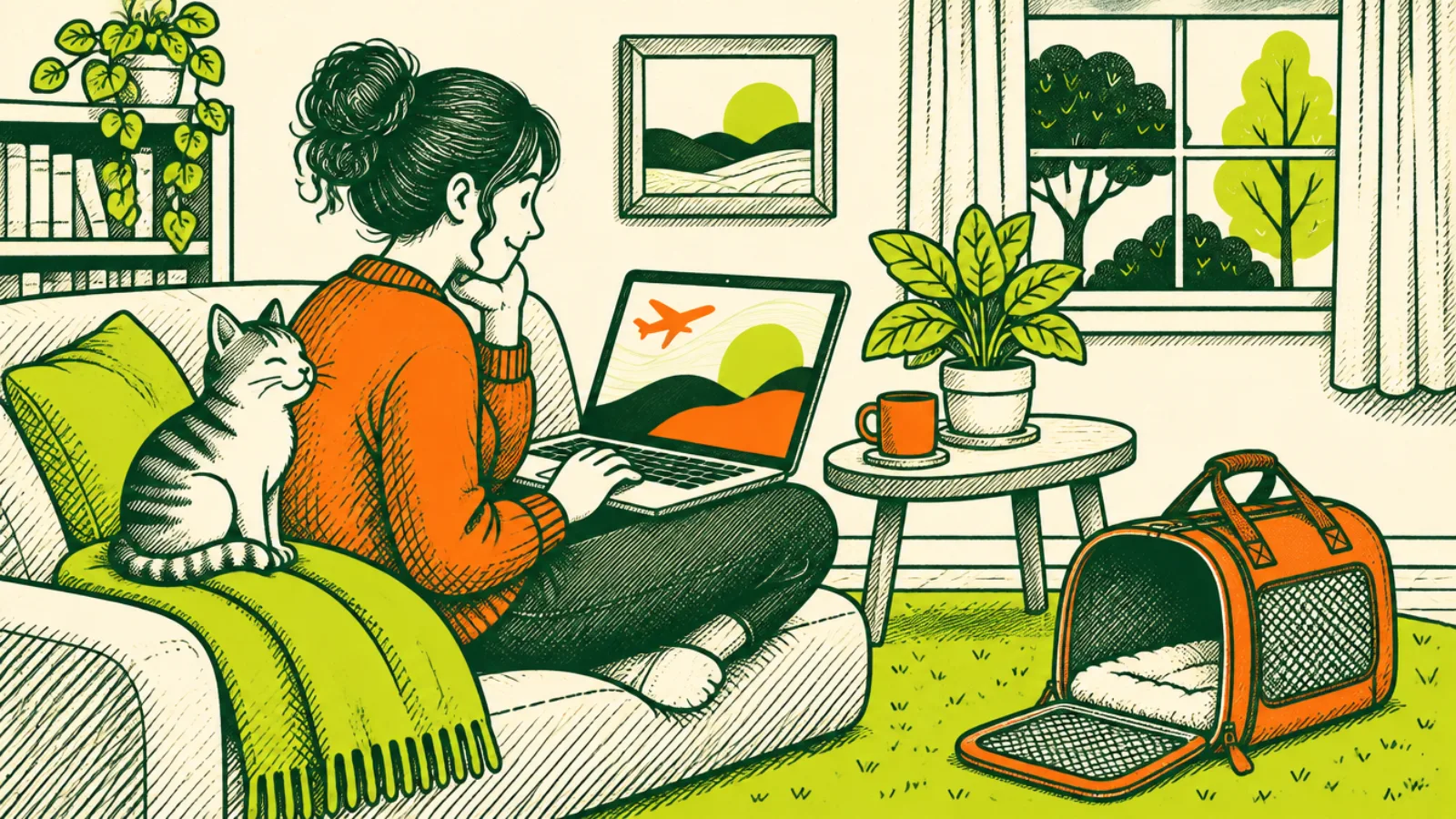
The 30-second version
- Book the pet, not just the seat. Add your pet to the reservation as soon as you book. Airlines cap the number of pets per flight.
- Go by the operating airline. If one airline sells the ticket and another flies the plane, the one flying the plane usually sets the pet rules. Check the flight details.
- Measure the carrier. It has to meet the airline’s size limit and fit under the seat in front of you. Soft-sided carriers fit more easily.
- Expect a fee each way. As of November 10, 2026, American, Delta and United list $150 each way for a domestic in-cabin pet, and Southwest lists $125 per carrier, one way, on the US mainland.
- At TSA, never X-ray your pet. Empty carrier on the belt, pet in your arms or on a leash through the metal detector.
- Use the relief area. Each airport lists relief areas before and after security. Go right before you board.
Step 1: Pick the flight around your pet
Start with the flight, because it decides almost everything else.
- Nonstop if you can. Fewer connections mean fewer chances for a missed pet spot, a long layover or a change of aircraft with a smaller under-seat space.
- Find the operating airline. Codeshare tickets are common. A flight sold by one airline may be “operated by” another, including a regional partner. Pet rules, fees and carrier sizes follow the operating airline in most cases. If the flight details say “operated by,” read that airline’s pet page, then confirm with the airline that sold your ticket.
- Check the aircraft. Some planes have less space under the seats. United, for example, says it allows only one pet per person on several aircraft types because of limited space under the middle seat.
- Book early. Delta says pets are booked first-come, first-served, with a limit per flight. The same idea applies on most airlines.
If you’re choosing between BWI, DCA and Dulles, look at where the airline you want flies from, then compare nonstop options. A nonstop from a farther airport can be easier on your pet than a connection from a closer one.
Step 2: Read the operating airline’s pet rules
Pet policies change, so go to the airline’s own page before you book. Here’s what four big US airlines list right now for a cat or dog in the cabin.
- American Airlines. $150 per kennel, each way, within and between the US, Canada, Mexico, Central America and the Caribbean. Recommended soft-sided carrier: 18 x 11 x 11 inches (length x width x height). Hard-sided limits: 19 x 13 x 9 inches on American mainline flights, 16 x 12 x 8 inches on American Eagle flights. Pets must be at least 8 weeks old for travel within the US and Puerto Rico. You add the pet to your trip online or in the app, and you pay at the American ticket counter.
- Delta. $150 each way for domestic tickets issued on or after April 8, 2025, and 200 each way for international travel (Delta lists it as USD, CAD or EUR). Delta recommends a soft-sided kennel up to 18 x 11 x 11 inches (length x width x height), notes that the real limit depends on the aircraft, and asks you to book your pet through Delta Reservations with the kennel’s measurements ready. Pets must be at least 8 weeks old for domestic travel.
- United. $150 each way, cats and dogs only, in the cabin. Hard-sided carriers up to 17.5 x 12 x 9 inches and soft-sided up to 18 x 11 x 11 inches (length x width x height). On a Boeing 737 MAX, United says the carrier can be no more than 10 inches tall. Up to two pets per person on most flights, but you buy a second seat for the second pet. You add the pet with “Travel with a pet” when booking on united.com, or in My Trips. United says you can’t add a pet in the United app, and for international trips you have to call to add a pet.
- Southwest. Its optional charges page lists a one-way pet charge of $125 per pet carrier on the US mainland and $35 between the Hawaiian Islands, paid at the ticket counter. Carriers can be up to 18 x 10.5 x 10 inches (length x width x height), or Southwest’s own 15 x 10 x 10-inch carrier. Pet reservations can’t be booked online: call Southwest to book your pet. Small cats and dogs only, at least 8 weeks old, on domestic flights, and no pets in cargo.
Flying another airline? Look for its “traveling with pets” page and find the same five things: fee, carrier size, age minimum, how many pets per flight, and how to add the pet to your booking.

Step 3: Measure the carrier and the pet
The carrier is where most pet trips go wrong. Measure before you buy, and again before you leave.
- Match the airline’s limit. Use the smallest limit if your trip uses more than one airline or aircraft type.
- Choose soft-sided if you can. American and Delta both recommend soft-sided carriers, and they squeeze under seats more easily.
- Check the fit under a seat. The carrier has to slide all the way under the seat in front of you and stay there for the flight. United says the carrier must be ventilated and fit under the seat or you can’t fly with your pet.
- Make sure your pet fits too. Your pet should be able to stand and turn around comfortably. A carrier that meets the size limit but cramps your pet is the wrong carrier.
- Practice at home. TSA suggests getting your pet used to the carrier in the days before the trip. Leave it open in the living room with a blanket and treats inside.
Write the carrier’s length, width and height on a note in your phone. Delta asks for them when you book, and other airlines may ask at the counter.

Step 4: Add your pet to the reservation
Don’t just show up with a carrier. Each airline has its own way to add a pet:
- American: open your trip online or in the app, go to Additional Services and choose “Add carry-on pets.” Pay the fee at the ticket counter.
- Delta: contact Delta Reservations as soon as possible with your kennel measurements.
- United: select “Travel with a pet” while booking on united.com, or add it in My Trips. Not in the app. International trips: call United.
- Southwest: call Southwest to book your pet. Pet reservations can’t be made online.
- Other airlines: follow the steps on the airline’s pet page.
When it’s done, look for the pet on your confirmation or in your trip details. If you don’t see it, call before you travel.
Service dogs are a different category
Pets and service animals follow different rules. Under the US Department of Transportation’s rules, a service animal is a dog individually trained to do work or perform tasks for a person with a disability. DOT says emotional support animals, comfort animals and service animals in training are not service animals.
What that means in practice:
- Airlines must recognize service dogs. Other species and emotional support animals are handled as pets, if the airline accepts them.
- Airlines may require DOT forms. One attests to the dog’s health, behavior and training. A second, for flights of 8 hours or more, covers whether the dog can relieve itself in a sanitary way.
- Where the dog rides. DOT says a service animal must be allowed in the space under the seat in front of you, and some small service animals may sit on your lap if it can be done safely.
At the airport, ask an airport or airline employee where the nearest service animal relief area is. The relief areas listed below serve service animals and pets alike.

Bigger pets and cargo
If your pet won’t fit under a seat, your options are narrower than they used to be.
- United says it no longer accepts pets through its PetSafe program, and pets can fly in cargo only with certain active-duty military or State Department employees.
- American accepts checked pets only for active-duty US military and US State Department Foreign Service personnel on official orders. Other pets that don’t qualify for the cabin can ship through American Airlines Cargo’s PetEmbark service, with fees that vary by trip.
- Delta has a separate page on shipping pets.
If cargo is your only option, start early and talk to the airline’s cargo team directly. Driving may also be worth comparing for trips within a day’s reach.
Flying internationally with a pet
International pet travel is mostly paperwork, and it takes time.
- Your destination sets the rules. USDA APHIS says a USDA-accredited veterinarian can help you figure out your destination country’s pet entry requirements and get a USDA-endorsed health certificate if you need one. APHIS says to contact a vet as soon as you decide to travel.
- Coming back to the US with a dog. The CDC is the main authority for dogs entering or returning to the US. Its requirements depend on where the dog was vaccinated and which countries it has been in during the 6 months before arrival. Use CDC’s Dog Importation Navigator before you book.
- Airline extras. United notes that dogs flying into Mexico need a New World Screwworm inspection certificate, signed by a USDA-accredited veterinarian no more than 5 days before travel. Rules like this change, so check them close to your trip.

Airport day: check-in
Give yourself extra time. A pet adds a stop at check-in and a slower trip through security.
- American: pay the pet fee at the ticket counter. American says the counter takes credit cards and paper vouchers, not cash or checks, and staff check that your pet and kennel meet the requirements.
- United: check in for a domestic flight at a kiosk with your confirmation number, and it prints a tag for the carrier.
- Delta: the fee is collected each way at check-in.
- Everyone: have your confirmation, the carrier measurements and any vaccination or health paperwork your trip needs.
Pack a small pet kit in your personal item: a leash, a collapsible water bowl, waste bags, a few treats, a familiar blanket and puppy pads for the carrier.
Getting through TSA with a pet
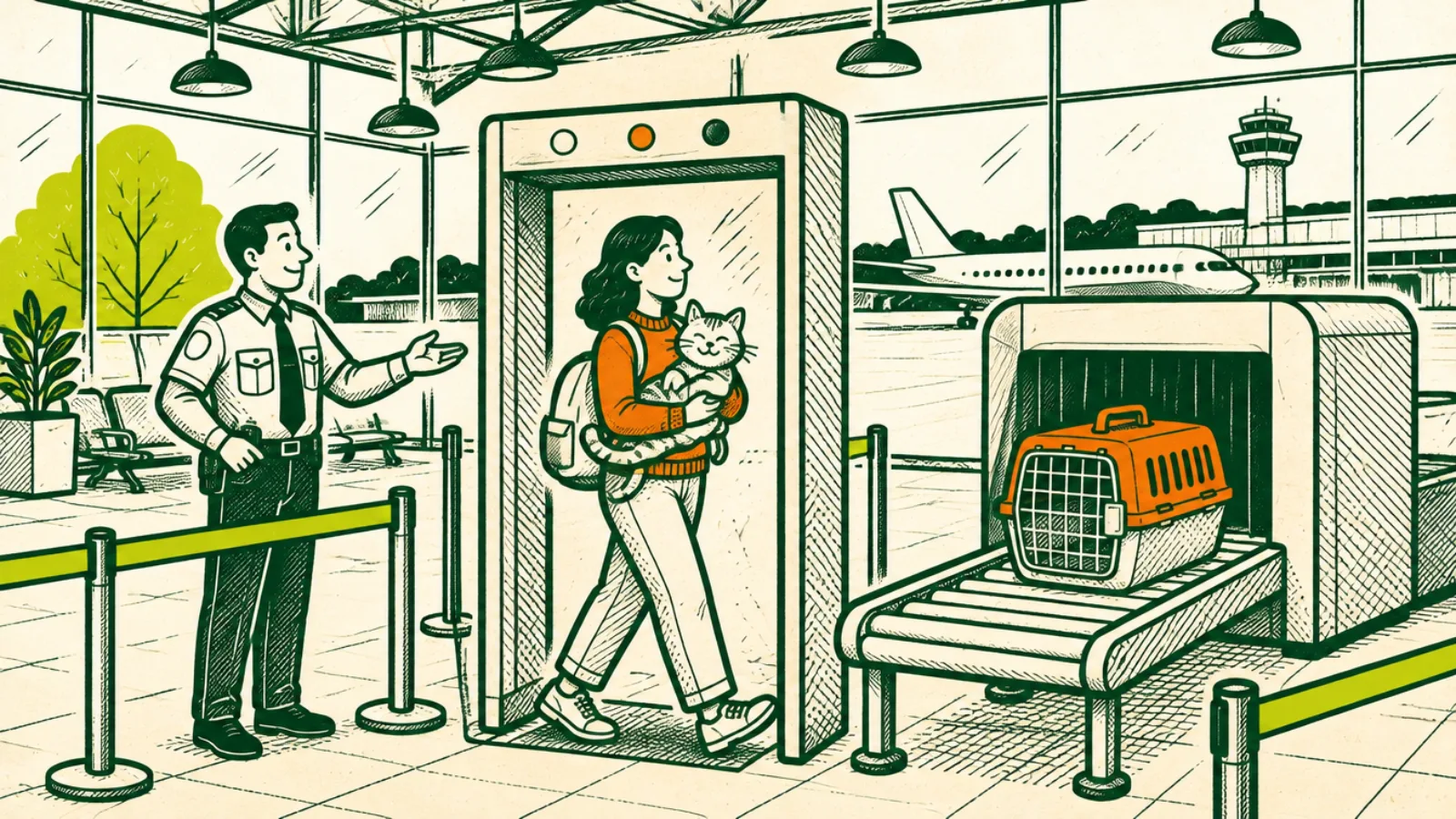
TSA’s steps, from its pet-screening guidance at Dulles, are the same at every checkpoint:
- Bring your pet to the checkpoint in a hand-held carrier.
- Take your pet out of the carrier just before screening starts.
- Put the empty carrier on the belt so it can be X-rayed.
- Never put your pet in the X-ray tunnel. The X-ray is for bags only.
- Carry your pet through the metal detector, or walk it through on a leash. Follow the officer’s directions.
- Expect a hand swab. An officer may swab your hands to check for explosive residue.
- Put your pet back in the carrier at the re-composure area, away from the checkpoint.
TSA adds two tips: know your pet’s temperament, especially cats that get skittish out of the carrier, and give working airport dogs space. If you see a working canine at a checkpoint, consider using a different lane.
Pet relief areas at BWI
BWI lists four animal relief areas, two on each side of security.
Before security
- Near Concourse E: on the lower level outside door #19, near the international terminal and next to the Light Rail station.
- In front of the Hourly Garage: reach it from Concourses B, C or D by skywalk, elevator or tunnel to Level 3, then follow the paver path.
After security
- Concourse C: at the beginning of the concourse.
- Concourse D/E connector: just past the Concourse D/E security checkpoint.
Pet relief areas at Reagan National (DCA)
Reagan National lists eight pet relief areas.
Before security
- Next to the North Metrorail Station entrance.
- Next to the South Metrorail Station entrance.
- At the north end of the Gates A1–A9 terminal roadway curb.
- At the south end of the Gates A1–A9 terminal roadway curb.
After security
- Terminal 1, near Gates A1–A9.
- Terminal 2, near Gates E46–E59.
- Terminal 2, north end of National Hall.
- Terminal 2, south end of National Hall.
The airport says the areas are clearly marked and stocked with waste bags and bins.

Pet relief areas at Dulles (IAD)
Dulles’s own pages don’t agree on the count. The written list on its pet relief page names six areas, three inside security and three outside, while the page’s photo cards show five. Here’s the written list.
After security (inside the concourses)
- Concourse A: next to Gate A32, by the Virgin Atlantic Club.
- Concourse D: across from Gate D1, near &pizza.
- Concourse E: across from Gate E12, near BonChon Chicken.
Before security (outside the terminal)
- Departures level, one end: exit through Door 16 near the United Airlines ticket counter and turn right.
- Departures level, other end: exit through Door 1 near the Aeromexico ticket counter and turn left.
- Arrivals level: exit near Baggage Claim 1, go through the tunnel and across the parking lot. The area is straight ahead.
One thing to know: older sources give smaller counts. Dulles’s general traveling-with-pets page and a 2023 TSA release both say four relief areas, two before security and two after. The A32 and D1 areas appear in every version. If you’re counting on the Gate E12 or baggage claim areas, ask an airport information desk to confirm them on the day.

Your pet travel checklist
When you book
- ☐ Operating airline’s pet rules read
- ☐ Pet added to the reservation and showing on the trip
- ☐ Fee noted for each way
- ☐ Nonstop, or a connection with enough time
A week before
- ☐ Carrier meets the airline’s size limit and your pet can turn around in it
- ☐ Pet has practiced in the carrier at home
- ☐ Vaccination or health paperwork ready, if your trip needs it
- ☐ International trip: vet and destination rules done well ahead
Airport day
- ☐ Extra time for check-in and security
- ☐ Pet kit: leash, water bowl, waste bags, treats, pads
- ☐ Relief area picked before security and after security
- ☐ At TSA: empty carrier on the belt, pet in your arms
Common mistakes
- Booking the seat but not the pet. The spot can fill before you add it.
- Checking the wrong airline’s rules. On a codeshare, go by the airline operating the flight.
- Buying the biggest carrier allowed. It has to fit under the seat on your actual plane.
- Sending the pet through the X-ray. Never. Empty carrier only.
- Skipping the relief area. Go right before boarding, especially on longer flights.
- Calling an emotional support animal a service animal. Under DOT rules it’s a pet, with pet fees and carrier rules.
- Leaving international paperwork to the last week. Health certificates and dog import rules take time.
FAQ
How much does it cost to bring a pet in the cabin?
It depends on the airline. As of November 10, 2026, American, Delta and United list $150 each way for a domestic in-cabin pet, and Southwest lists $125 per carrier, one way, on the US mainland. Check your airline before you book.
What size carrier do I need?
Whatever your operating airline allows that also fits under the seat. American and Delta recommend a soft-sided carrier up to 18 x 11 x 11 inches (length x width x height). United allows soft-sided carriers up to 18 x 11 x 11 inches and hard-sided up to 17.5 x 12 x 9 inches (length x width x height), and no more than 10 inches tall on a Boeing 737 MAX. Southwest allows up to 18 x 10.5 x 10 inches (length x width x height).
Does my pet go through the X-ray at TSA?
No. Take your pet out, send the empty carrier through the X-ray, and carry your pet through the metal detector or walk it through on a leash.
Where is the pet relief area at BWI?
BWI lists two before security, near Concourse E outside door #19 and in front of the Hourly Garage, and two after security, at the start of Concourse C and in the D/E connector past the D/E checkpoint.
Where can my dog go at Reagan National?
Reagan lists eight relief areas. After security, they’re in Terminal 1 near Gates A1–A9 and in Terminal 2 near Gates E46–E59 and at both ends of National Hall. Four more are before security, by the Metrorail entrances and the A1–A9 curb.
Is there a pet relief area inside security at Dulles?
Yes. Dulles lists areas next to Gate A32 in Concourse A and across from Gate D1 in Concourse D. Its written list also names one across from Gate E12 in Concourse E, which older pages leave out, so confirm that one on the day.
Is an emotional support animal a service animal on a plane?
No. The Department of Transportation says only dogs individually trained to do work or perform tasks for a person with a disability are service animals. Emotional support animals travel under the airline’s pet rules.
Can my dog fly in cargo?
Fewer airlines offer it now. United says pets can fly in cargo only with certain active-duty military or State Department employees. American limits checked pets to military and Foreign Service personnel on orders and ships other pets through PetEmbark cargo. Ask your airline.
Sources
Checked November 10, 2026:
- BWI: Animal relief areas
- Reagan National: Pet relief areas
- Dulles: Pet relief areas
- Dulles: Traveling with pets
- TSA: Traveling with pets through the security checkpoint at Dulles
- US DOT: Service animals
- USDA APHIS: Pet travel
- CDC: Bringing a dog into the United States
- American Airlines: Pets
- Delta: Pet travel
- United: Traveling with pets
- Southwest: Optional travel charges
- Southwest: Pet policy
- Southwest: Pet carriers