
Who Maintains My Road in Prince George’s County?
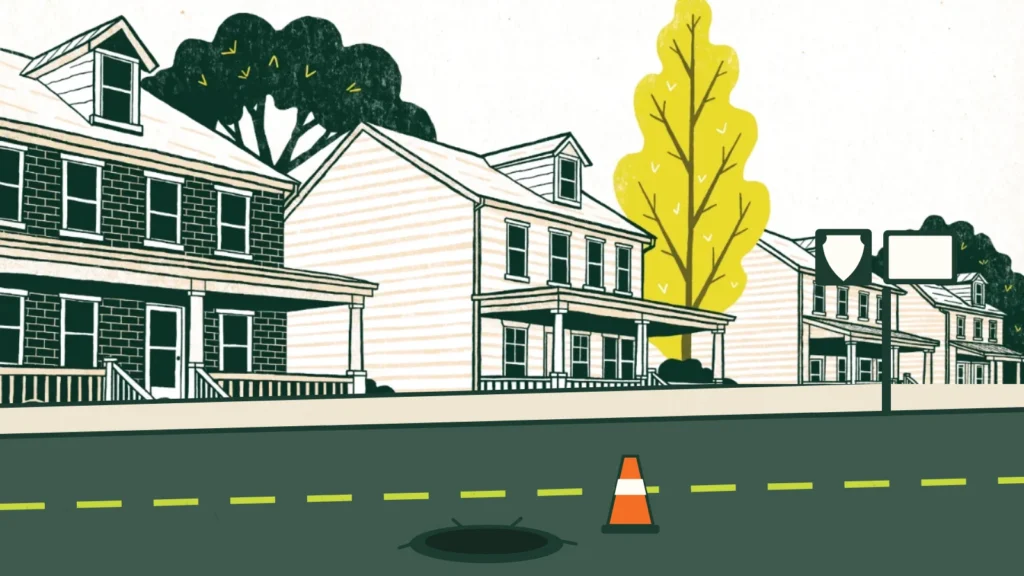
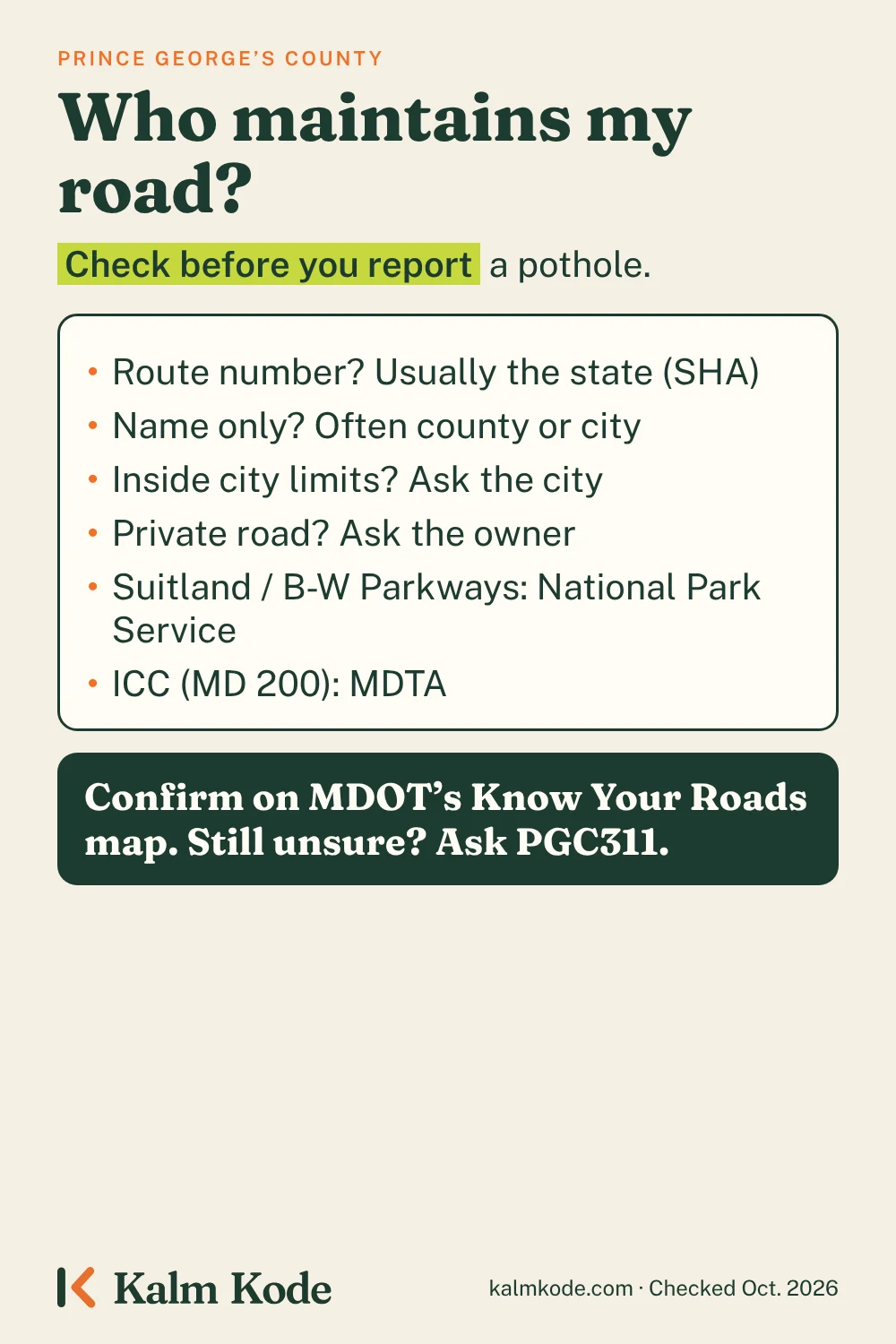
Short answer: in Prince George’s County, the road in front of your home is usually maintained by one of four groups.
- The county: most named neighborhood roads. Report problems to PGC311.
- The state: roads with a route number, like MD 4, US 1 or I-495. Report problems to the Maryland State Highway Administration (SHA).
- Your city or town: streets inside the limits of one of the county’s 27 municipalities. Contact the city or town.
- The property owner: private roads in some HOAs, apartment complexes and business parks. Contact the owner, HOA or management.
A few roads belong to someone else entirely, such as the National Park Service’s parkways and the Intercounty Connector (MD 200) toll road.
The quickest check is the sign: a route number usually means the state. To be sure, click your exact stretch of road on the state’s Know Your Roads map. If you still can’t tell, ask PGC311.
Last checked October 14, 2026, against official county, state and federal pages (sources at the bottom). Kalm Kode is an independent guide, not a government service. We can’t file a report for you or promise when anything gets fixed.
The 30-second version
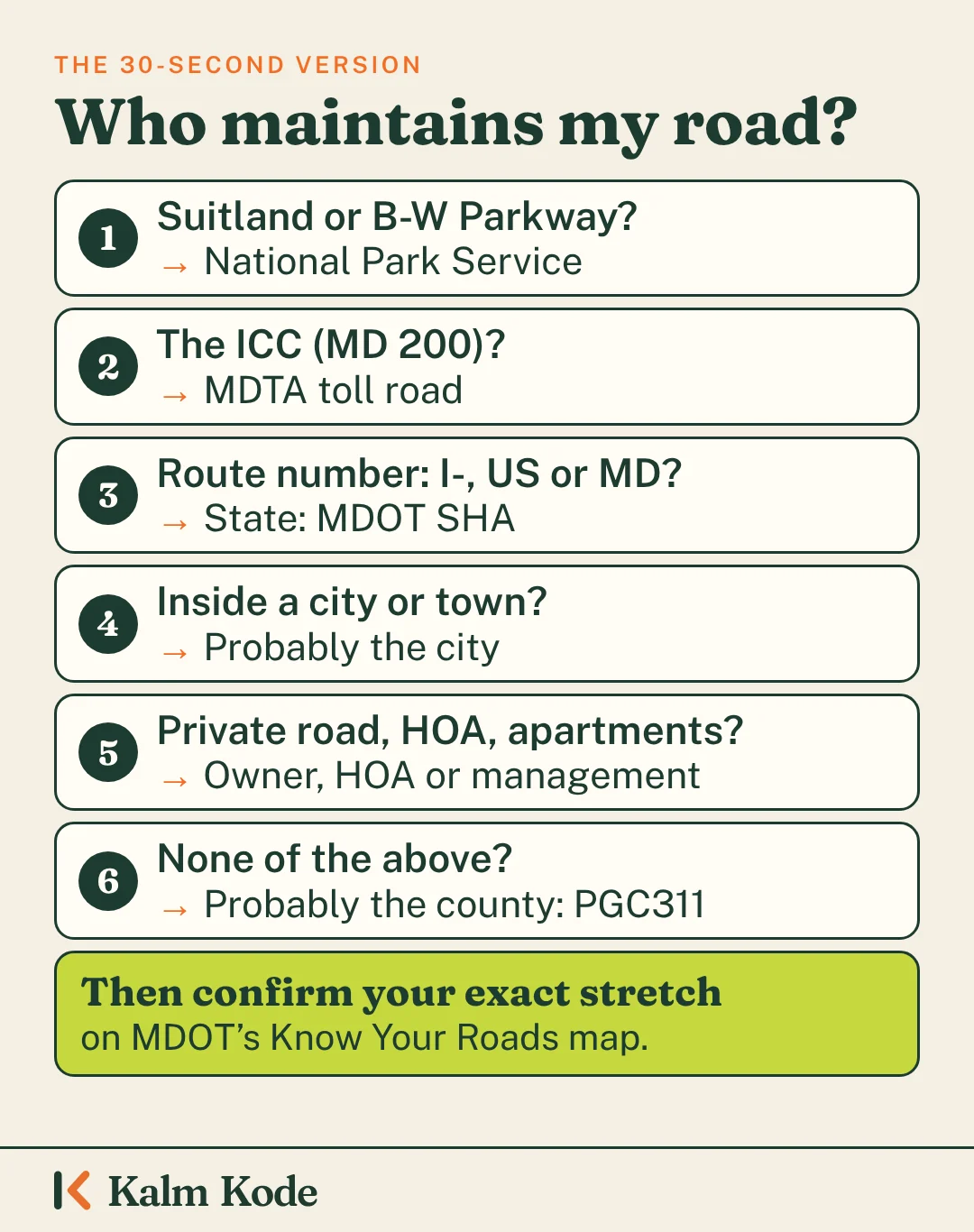
Ask these in order. The first “yes” usually tells you who to contact.
- Is it Suitland Parkway or the Baltimore-Washington Parkway? The National Park Service runs those. (Other roads named “Parkway,” like Bowie’s Evergreen Parkway, can belong to a city or the county.)
- Is it the Intercounty Connector (MD 200)? That’s a toll road run by the Maryland Transportation Authority (MDTA), not SHA.
- Does the road sign show a route number (I-, US or MD)? It’s probably a state road. Contact SHA.
- Is it inside the limits of a city or town? It’s probably the city’s street, though some main roads through town belong to the state or county.
- Is it a private road in an HOA, apartment complex or business park? The owner, HOA or management handles it.
- None of the above? It’s probably a county road. Report it to PGC311.
“Probably” is doing real work in that list. Ownership can change partway down a road, so for anything you’re about to report, confirm the exact stretch on the map in Step 2.
Step 1: Look at the road sign
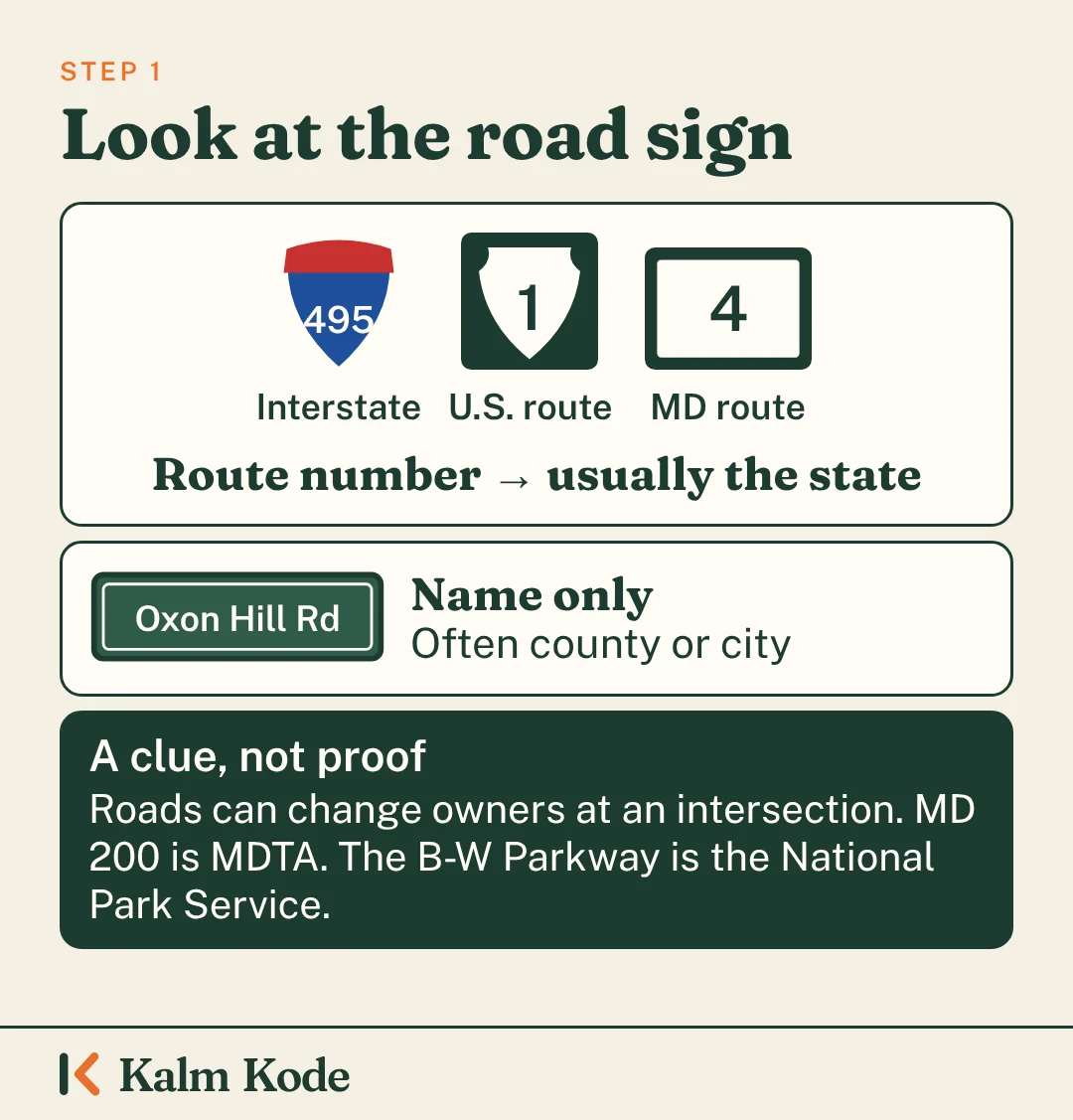
Maryland’s state roads all have a route number, though it isn’t always posted. When it is, the sign shape tells you which kind:
- Interstates: a blue and red shield, such as I-95 or I-495 (the Capital Beltway).
- U.S. routes: a white shield, such as US 1 or US 50.
- Maryland routes: a white rectangle, such as MD 4 or MD 214.
Many state roads also have a name. Pennsylvania Avenue is MD 4 and Central Avenue is MD 214. MD 210, MD 450 and US 1 are state roads too. MDOT’s Know Your Roads page puts it simply: if your road doesn’t have one of these signs, you probably don’t live on a state-maintained road.
The county’s own pages say county roads are identified by name only, like Oxon Hill Road or Harry S. Truman Drive.
Why the sign isn’t the final word
A few things can trip you up:
- Some state roads go mostly by a name. The City of Bowie’s pothole page lists Hall Road with its state roads, for example.
- One road can change owners. Bowie says Mitchellville Road is a city street north of MD 197 and a county road south of it.
- Some big roads aren’t SHA’s. The Intercounty Connector is signed MD 200 but belongs to MDTA, and the Baltimore-Washington Parkway is a National Park Service park.
So use the sign as your first clue, then check the exact stretch in front of you.
Step 2: Check the official map
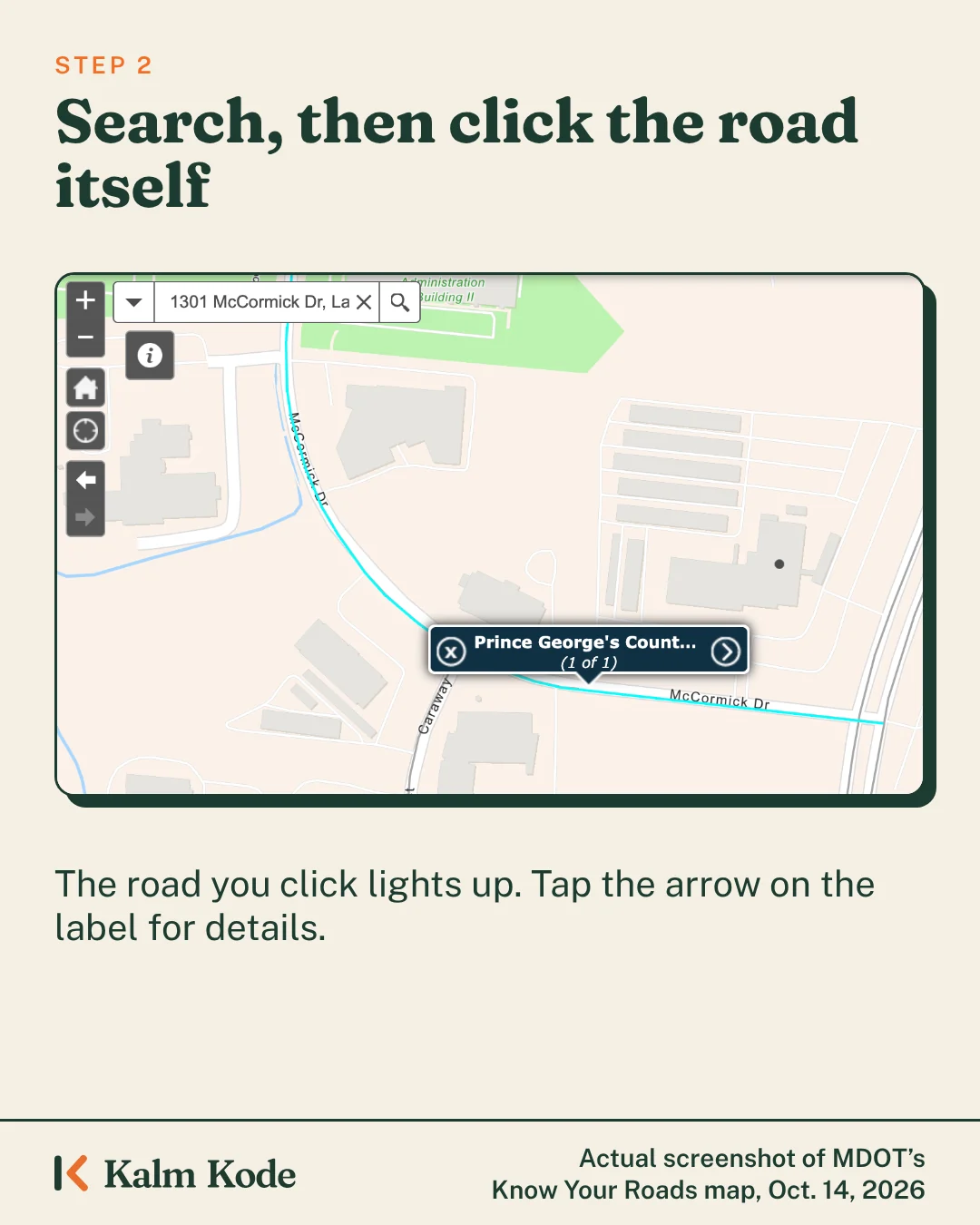
The Maryland Department of Transportation’s Know Your Roads map shows who maintains each road in the state. MDOT says to click your road to find out who maintains it.
- Open MDOT’s Know Your Roads page. The map is on the page. (The full-screen version asks you to agree to MDOT’s terms before it opens.)
- Type an address or intersection into the search box.
- Click the line for the road itself, right where the problem is. Not the house, and not the next block over. The road lights up and a small label appears.
- Click the arrow on the label to see the details: Maintenance Responsibility, the road name and route, and links for that agency.
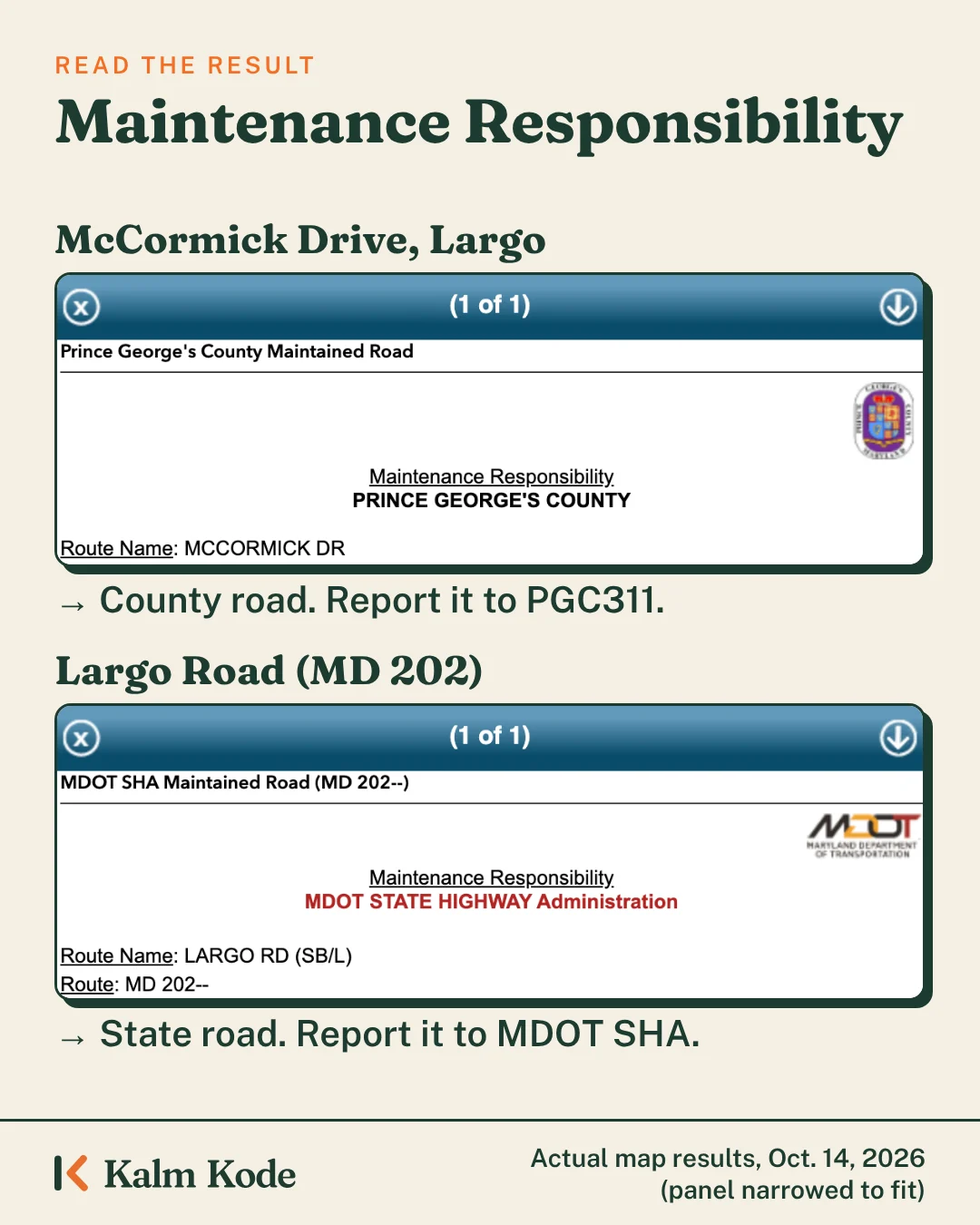
For example, when we searched the county’s administration building at 1301 McCormick Drive in Largo, McCormick Drive came back as Prince George’s County, and nearby Largo Road came back as MDOT State Highway Administration (MD 202).
The result might also be a city or town, the National Park Service, a state toll road or a private owner. MDOT says maintenance responsibility on the map is updated once a year, so a road that changed hands recently might not show it yet.
Use the map to find out who maintains the road, then report through that agency’s usual channel. The map’s contact details can lag behind. For McCormick Drive it listed 301-883-5600, while the county’s own road pages give 311 or 301-883-4748 for PGC311.
What about the county’s map?
The county points residents to its own map, the Pavement Assessment Management System (PAMS), for checking whether a road is county-maintained. When we tried it on October 14, 2026, one link asked us to sign in to a county account and the other loaded an empty map. If it works for you, great. If not, use the state map or call PGC311.
If the map doesn’t give you a clear answer
Don’t assume a road is private just because the map shows nothing. Some roads aren’t labeled, and the boundaries between owners aren’t always obvious. Call PGC311 at 311 or 301-883-4748 and ask who maintains the road at your nearest address or intersection.
Step 3: Report it to the right place
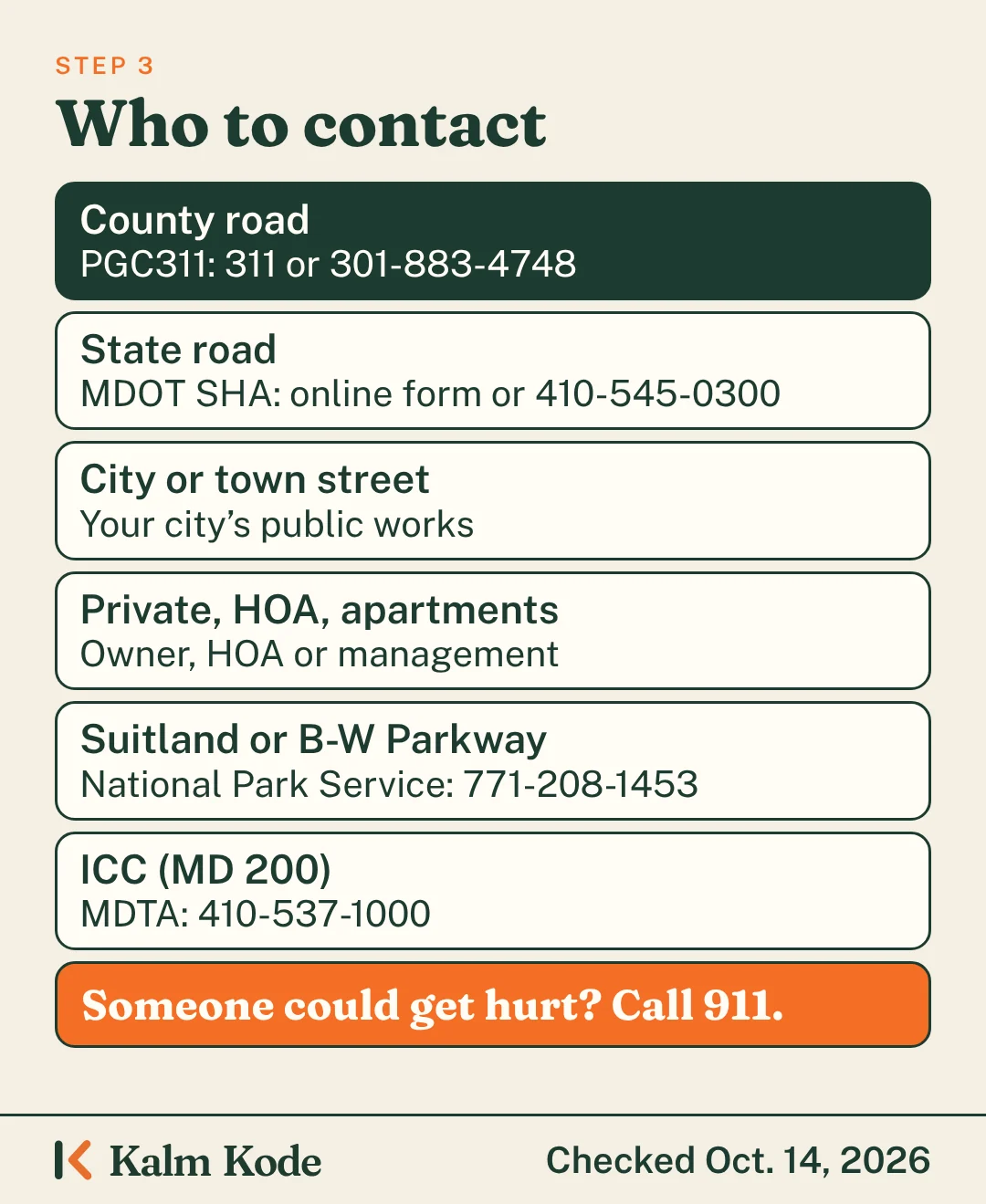
County roads: PGC311
- Online: pgc311.com. Pick Pothole Repair for potholes, or Street and Sidewalk Issues for other street problems.
- Phone: 311 from inside the county, or 301-883-4748. Monday to Friday, 7 a.m. to 7 p.m.
- After-hours county road emergencies: 301-324-2710.
The county also takes reports about hazards in the county right-of-way along the road, including sidewalks, curbs and gutters, and uneven pavement.
State roads: MDOT SHA
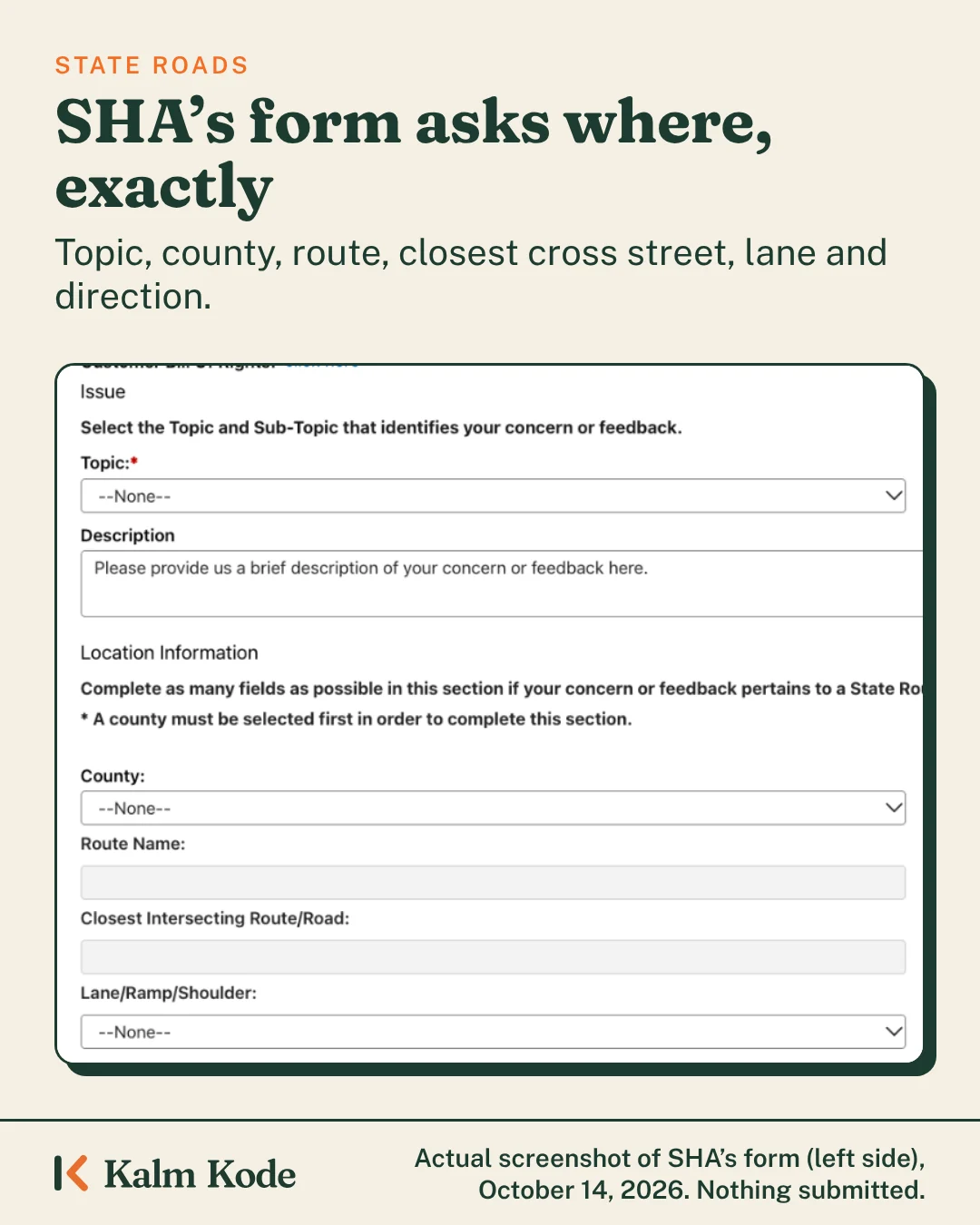
- Online: SHA’s customer care form. Choose the topic Potholes / Holes / Sinkholes or whichever fits, then pick Prince George’s as the county.
- Phone: 410-545-0300 or 800-323-6742, Monday to Friday, 8:30 a.m. to 4:30 p.m., except holidays.
- Prince George’s maintenance shops: Laurel, 301-776-7619; Marlboro (Upper Marlboro), 301-952-0555.
- SHA’s district office for Prince George’s and Montgomery: Greenbelt, 301-513-7300.
- Highway emergencies that don’t need police, such as a sinkhole or a signal that’s out: 1-800-543-2515 or 410-582-5650.
SHA’s form asks for the route, the closest cross street, the direction and the lane, so note those before you start.
City and town streets
Contact your city or town’s public works department. The county has 27 municipalities:
Berwyn Heights, Bladensburg, Bowie, Brentwood, Capitol Heights, Cheverly, College Park, Colmar Manor, Cottage City, District Heights, Eagle Harbor, Edmonston, Fairmount Heights, Forest Heights, Glenarden, Greenbelt, Hyattsville, Landover Hills, Laurel, Morningside, Mount Rainier, New Carrollton, North Brentwood, Riverdale Park, Seat Pleasant, University Park and Upper Marlboro.
Bowie, for example, takes pothole reports for city streets at 301-809-2344 or through its online service requests.
Our tip: a mailing address isn’t proof you live inside city limits. If you’re unsure, check the map or ask the city.
Private roads, HOAs and apartment complexes
The county says private roads are maintained by the adjacent property owners. In practice, that usually means your HOA, your apartment or condo management, or the owner of the property. Check your HOA documents or lease, or ask management.
Parkways and the ICC
- Baltimore-Washington Parkway: a National Park Service park. Park phone: 771-208-1453. For emergencies, the park directs you to the U.S. Park Police at 202-610-7500.
- Suitland Parkway: managed by the National Park Service’s National Capital Parks-East. Park phone: 771-208-1453.
- Intercounty Connector (MD 200): owned and operated by the Maryland Transportation Authority. It runs from I-270 in Montgomery County to US 1 in northwestern Prince George’s. MDTA’s management offices: 410-537-1000.
For anything life-threatening on any road, call 911.
How long does a pothole repair take?
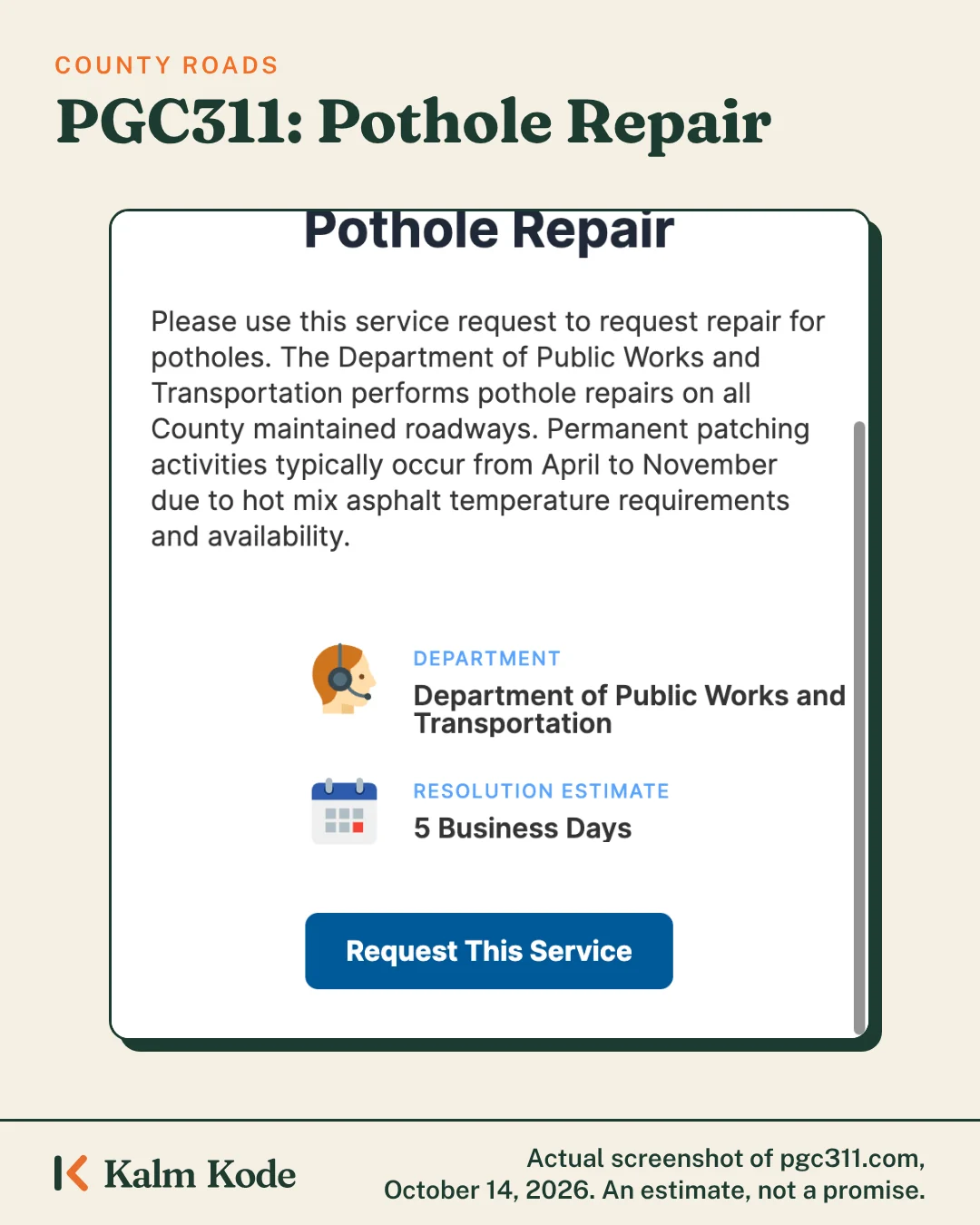
When we checked PGC311 on October 14, 2026, its Pothole Repair request showed a resolution estimate of 5 business days. That’s an estimate, not a promise.
PGC311 also says the county’s permanent patching typically happens from April to November, because of hot mix asphalt temperature requirements and availability. The county’s roadway hazards page describes the same pattern: hazardous spots may be made safe with temporary patches first, then added to a list for permanent repair as funds become available.
Streetlight, drainage or another neighborhood problem? Use Who Handles This? to find the right contact and what to have ready before you report it.
Not everything on your street belongs to the road owner
Even once you know who maintains the road, a few things work differently:
- Neighborhood streetlight out? Report it to your electric utility. The county says that once streetlights are installed, the utility companies maintain them. It’s usually the same company that provides your home’s electricity. PGC311 is for requesting new or better lights on county roads, not outages. For lights along a state highway, SHA’s form has a lighting topic.
- Snow on your street? The county plows county roads. If yours is still bad, the county asks you to wait 24 hours after the snow or ice stops, then call 311 or 301-883-4748. The county’s PGCTrackSnow map shows treatment status. State roads go to SHA, and HOA, apartment and city roads go to whoever maintains them.
- Sidewalk or curb along a county road? Report it to PGC311 as a roadway hazard.
- Tree down or a flooded storm drain? PGC311 has categories for both. On a state road, use SHA’s form, which has topics for trees and for ditches and drainage. Our advice: if a tree is touching power lines or blocking traffic, stay away and call 911 or your electric utility.
Common mistakes
- Reporting a state road to the county, or the other way around. Check the sign and the map first.
- Checking the wrong stretch. Ownership can change at an intersection, so click the exact spot.
- Assuming a mailing address means city limits. It doesn’t always.
- Assuming “not on the map” means private. Ask PGC311 before you decide.
- Calling the county about a streetlight outage. That goes to your electric utility.
- Calling 311 for a real emergency. If someone could get hurt right now, call 911.
Have this ready before you report
These are our suggestions. They line up with what SHA’s form asks for, and they work for any report:
- The road name and route number, if it has one
- The nearest address or cross street
- Your direction of travel, and which lane or the shoulder
- What the problem is and roughly how big
- A photo, taken only when it’s safe and never while driving
- Your request or confirmation number afterward, so you can follow up
FAQ
How do I know if my road is a county road?
Look for a route number first. County roads go by name only. To confirm, click your road on MDOT’s Know Your Roads map, or ask PGC311 at 311 or 301-883-4748.
Who fixes potholes on Pennsylvania Avenue or Central Avenue?
The state. Pennsylvania Avenue is MD 4 and Central Avenue is MD 214, so report them to SHA.
Who fixes potholes on the Capital Beltway?
The Beltway (I-95/I-495) is an interstate, and MDOT lists interstates among the roads the state maintains. Report it to SHA, and confirm on the Know Your Roads map if you’re unsure.
My road doesn’t show up on the map. Is it private?
Not necessarily. Some roads aren’t labeled. Ask PGC311 (311 or 301-883-4748) before assuming anything.
I live in an HOA. Who plows and repairs our streets?
It depends on whether your streets are private or public. Some HOA communities have county roads. Check the map, and ask your HOA.
How long does the county take to fix a pothole?
PGC311 showed an estimate of 5 business days when we checked on October 14, 2026. Permanent patching typically happens from April to November.
Who do I call about a streetlight that’s out?
Your electric utility, usually the same company that sends your home’s electric bill. The county says utilities maintain streetlights once they’re installed.
Who handles the Baltimore-Washington Parkway?
The National Park Service. Its park phone is 771-208-1453, and for emergencies it directs you to the U.S. Park Police at 202-610-7500.
More Kalm Kode guides
- Do you need an appointment for bulky trash?: what goes out on trash day and what needs a PGC311 appointment
- How to get a mattress picked up: wrapping, counting and setting it out
- Bulky trash not picked up?: what to check, and when to report it
- How to get rid of a TV: tube TVs, flat screens and free e-waste events
Official sources
Checked October 14, 2026:
- What Is a County Road? (DPW&T)
- Pothole Repairs (DPW&T)
- Roadway Hazards (DPW&T)
- PGC311 service portal
- FAQ: Is the road in front of my property maintained by the county or SHA?
- Pavement Assessment Management System (PAMS)
- Snow and Ice Control
- Street Lights
- MDOT: Know Your Roads
- MDOT SHA: Roads and Highways in Maryland
- MDOT SHA: Customer Service
- MDOT SHA: District 3 (Prince George’s and Montgomery)
- MDTA: Intercounty Connector brochure (PDF)
- National Park Service: Baltimore-Washington Parkway
- National Park Service: Suitland Parkway Trail news release, February 20, 2026
- Maryland Manual: Prince George’s County municipalities
- City of Bowie: Potholes
Roads change hands and phone numbers change. If anything here doesn’t match what PGC311 or SHA tells you, go with them, and message us at @kalmkode so we can update this guide.