
DC Moving Truck Permit: When to Apply and When Signs Go Up
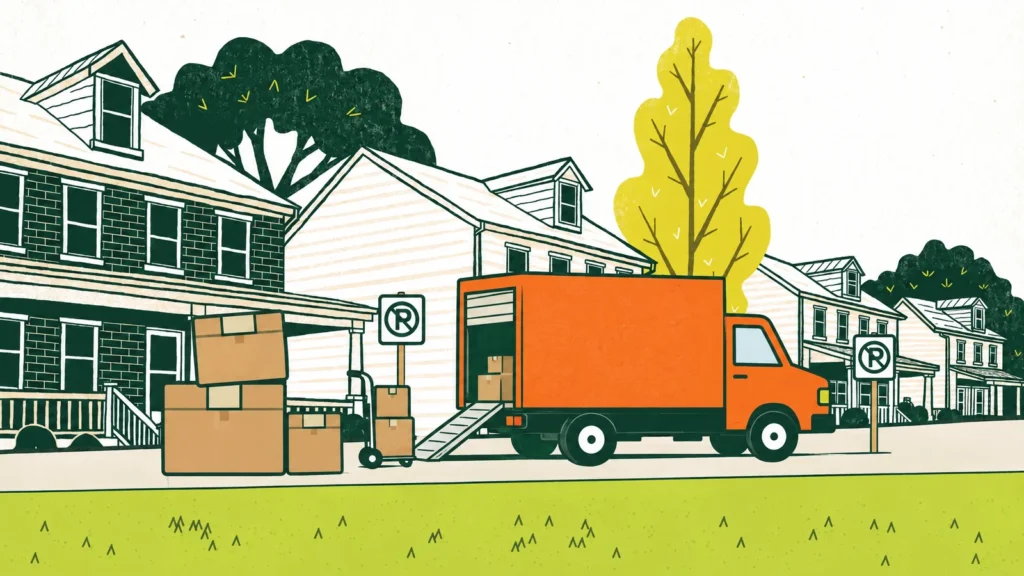
Short answer: to park a moving truck or container on a DC street, you need a public space permit from DDOT (the District Department of Transportation). You apply online in TOPS, DDOT’s permit system. Once it’s approved and paid, you print No Parking signs and post them at least 72 hours before the truck arrives at spaces without meters, or at least 24 hours before at metered spaces. Then you verify the signs.
Want your dates worked out? Our DC Moving-Day Check counts back from your arrival time and gives you a printable plan and a calendar file.
Last checked November 1, 2026, against DDOT’s own guidance (sources at the bottom). Kalm Kode is an independent guide, not DDOT. We can’t issue permits, reserve spaces or guarantee a clear curb. The permit DDOT issues, and the instructions printed with it, control.
The 30-second version
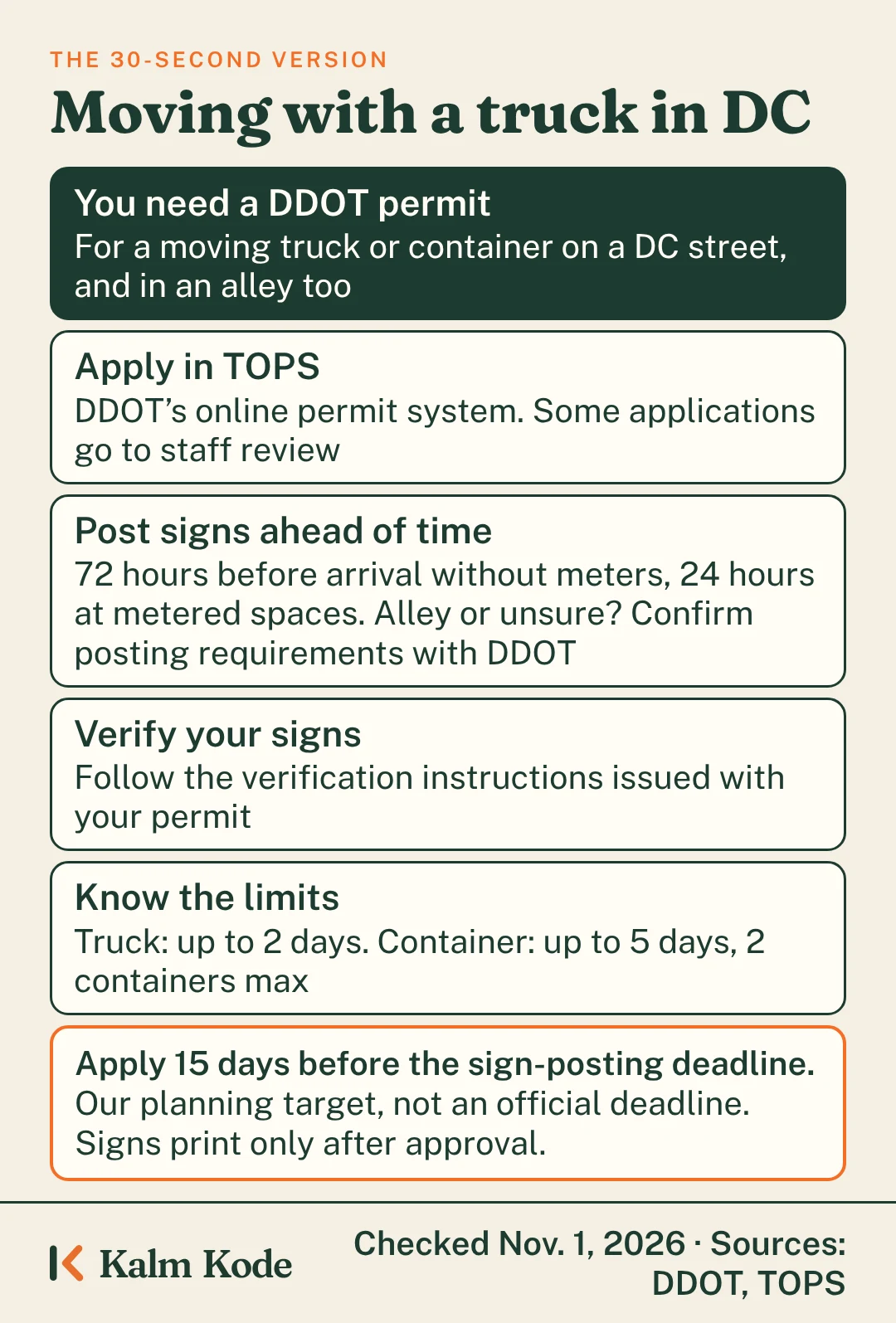
- You need a permit to park a moving truck on the street in front of your home. DDOT says parking in an alley needs one too.
- Apply in TOPS. Many applications approve automatically; others go to a staff review, and DDOT says to allow up to 2 weeks.
- Signs go up at least 72 hours before arrival at spaces without meters, and at least 24 hours before at metered spaces. Using an alley or not sure? Confirm the posting requirement with DDOT.
- Verify your posted signs using the instructions issued with your permit.
- A moving truck can stay in public space for up to 2 days. A moving container can stay up to 5 days, and the permit covers up to 2 containers. These are maximums; the dates on your permit control.
Step 1: Apply in TOPS
Register and apply at TOPS. For a truck, the permit type is Moving Truck. For a pod-style container, it’s Moving Storage Container (the container company needs its own annual permit, but you still need yours).
Before you start, know:
- Your address and the dates and times you need the curb.
- Whether the spaces are metered. TOPS lists the meter numbers on your block if they are.
- Whether rush-hour or street-sweeping restrictions apply there. Trucks can’t park against those restrictions.
Cost: DDOT’s moving-truck FAQ lists a $50 permit fee, plus parking meter fees if you use metered spaces. For containers, its FAQ lists $50 for up to 8 by 12 feet, plus $25 for each extra 6 feet of parking lane. TOPS also adds a 10% technology surcharge to base fees. We haven’t confirmed the current amount inside TOPS, so go by the total TOPS shows before you pay.
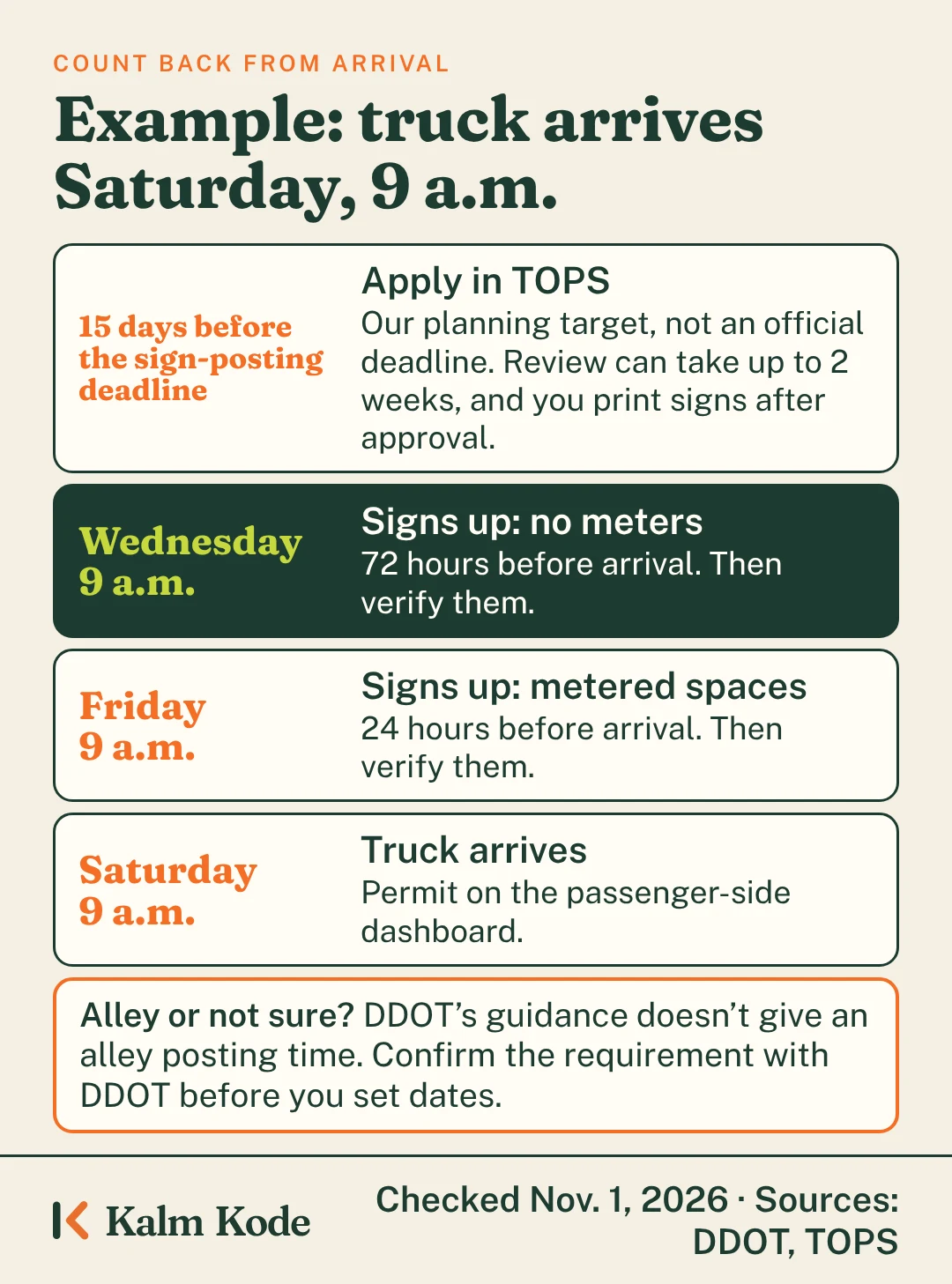
Our planning target, not an official deadline: apply 15 days before your sign-posting deadline. That leaves up to 2 weeks for a staff review plus a day to print the signs.
Step 2: Print and post the signs
DDOT says signs can only be printed after the permit is approved, paid for and issued, and only at a DDOT kiosk or the permit office. Kiosks are at the permit office and at Metropolitan Police Department district stations. Handwritten signs aren’t accepted.
Count the notice in real hours. DDOT’s guidance gives it in hours with no weekend exception, so for a Saturday-morning truck at an unmetered space, plan on signs up by Wednesday morning. If a clock change falls in between, the clock time shifts by an hour; our moving-day check handles that for you.
Using an alley, or not sure whether your block is metered? DDOT’s guidance doesn’t give a separate posting time for alleys. Confirm the posting requirement with DDOT before you set your dates.
Step 3: Verify your signs
Posting the signs isn’t the last step. DDOT permits have required sign verification, and DDOT has said the verification instructions print with the permit. Follow the instructions issued with yours, and check TOPS. If your signs come down before the notice period ends, post them again right away.
On moving day
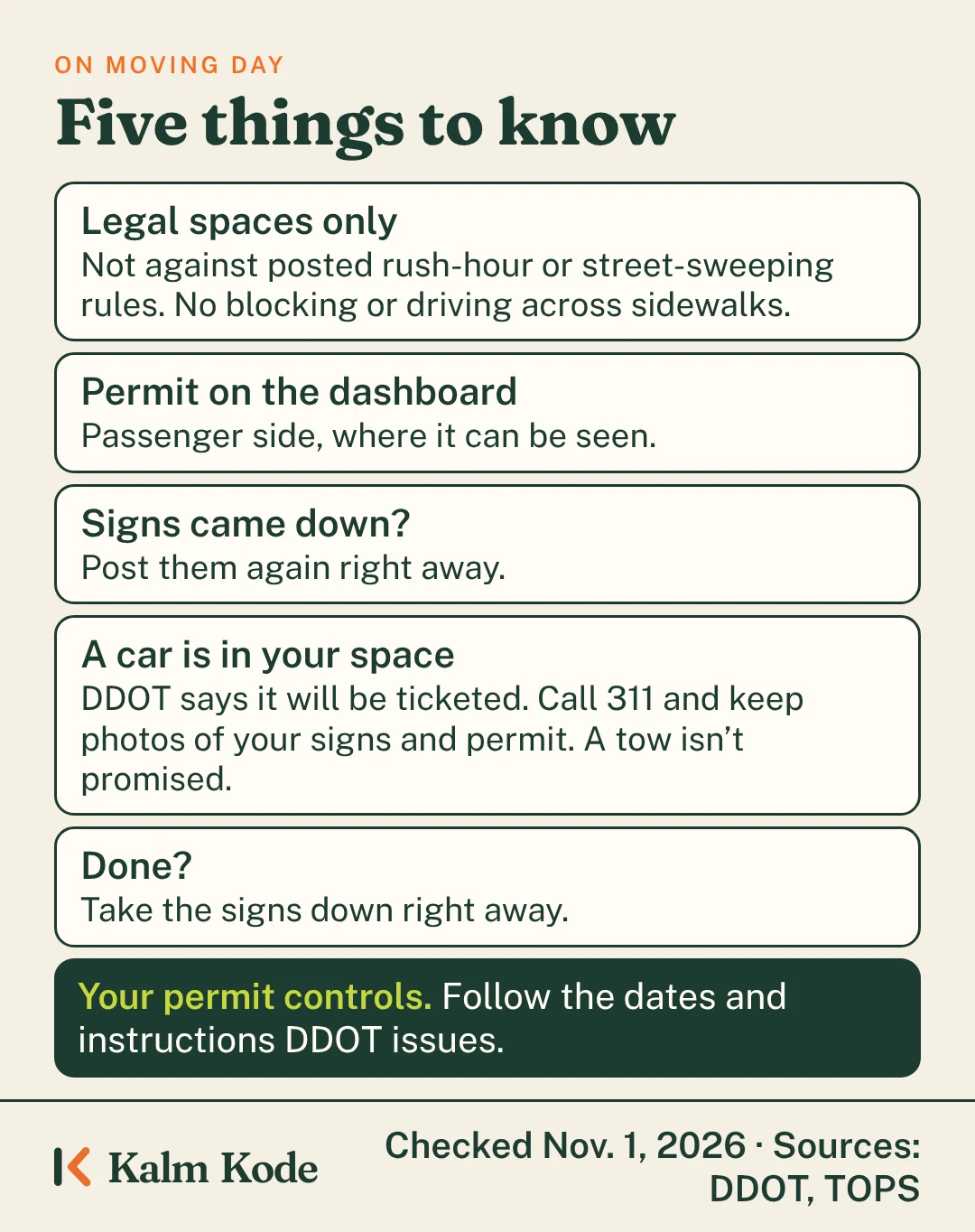
- Park only in legal spaces, and not against posted rush-hour or street-sweeping restrictions.
- Don’t block or drive across a sidewalk.
- Put a copy of the permit on the truck’s passenger-side dashboard.
- Take the signs down as soon as you’re done.
If a car is parked in your space
DDOT’s TOPS FAQ says cars parked in a posted zone will be ticketed. DC’s Department of Public Works says to call 311 to request parking enforcement. Keep photos of your posted signs, your permit and your sign verification. Ticketing is mentioned in DDOT’s guidance; a tow isn’t promised, and neither is how fast enforcement arrives.
Moving into or out of an apartment building?
If the truck stays entirely on private property, like the building’s loading dock, DDOT’s public-space permit may not be what you need, but if any part of the move uses the street, the alley or the sidewalk, it is. Ask your building:
- Do I need to reserve the elevator or a move time slot?
- When is the loading dock open, and can a truck my size fit?
- Do movers need a certificate of insurance?
- Is there a move-in or move-out fee or deposit?
Moving in Maryland or Virginia instead? Moving permits there come from your county or city, not DDOT. Moving your license to Maryland? Try our license-transfer check.
Sources
- DDOT: Moving Trucks on Public Space FAQs (file dated Mar 26, 2022)
- DDOT: Moving Containers in Public Space FAQs (file dated Mar 26, 2022)
- DDOT: Temporary Parking Restrictions
- TOPS permit types: Moving Truck and Moving Storage Container
- TOPS: Frequently Asked Questions for Applicants
- DPW: Request Parking Enforcement