
How to Get a Mattress Picked Up in Prince George’s County

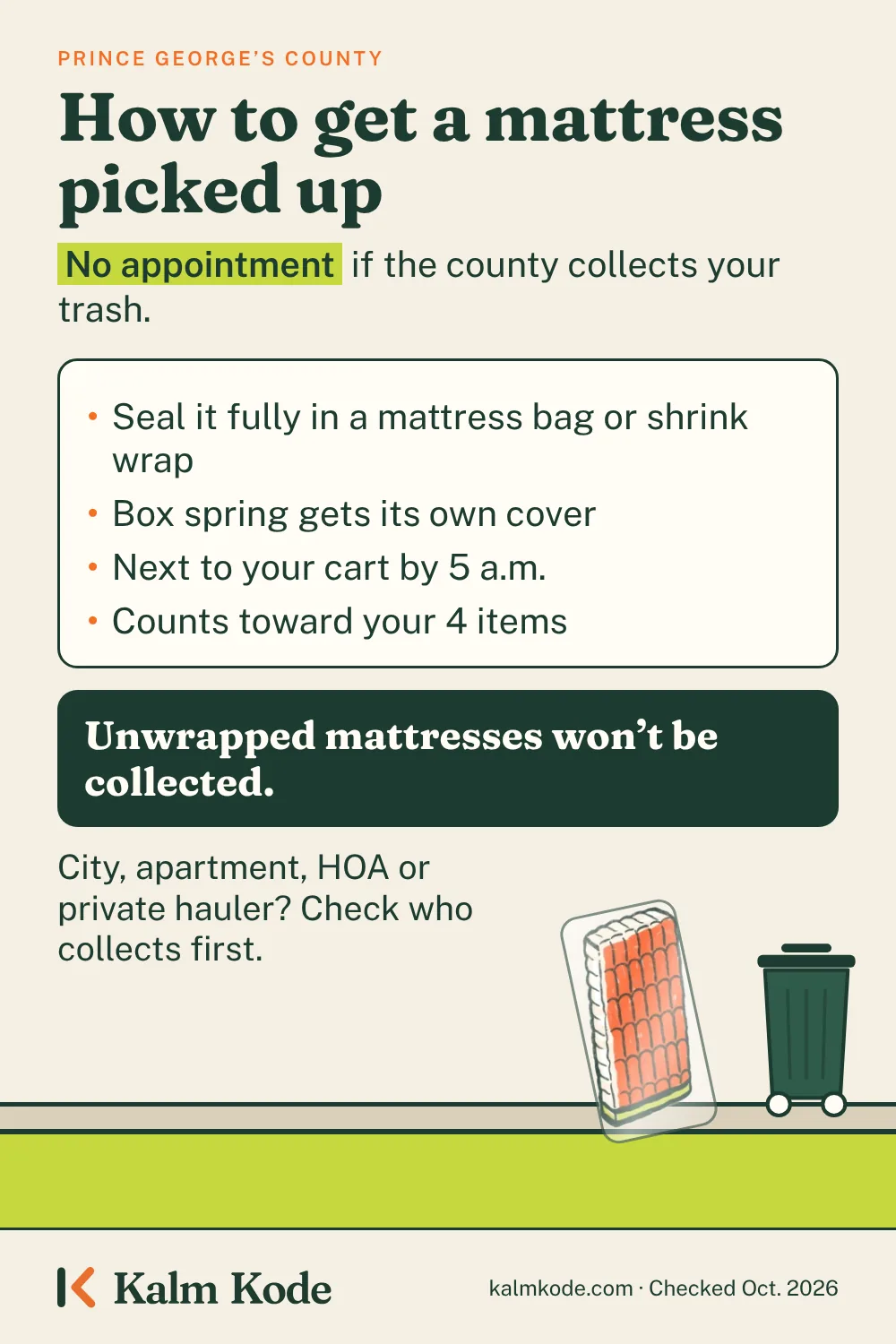
Short answer: if Prince George’s County collects your trash, you don’t need an appointment. Seal the mattress completely in plastic (a mattress bag or shrink wrap), then set it next to your trash cart by 5 a.m. on your regular trash day. It counts as one of your four bulky items for the week. A mattress that isn’t fully covered won’t be picked up.
A box spring follows the same rule and needs its own cover. If you pay the county only for bulky pickup, schedule it through PGC311 first. If your city, apartment complex, HOA or a private hauler collects your trash, check their rules, because the county route may not apply.
This guide covers the whole job: checking that the county route is yours, picking a cover, wrapping and sealing it, counting it toward your limit, setting it out, and what to do about bed bugs, bed frames and drop-off.
Last checked October 14, 2026, against Prince George’s County’s official pages (sources at the bottom). Kalm Kode is an independent guide, not a county service. We can’t book a pickup or guarantee that anything gets collected. When in doubt, PGC311 has the final word.
The one rule that trips people up
Most bulky items just need to be next to your cart on the right day. Mattresses and box springs have one extra requirement, and it’s the reason a lot of them sit at the curb for another week.
Since February 1, 2019, the county has required residents using curbside bulky pickup to completely cover mattresses and box springs in a protective plastic covering. The county’s own one-page instructions are blunt about it: unwrapped mattresses won’t be collected.
The county gives health and safety reasons. Its bulky trash page cites the health and safety of staff. Its one-page instructions add that sealing the mattress completely helps prevent contamination, pests and the spread of bed bugs, and that proper preparation protects workers and helps ensure timely collection.
There’s one possible exception. The county says mattresses and box springs that residents deliver to the landfill themselves don’t need the cover. That only applies if you drive it there, and the exact drop-off site is worth confirming first (more on that below). Anything going out to the curb needs to be wrapped.
Step 1: Make sure the county route is yours
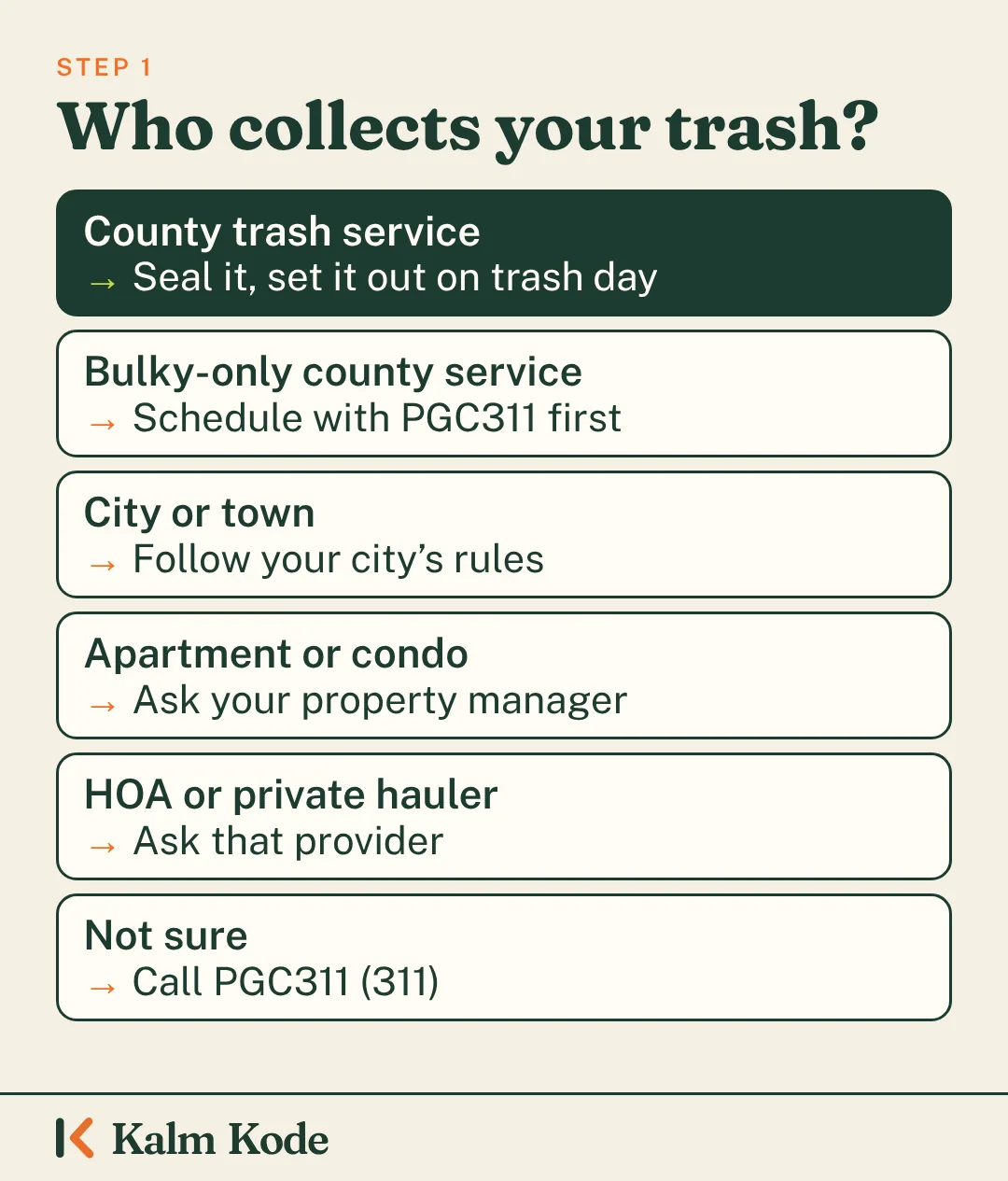
Before you buy a bag, spend a minute on who actually collects your trash. A PG County mailing address doesn’t settle it.
- County-contracted trash and recycling: everything in this guide applies. No appointment needed.
- You pay the county only for bulky service: the county says to schedule bulky pickup through PGC311. Wrap the mattress the same way, but set it out on the date you’re given.
- A city or town with its own trucks: follow your municipality’s rules. Some, like Glenarden, also require mattresses and box springs to be fully covered. Others, like Hyattsville, require you to schedule bulk pickup ahead of time. Check your city’s current page before setting anything out.
- Apartment or condo: the county’s bulky program excludes apartment complexes. Ask your management office where mattresses go and whether there’s a bulk day, a fee or a request form.
- HOA or private hauler: ask the company how it handles mattresses: whether it takes them, how they should be wrapped, which day, and whether there’s a charge.
Our first guide, Do You Need an Appointment for Bulky Trash in Prince George’s County?, walks through each of these in more detail. If you’re still not sure, call PGC311 and ask, “Who handles bulky trash pickup at my address?”
Step 2: Get the right cover
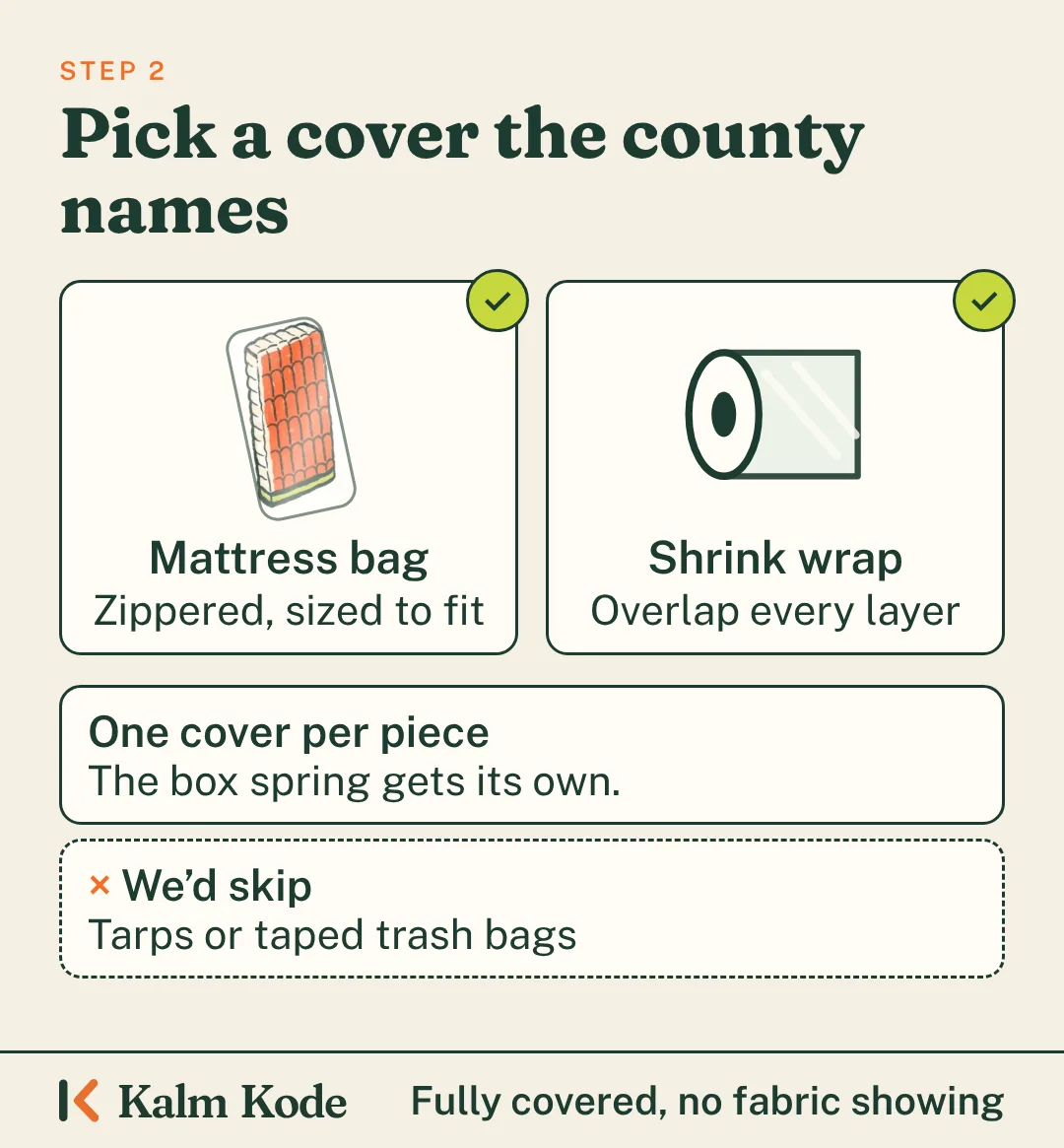
The county’s instructions name two options: a mattress bag or shrink wrap. Either works, as long as the mattress ends up fully enclosed.
Mattress bags
This is the easiest route for most people. The county says plastic zippered mattress covers are sold at many local retail stores for a nominal fee. Try the moving-supplies section of home and hardware stores, or order one online.
A few tips before you buy:
- Match the size. Bags are usually sold by mattress size: twin, full, queen, king. A bag that’s too small will tear when you force it on. If you’re between sizes, size up.
- Check the thickness. Pillow-top and hybrid mattresses can be much deeper than older ones. Look for a bag rated for your mattress depth.
- Box springs need their own bag. A mattress bag stretched over two pieces usually won’t close. Buy one for each piece you’re getting rid of.
- Heavier plastic is easier. Thin bags rip on corners and staples. A sturdier bag is worth it if you’re dragging the mattress down stairs.
Shrink wrap
Stretch wrap, the kind sold on a roll for moving, also meets the county’s description. It takes longer, and it’s easy to leave gaps. Wrap in overlapping layers until no fabric shows anywhere, including the corners and the ends.
What we wouldn’t use
The county’s list of items it won’t take curbside includes “plastic packing materials and plastic sheeting.” That line is about loose plastic as trash, not about covers. Still, the county’s instructions name a bag or shrink wrap, not a tarp, drop cloth or trash bags taped together. Patchwork covers also tend to come apart in wind or rain. Stick with a bag or shrink wrap, and you’re doing exactly what the county’s instructions name.
Step 3: Wrap it and seal it completely
The county’s four steps are simple: wrap it, seal it, set it out, place it properly. Here’s how to do the first two with less wrestling.
Wrapping with a bag
- Strip the bed. Remove sheets, pads and any toppers you’re keeping.
- Stand the mattress on its short end. Leaning it against a wall makes it much easier to handle alone.
- Pull the open bag down over the top, like putting on a pillowcase. Work it down a little at a time on each side.
- Tip the mattress onto its side and pull the bag the rest of the way. A second person helps a lot here.
- Close it. Zip it, or fold the open end over and tape it shut across the full width.
Wrapping with shrink wrap
- Lay the mattress flat or prop it on its side.
- Wrap around the long way first, overlapping each pass by about half the width of the roll.
- Turn it and wrap around the short way so the ends are covered too.
- Finish with extra layers on the corners, which tear first.
The seal check
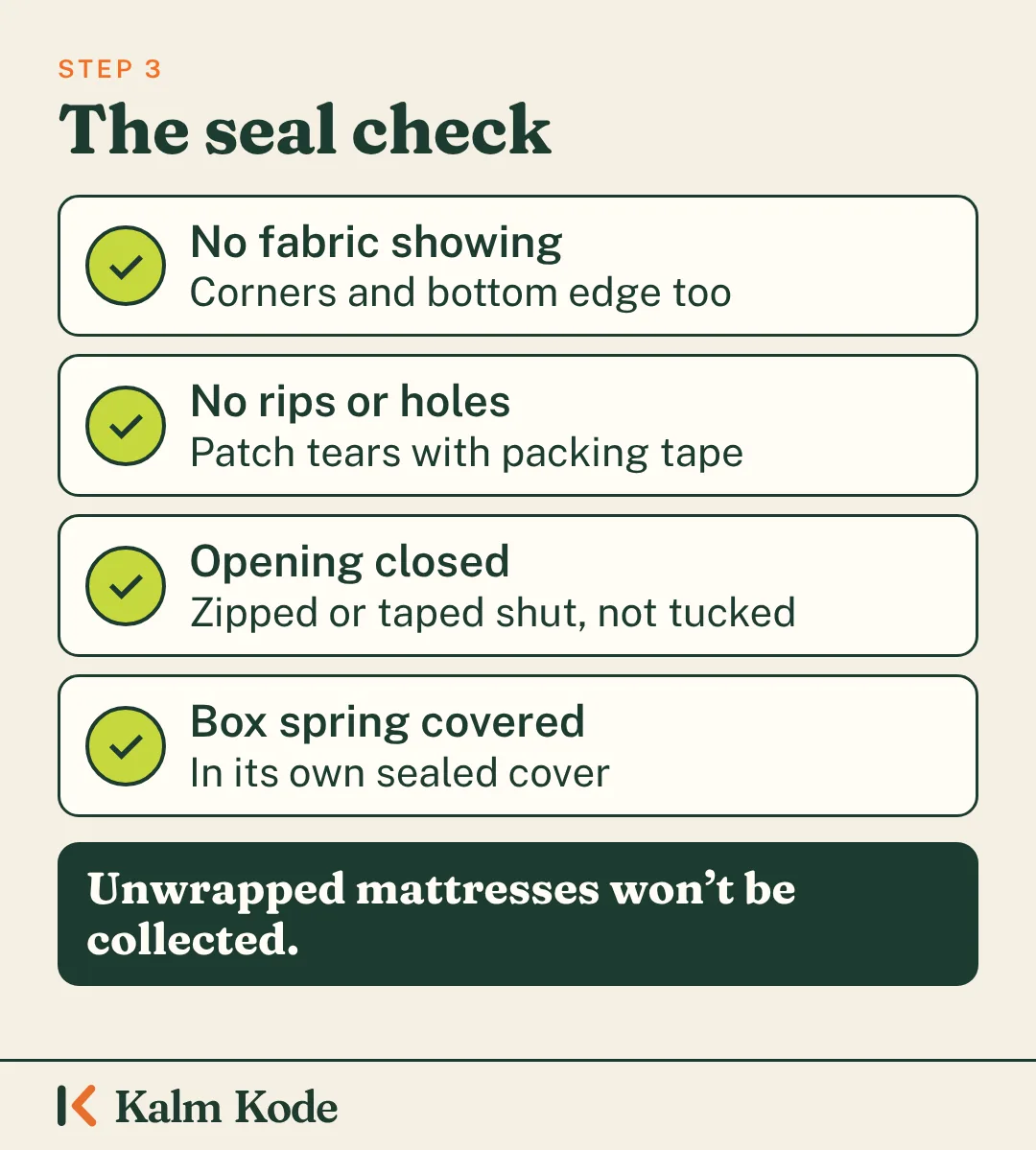
“Completely covered” is the standard, so check before it goes outside:
- No fabric showing anywhere, including corners, handles and the bottom edge.
- No rips or holes. Patch small tears with packing tape over the hole.
- The open end is zipped or taped shut, not just tucked.
- A box spring has its own sealed cover.
If the bag tears on the way down the stairs, patch it before you set it out. A rip is easy to miss in the dark at 5 a.m.
Step 4: Count it toward your four
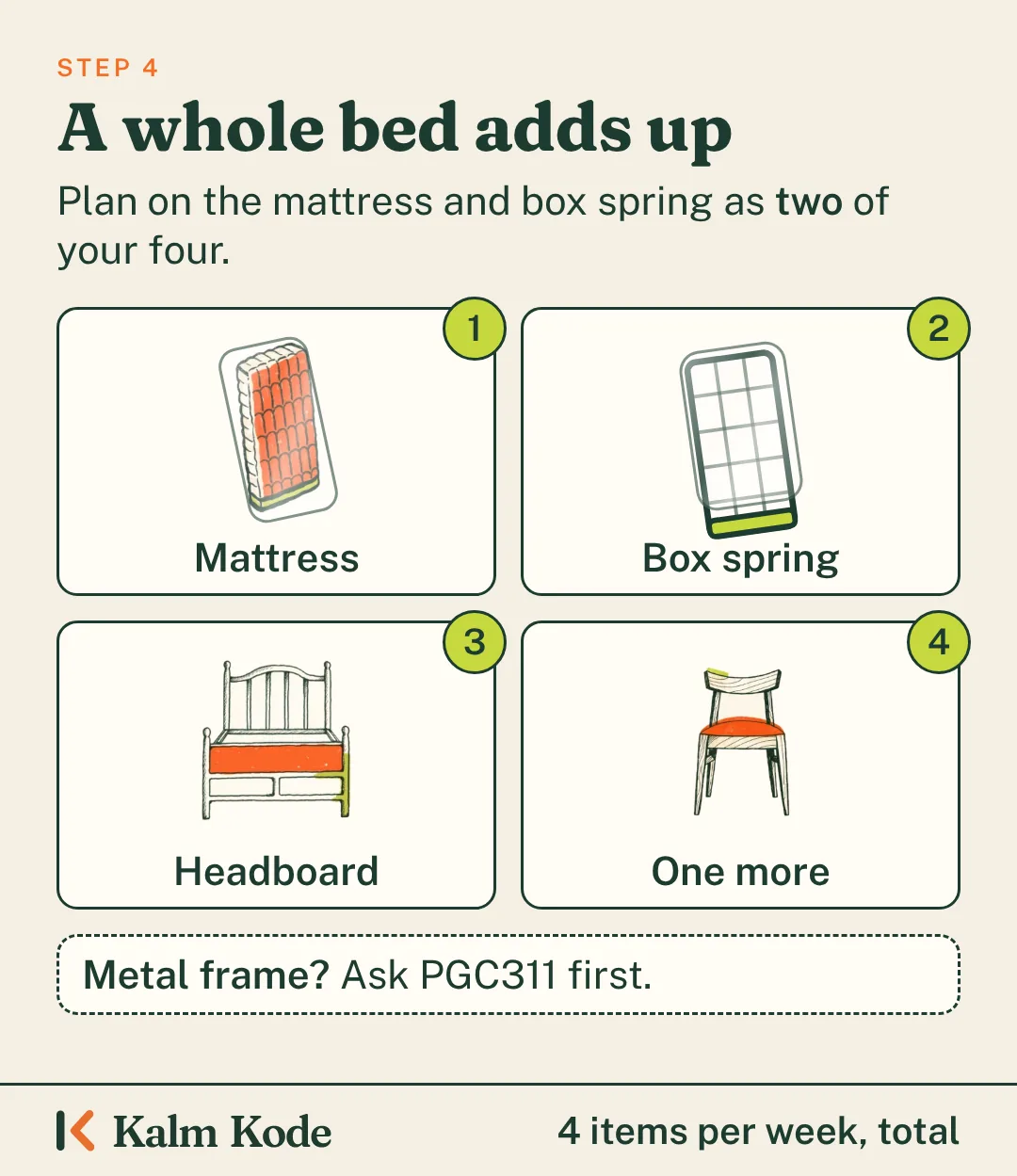
County-contracted homes can set out four bulky items per week, or four tightly secured bags of small household items. It’s four total, not four of each. The hauler collects up to four, so plan anything extra for another week.
A mattress and a box spring are two pieces. The county’s pages don’t say whether they count as one item or two. Hyattsville’s bulk-pickup example lists “one mattress, one box spring” separately, which is how we’d plan for it too. So if you’re clearing a whole bed, a mattress and box spring use two of your four, leaving room for two more things that week.
What about the bed frame?
The county’s accepted list includes headboards and footboards as furniture, so those can go out as bulky items. Bed frames themselves, especially metal rails and slats, aren’t named on the list. Before you set out a metal frame, ask PGC311 whether it goes with regular bulky pickup or the separate scrap metal appointment. The Can They Take This? tool also has a bed frame entry that walks you through it.
A few common whole-bed clean-outs:
- Mattress only: 1 of your 4.
- Mattress and box spring: plan for 2 of your 4.
- Mattress, box spring and a wooden headboard: plan for 3 of your 4.
- Two twin beds (two mattresses, two box springs): plan for all 4 in one week, and nothing else.
Step 5: Set it out the right way
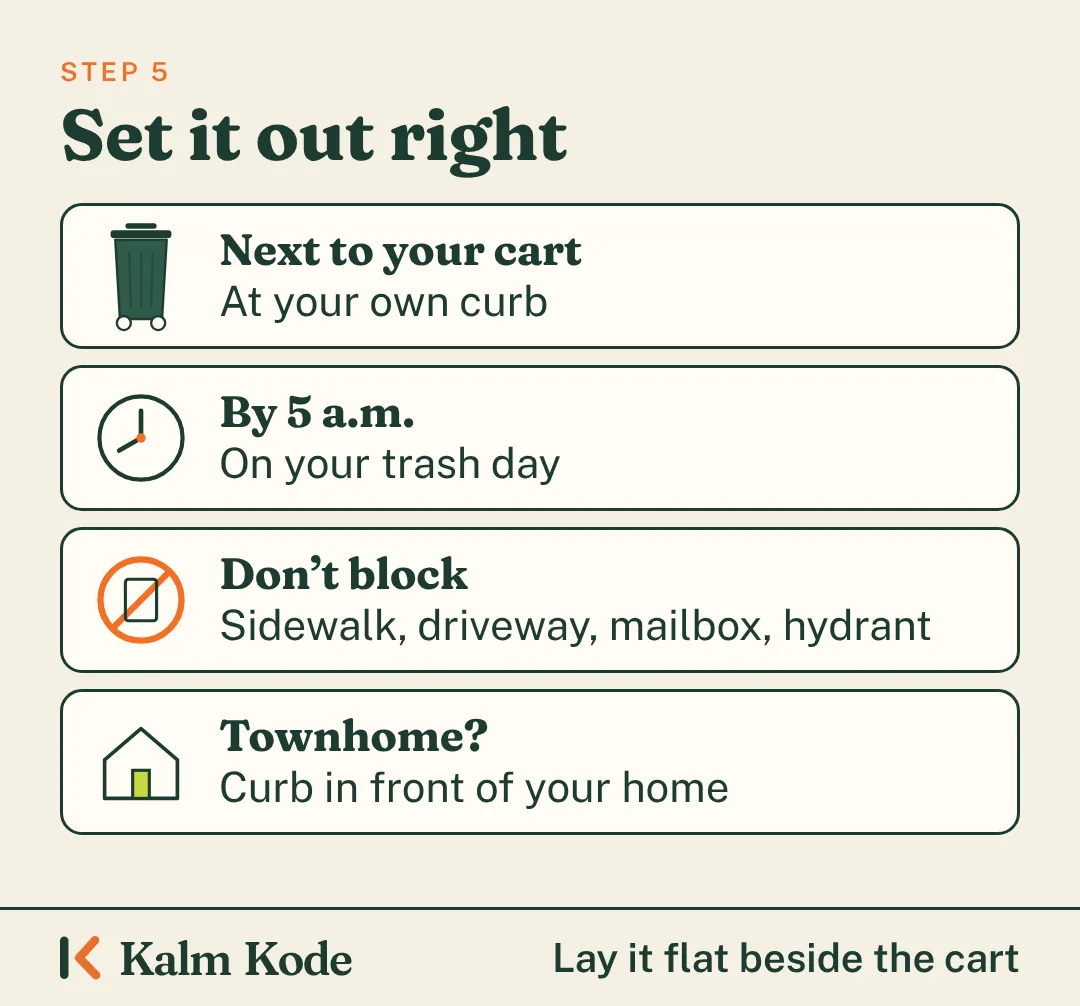
The county’s instructions and bulky trash page add up to four placement rules:
- Next to your trash cart, at the curb, on your regular collection day.
- By 5 a.m. The county allows carts at the curb after 6 p.m. the night before, so setting the mattress out that evening is the easiest way to make the cutoff, if your HOA or community rules allow it.
- Out of the way. The county says not to block sidewalks, driveways, mailboxes, fire hydrants or the road.
- At your own curb. Townhome residents should use the curb in front of their home or assigned parking space, not a shared lot or common area.
Laying the mattress flat beside the cart keeps it from blowing over. If it has to lean, lean it against the cart, not across the sidewalk.
If you have bed bugs
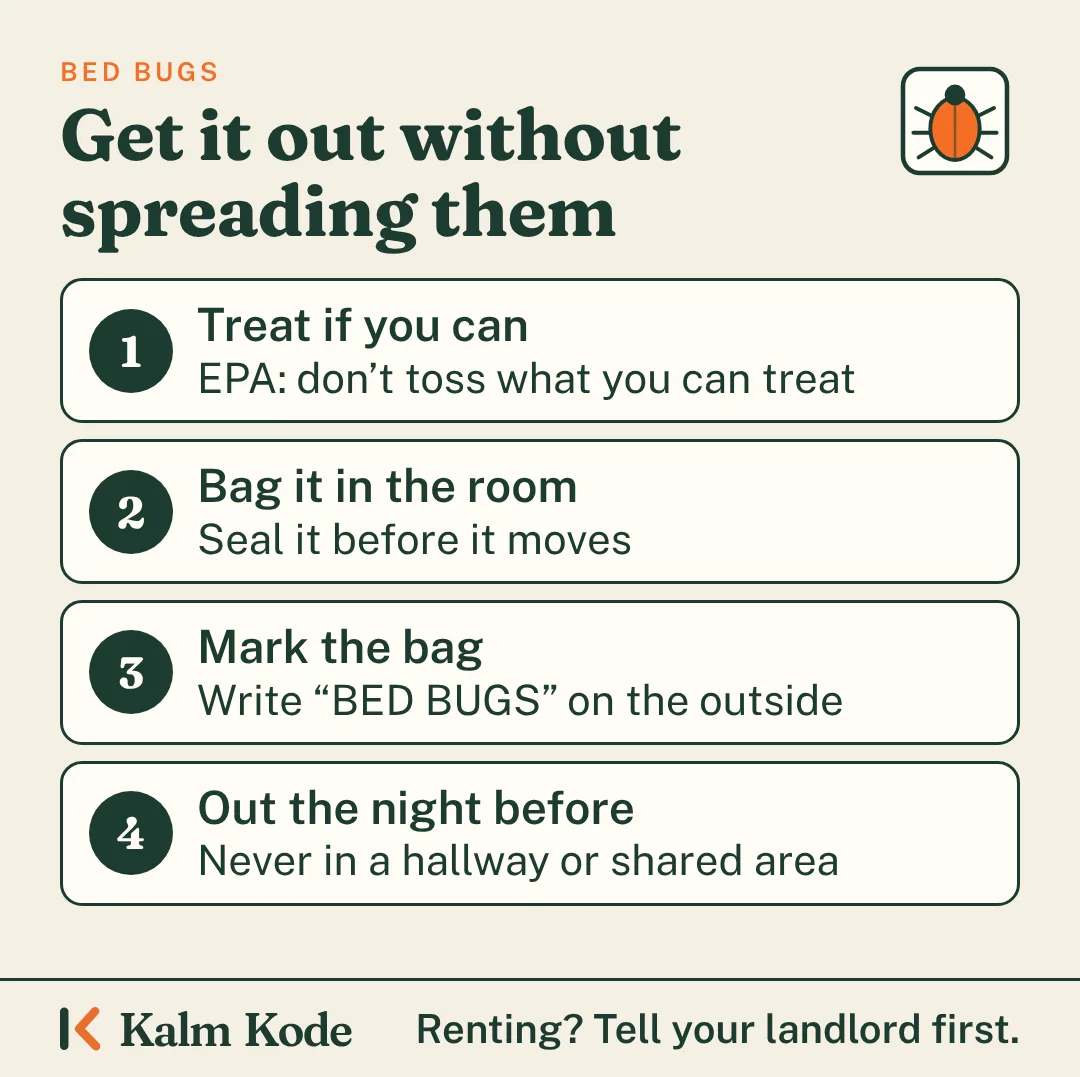
Bed bugs are one of the main reasons people throw out a mattress, and they’re a big reason the county requires a sealed cover in the first place. The goal is to get the mattress out of your home without spreading bugs to your hallway, your car or someone else’s home.
- Treat before you toss, if you can. The U.S. Environmental Protection Agency’s bed bug guidance says not to discard furniture you can safely treat, and suggests sealed encasements that trap the bugs inside. A pest control professional can tell you whether your mattress is worth saving.
- Seal it before it leaves the room. Bag it in the bedroom, then carry it out. That keeps bugs from dropping off along the way.
- Mark it. The EPA suggests marking discarded furniture so no one is tempted to take it home. For curbside pickup, keep the cover sealed and write “BED BUGS” on the outside of the bag in large marker.
- Don’t leave it in a common area. Take it straight to your curb the night before your trash day (after 6 p.m.), not into a hallway, stairwell or shared lot for days.
- Get it collected quickly. The EPA advises having infested items picked up as soon as possible, so time it for the night before your trash day.
If you rent, tell your landlord or management office before you move the mattress. They may have a treatment plan or a specific disposal process.
Other ways to get rid of a mattress
Curbside pickup isn’t the only route.
Take it to the drop-off center yourself
If you have a vehicle that fits it, the county landfill page says mattresses are standard bulky household items to take to the Brown Station Road Convenience Drop-off Center at 3501 Brown Station Road in Upper Marlboro. The county’s February 11, 2026 notice lists that center’s hours as Monday through Saturday, 7 a.m. to 6 p.m.
The county’s pages don’t line up perfectly here, so we’ll be upfront about it:
- The convenience centers page has an accepted-items table that doesn’t mention mattresses, even though the landfill page sends mattresses to that center.
- The landfill page mentions proof of residency, such as a driver’s license, for some drop-offs. Bring ID.
- The landfill page describes free drop-off for residential, unmodified passenger vehicles up to ¾ ton, but another line on the same page contradicts it. The same page says trailers aren’t allowed at the Brown Station Road Convenience Center.
Call 311 before you load up to confirm the destination, hours and any fee. Ask about wrapping too: the county’s no-cover exception names the landfill, but its landfill page sends mattresses to the convenience center. A cover keeps your car cleaner either way.
Ask about haul-away when you buy a new one
Some mattress retailers offer to take your old mattress when they deliver a new one, sometimes for a fee. Ask before you buy, and ask what condition it needs to be in. This can save you both the bag and the trip to the curb.
Donate it, if it’s truly in good shape
Used mattresses can be harder to donate than other furniture, so check before you load one up. The county’s reuse and donation list doesn’t mention mattresses specifically, but it points to the MD Recycles donation directory, which lists organizations that take beds. Check each organization’s current rules before you load anything up. Never donate a mattress that’s had bed bugs.
What about recycling?
The county pages we checked don’t list a mattress recycling program for residents. A 2026 Maryland bill to create a statewide mattress recycling program (SB 603) didn’t pass. If that changes, we’ll update this guide.
Common mistakes that get mattresses left behind
- No cover, or a partial cover. The most common reason, and the one the county calls out directly.
- A torn bag. Rips from stairs and doorframes count as uncovered fabric. Patch them.
- One bag stretched over a mattress and box spring. Each piece needs its own sealed cover.
- Going over four items. A whole-bed clean-out can use your entire week’s limit.
- Setting it out late. The bulky trash page says by 5 a.m.
- Leaving it in a shared area instead of at your own curb.
- Blocking the sidewalk or driveway with a leaning mattress.
- Following county rules when your city, building or hauler handles trash.
If it wasn’t picked up
Full walkthrough: Bulky trash not picked up? What to check next covers timing, holiday and weather delays, and how to report a missed pickup.
Run through the list above first: cover, tears, count, timing and location. If everything checks out, the county says you can report a missed collection through PGC311 starting at noon on your collection day.
- Online: pgc311.com
- Phone: 311 from inside the county, or 301-883-4748. Monday to Friday, 7 a.m. to 7 p.m.
If it’s a rule problem (no cover, too many items), bring it back in, fix it, and set it out the next trash day.
Quick checklist
- ☐ The county collects my trash (not my city, building, HOA or a private hauler), or I scheduled bulky-only pickup through PGC311.
- ☐ The mattress is completely sealed in a mattress bag or shrink wrap. No fabric showing.
- ☐ The box spring has its own sealed cover.
- ☐ Tears are patched and the opening is zipped or taped shut.
- ☐ I’m setting out four bulky items or fewer this week, counting the mattress and box spring separately.
- ☐ It’s next to my trash cart by 5 a.m., not blocking the sidewalk, driveway, mailbox or hydrant.
- ☐ Bed bugs? Bagged in the room, marked on the outside, and out only the night before trash day.
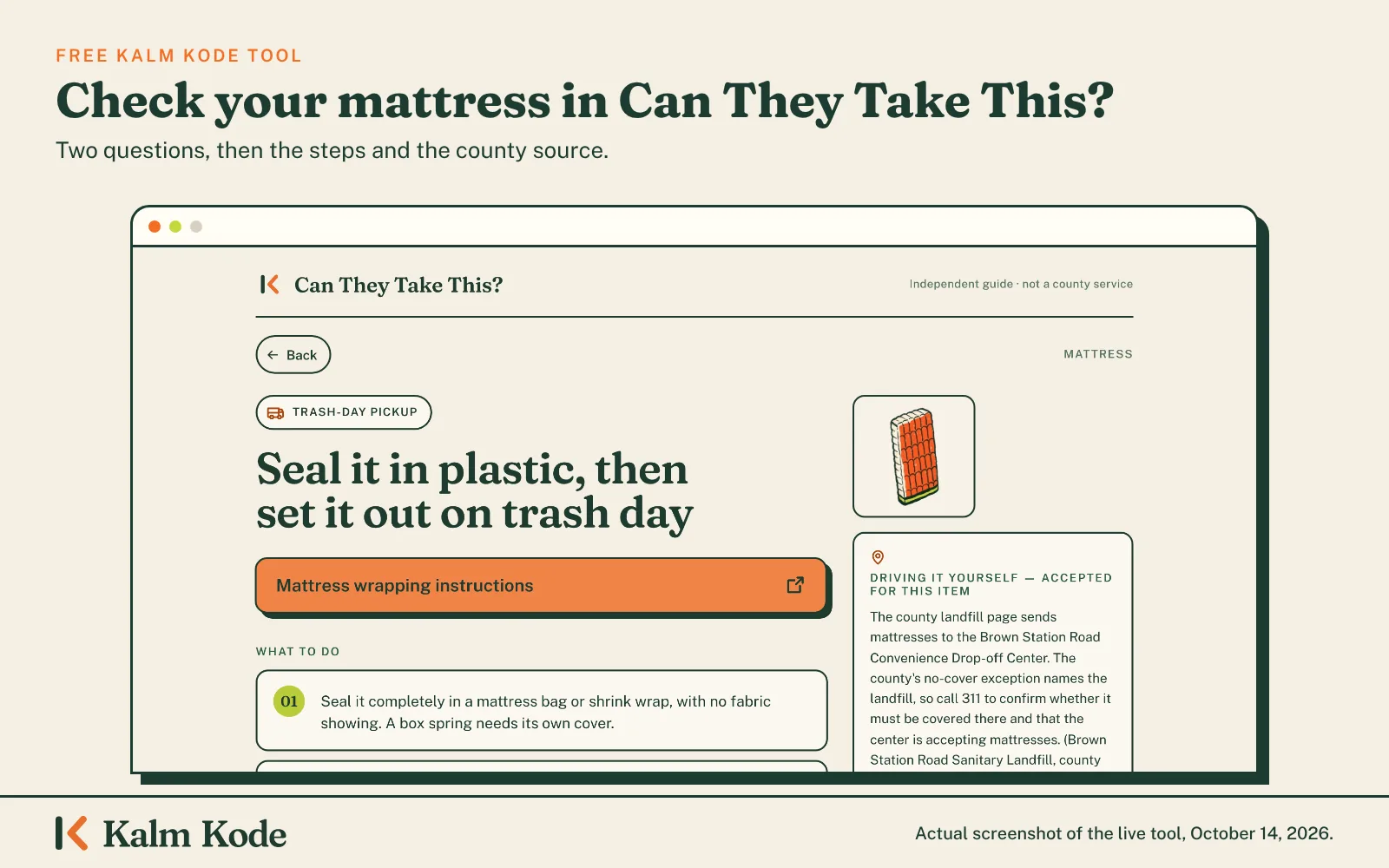
Not sure about something else in the pile? Can They Take This? covers 22 common household items, including mattresses and bed frames, one question at a time, with the county source for each answer.
Frequently asked questions
Do I need an appointment to get rid of a mattress in PG County?
Not if you have county-contracted trash service. Seal it in plastic and set it next to your trash cart on your regular collection day. If you pay the county only for bulky service, schedule through PGC311.
Does a mattress have to be wrapped for bulky pickup?
Yes. Since February 1, 2019, mattresses and box springs set out for curbside pickup must be completely covered in protective plastic. The county says unwrapped mattresses won’t be collected.
What can I wrap it in?
The county’s instructions name a mattress bag or shrink wrap. The county says zippered mattress covers are sold at many local retail stores for a nominal fee.
Does a box spring need to be wrapped too?
Yes. The county’s rule covers both mattresses and box springs. Give each piece its own sealed cover.
Do a mattress and box spring count as one item or two?
The county’s pages don’t say. Plan for two of your four weekly bulky items to be safe.
Can I put out a bed frame?
Headboards and footboards are on the county’s accepted furniture list. Metal frames and rails aren’t named, so ask PGC311 whether they go with regular bulky pickup or a scrap metal appointment.
Do I need to wrap a mattress I take to the landfill myself?
The county says mattresses and box springs residents deliver to the landfill don’t need a cover. But its landfill page sends mattresses to the Brown Station Road Convenience Drop-off Center, so ask 311 whether a cover is needed there, and confirm the location and hours, before you go.
How should I get rid of a mattress with bed bugs?
Seal it completely in a mattress bag before it leaves the room, write “BED BUGS” on the outside, and set it out only on the night before your trash day. The EPA also recommends treating furniture when that’s possible instead of throwing it out.
My mattress wasn’t picked up. What now?
Check that it was fully covered, within the four-item limit, next to your cart and out by 5 a.m. Then report a missed collection through PGC311, starting at noon on your collection day.
More Kalm Kode guides
- Do you need an appointment for bulky trash?: what goes out on trash day and what needs a PGC311 appointment
- Bulky trash not picked up?: what to check, and when to report it
- Who maintains my road?: county, state, city or HOA, and where to report a pothole
- How to get rid of a TV: tube TVs, flat screens and free e-waste events
Official sources
Checked October 14, 2026:
- Bulky Trash, Prince George’s County
- Mattress Disposal Instructions (county PDF)
- Acceptable and Non-acceptable Bulky Trash
- Residential Trash Collection
- Brown Station Road Sanitary Landfill
- Convenience Centers
- County news, February 11, 2026: convenience centers resume regular hours
- Recycling and Reuse Alternatives
- U.S. EPA: Do-it-yourself Bed Bug Control
- City of Hyattsville: Bulk Waste and Special Services
- City of Glenarden: Trash Removal
- Maryland SB 603 (2026), Mattress Stewardship Program (status per BillTrack50: did not pass)
Rules change. If anything here doesn’t match what PGC311 tells you, go with PGC311, and message us at @kalmkode so we can update this guide.